软件贷款

Search documents
The PNC Financial Services Group (NYSE:PNC) 2026 Conference Transcript
2026-03-10 15:42
Summary of PNC Financial Services Group Conference Call Company Overview - **Company**: The PNC Financial Services Group (NYSE:PNC) - **Market Capitalization**: Approximately $80 billion - **Total Assets**: About $574 billion - **Stock Valuation**: Trades at approximately 1.8x tangible book value - **Branch Network**: Over 2,400 branches across the United States [1][1][1] Key Industry Insights Commercial and Industrial Loan Demand - **Growth**: Experienced strong growth in the Commercial and Industrial (C&I) loan book, with a 9% growth in Q4 2025 and an overall 5% growth for the year [4][4][4] - **Drivers**: Growth driven by broad-based activity across C&I, despite challenges in the real estate sector, particularly related to office spaces [3][4][5] - **Client Resilience**: Clients have adapted well to market volatility, with many reporting improved business resilience due to lessons learned during the pandemic [5][10][10] Real Estate Sector - **Outlook**: Anticipates an inflection point in the commercial real estate portfolio by Q2 2026, with a significant increase in the real estate banking lending pipeline, up 300% [28][28][32] - **Focus Areas**: Emphasis on multifamily housing due to ongoing housing shortages, with additional opportunities in under-invested sectors like retail and industrial [29][31][32] - **Office Space**: Notable improvement in office space lending, with a reduction in exposure from $10 million to approximately $5 million, indicating a recovery in performance [31][32] Deposit Growth and Competition - **Deposit Growth**: Achieved an 8% growth in deposits, outpacing the 5% growth in loans, without significantly increasing rates paid [42][44] - **Market Position**: Maintained a disciplined approach to deposit rates, with a deposit beta of about 85% [44][44] Software Lending and AI Impact - **Exposure**: The company has a $5.3 billion exposure in the recurring revenue book, with a focus on managing risks associated with AI disruptions [58][61] - **Client Selection**: Emphasizes banking companies with strong business models and proprietary data to mitigate risks from AI advancements [62][63] Regulatory Environment - **Basel III Proposal**: Anticipates potential relief from risk-weighted assets, which could amount to $40 billion, without impacting minimum capital requirements [92][92][96] Strategic Priorities - **Expansion Markets**: Identified as the largest growth opportunity, with 40% of future growth expected from these markets [137][137] - **Treasury Management**: A significant revenue driver, contributing over $4 billion, with a client retention rate of 98% [106][138] - **Advisory Capabilities**: Focus on enhancing advisory services within capital markets to better serve client needs [138][139] Additional Insights - **Market Volatility**: Monitoring potential impacts from geopolitical conflicts and inflation on consumer behavior and credit quality [81][82] - **Acquisition Strategy**: Open to future acquisitions to enhance service offerings, though currently satisfied with existing capabilities [122][122] This summary encapsulates the key points discussed during the conference call, highlighting PNC's performance, strategic focus, and outlook for the coming years.

软件股暴跌或成下一轮信贷危机导火索?
Hua Er Jie Jian Wen· 2026-02-04 14:18
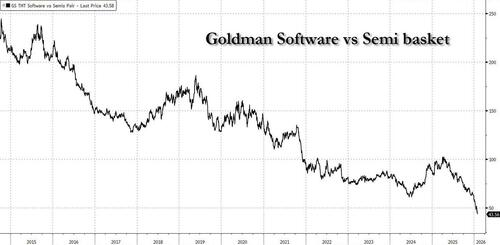
Core Insights - Wall Street analysts warn that the substantial software debt held by Business Development Companies (BDCs) could trigger the next credit crisis, with market concerns already surfacing [1] - BDCs, which primarily fund small to mid-sized private enterprises, have approximately 16% of their portfolios invested in software companies, facing significant asset impairment risks amid an unprecedented sell-off in the software sector [1][3] - The software sector has seen a decline in stock prices, with 9 out of the last 12 trading days experiencing drops, leading to a severe deterioration in market sentiment [1][3] Group 1: Market Conditions and Risks - The collapse in the software sector is largely attributed to the disruptive threat posed by artificial intelligence (AI), causing panic among investors who fear AI could be the end of software companies [3] - BDCs, viewed as major lenders in the Software as a Service (SaaS) space, are experiencing significant market pressure, with any minor fluctuations causing substantial impacts [3] - Morgan Stanley's analysis indicates that the BDC industry may need to undergo a stress test similar to that faced by airline leasing companies during the pandemic, highlighting the need for BDCs to demonstrate their risk resilience [3] Group 2: Financial Exposure and Impact - As of Q3 2025, the total investment portfolio of 30 tracked BDCs is approximately $359 billion, with software exposure amounting to about $70 billion, representing 16% of their portfolios [4] - The broader technology exposure among these BDCs totals around $80 billion, indicating a significant reliance on the tech sector [4] - There is a wide variance in risk exposure among different institutions, with some, like Blue Owl Technology Fund, having software exposure as high as 40% [6] Group 3: Stress Testing and Potential Losses - Morgan Stanley conducted stress tests on BDCs' software portfolios, revealing that under a simplified "33% rule" scenario, these BDCs could face approximately $22 billion in losses, reducing net assets by 11% and increasing leverage from 0.86 to about 1.0 [8] - In a more severe "extreme scenario" where 75% of software companies default and recovery rates are only 10%, the industry could incur cumulative net losses nearing $50 billion, diluting book values by 24% [8] Group 4: Specific Loan Concerns - The report highlights specific software loans under pressure, with several loans trading at significant discounts in the secondary market compared to their book values [10] - Cornerstone OnDemand, a widely held risk asset among six BDCs, has seen its loan price drop by about 10 points since November 2025, currently trading at 83, while the average mark price for BDCs remains at 97 [10] - Other notable loans include Finastra, Medallia, and Auctane, which are also experiencing significant price declines, indicating that the pressure on BDC assets may just be beginning [10]