迷你养生壶

Search documents
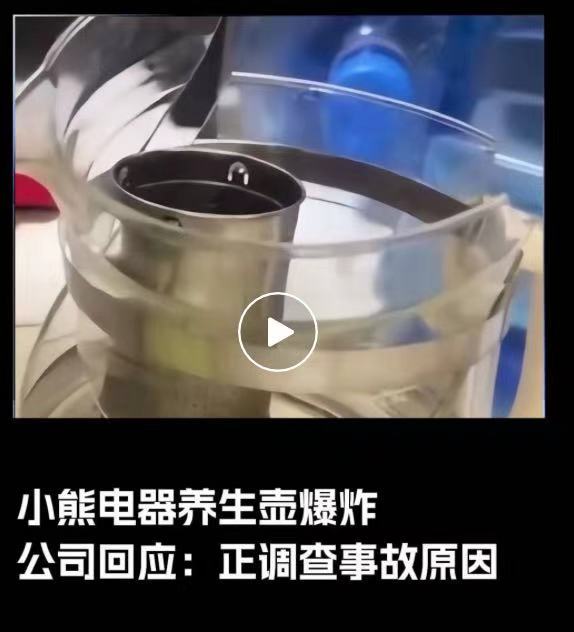
养生壶突然爆炸致一岁孩子大面积烫伤,“网红小家电”小熊电器回应
Xin Lang Cai Jing· 2025-09-28 05:41
Core Viewpoint - The recent explosion incident involving a health pot from Bear Electric has raised concerns, with the company actively investigating the cause and providing support to the affected family [1][3]. Company Response - Bear Electric confirmed the incident and is currently following up on the situation, including sending personnel to the hospital to assist the affected family [3]. - The company is unable to determine the cause of the explosion at this time due to lack of access to the product involved [3]. Incident Details - A netizen reported that on September 20, a Bear Electric health pot exploded, resulting in severe burns to a one-year-old child, with 40% of the body affected [3]. - The child underwent surgery on September 24 and will require skin grafting for scar recovery [3]. Financial Performance - For the first half of 2025, Bear Electric reported a revenue of 2.535 billion yuan, an increase of 18.94% year-on-year, and a net profit of 205 million yuan, up 27.32% year-on-year [13]. - The company attributes its performance to strategic adjustments, including the establishment of a kitchen division and enhancements in product offerings [13]. Market Strategy - Bear Electric has focused on increasing its online sales channels while also maintaining a presence in offline retail markets, targeting both urban and rural areas [13]. - The company plans to enhance its overseas brand presence and improve channel operations through targeted selection and promotion strategies [13].


谁杀死了小家电的利润?
Xi Niu Cai Jing· 2025-08-26 04:41
Core Viewpoint - The small home appliance industry has experienced a rapid rise and fall after the "stay-at-home economy," leading to a price war that has not resulted in increased sales despite significant price reductions [2][4]. Market Performance - The overall retail volume of small home appliances in the first half of 2025 is projected to be 136.52 million units, a year-on-year decrease of 1.2% [2]. - The kitchen appliance market's retail revenue in 2023 is approximately 54.93 billion yuan, down 9.6% year-on-year, with a retail volume of about 265 million units, also down 1.8% [2]. - During the 2024 "618" promotion, the retail revenue for kitchen appliances across online channels was 3.28 billion yuan, a decline of 10.3% year-on-year [2]. Profitability Issues - The small appliance industry's profit margin was only 8.3% in 2023, and the price war has exacerbated the profitability issues, with many companies facing a situation where selling more leads to greater losses [6]. - The average selling price for blow dryers has dropped below 300 yuan, with a market share increase of nearly 11 percentage points [6]. - Companies like Suoer reported a gross margin of 24.65% in their 2024 semi-annual report, a decrease of 0.63 percentage points year-on-year [11]. Market Dynamics - The small appliance market is characterized by severe homogenization, with low market entry barriers leading to intense competition and a lack of genuine innovation [4][5]. - Many brands are not investing in research and development, opting instead to modify existing molds and push new products at low costs, perpetuating a cycle of price competition [5]. - The market is increasingly crowded with new entrants, including internet brands and cross-industry players, which has diluted the market share of traditional brands like Midea and Supor [6][14]. Consumer Behavior - Consumers are becoming more discerning, often expressing dissatisfaction with new products that do not offer significant improvements over existing ones [4]. - There is a growing trend of impulse purchases leading to products being underutilized, contributing to a "sales ceiling" for many small appliance categories [4]. Future Outlook - The small appliance market is entering a deep adjustment period, and companies may need to shift from price competition to value competition to escape the current stagnation [19]. - Some companies are exploring differentiated competition strategies, such as offering value-added services like trade-in programs and proactive customer service [19][20].