差异化竞争

Search documents
8元蛋挞“偷袭”肯德基,麦当劳打的什么算盘?两大快餐巨头的场景与客流暗战
东京烘焙职业人· 2026-03-31 08:41
Core Viewpoint - The article discusses the competitive dynamics between McDonald's and KFC, particularly focusing on McDonald's recent introduction of egg tarts, which directly challenges KFC's long-standing dominance in this product category [6][50]. Group 1: McDonald's Strategy - McDonald's has quietly tested egg tarts in select locations, pricing them at 8 yuan each and 29.9 yuan for a pack of six, undercutting KFC's prices by 0.5 yuan per tart and nearly 10 yuan for the pack [4][14]. - The introduction of egg tarts is seen as a strategic move to capture market share from KFC, targeting existing customer flows and high-margin segments [7][25]. - McDonald's pricing strategy aims to disrupt consumer habits and encourage trial, leveraging the high profit margins associated with egg tarts, which can exceed 60% [28][14]. Group 2: KFC's Market Position - KFC's egg tart sales reached over 600 million units in 2023, generating approximately 3 billion yuan in revenue, making it a key product for the brand [18][20]. - The egg tart has evolved into a significant traffic driver for KFC, with many customers specifically visiting for this item, showcasing a unique consumer behavior where desserts lead to main course purchases [20][21]. - KFC's brand loyalty and consumer memory built over 20 years create a formidable barrier for competitors like McDonald's, making it challenging for them to attract KFC's loyal customer base [22][41]. Group 3: Market Dynamics and Challenges - The fast-food industry is experiencing intense competition, particularly in the main meal segment, leading to price wars and reduced profit margins [26][30]. - McDonald's entry into the egg tart market is not just about product introduction but also about addressing its own business weaknesses and tapping into the growing demand for desserts [29][33]. - Despite the potential for high profits in the egg tart market, McDonald's faces significant challenges, including product differentiation and overcoming KFC's entrenched brand loyalty [39][40]. Group 4: Insights for Entrepreneurs - The competition between McDonald's and KFC serves as a case study for the importance of strategic product extension and market positioning in the restaurant industry [43]. - Entrepreneurs should avoid blindly entering established markets without a clear competitive advantage, focusing instead on unique selling propositions [45]. - Building a diverse product matrix can enhance resilience against market fluctuations, as seen with McDonald's broader menu offerings supporting its new product trials [46][48].


8元蛋挞“偷袭”肯德基,麦当劳打的什么算盘?两大快餐巨头的场景与客流暗战
东京烘焙职业人· 2026-03-30 11:50
Core Viewpoint - The article discusses the competitive dynamics between McDonald's and KFC, particularly focusing on McDonald's recent introduction of egg tarts, which directly challenges KFC's long-standing dominance in this product category [4][5][8]. Group 1: McDonald's Strategy - McDonald's quietly tested egg tarts in select cities, pricing them at 8 yuan each and 29.9 yuan for a pack of six, undercutting KFC's prices [5][10]. - The pricing strategy aims to disrupt consumer habits and attract KFC's core customers by offering a more affordable option [15][16]. - McDonald's entry into the egg tart market is seen as a strategic move to capture a share of the high-margin dessert segment, which contrasts with the saturated main meal market [27][30]. Group 2: KFC's Market Position - KFC's egg tart sales reached over 600 million units in 2023, generating approximately 3 billion yuan in revenue, establishing it as a key product for the brand [19]. - The egg tart has become a significant traffic driver for KFC, with many customers specifically visiting for this item, showcasing its strong brand loyalty [21][22]. - KFC's long-term brand equity and consumer memory associated with its egg tarts create a formidable barrier for competitors like McDonald's [22][24]. Group 3: Challenges for McDonald's - McDonald's faces challenges in differentiating its egg tarts from KFC's offerings due to the high level of product homogeneity in the baking industry [37][40]. - The entrenched consumer preference for KFC's egg tarts, built over 20 years, poses a significant hurdle for McDonald's to overcome, as price alone may not sway loyal customers [41][42]. - KFC's promotional strategies, such as special discounts, further complicate McDonald's efforts to gain market share without sacrificing its profit margins [43]. Group 4: Insights for the Industry - The competition between McDonald's and KFC highlights the importance of strategic product differentiation and understanding consumer behavior in the restaurant industry [44]. - New entrants should carefully assess their unique value propositions before entering established markets dominated by major players [46]. - A diversified product matrix can provide resilience against market fluctuations, as seen with McDonald's existing offerings supporting its new egg tart initiative [47].
台华新材:深度研究锦纶产业链布局继续延伸,强化差异化竞争壁垒-20260324
东方财富· 2026-03-24 07:25
Investment Rating - The report maintains a rating of "Buy" for the company [3] Core Views - The company's growth momentum is expected to come from the ramp-up of new production capacity and the commercialization of high-end, differentiated products. The company has a leading R&D expense ratio compared to peers, and its new capacities in Huai'an and overseas are progressing smoothly, which will enhance its competitive advantage in high-value-added products and increase market coverage [2][7] - The company has achieved international certification for its recycled nylon, with a recovery purity of up to 100% and strong energy-saving capabilities. The customer base for its PA66 products has significantly increased, contributing positively to the company's operating performance [2] - The company is actively upgrading its industrial chain in response to industry expansion, and its differentiated and high-end products are expected to help mitigate industry cycles [2] Summary by Sections Company Overview - The company has been deeply involved in the nylon industry for many years, establishing a complete industrial chain that includes nylon filament, weaving, dyeing, and finishing. It has a production capacity of 345,000 tons of nylon filament and is expanding its production bases in Jiangsu and Vietnam [15][19] Industry Dynamics - The nylon industry is experiencing a "self-rescue" from overcapacity, with expectations for improved supply dynamics. The company is positioned to benefit from this trend as it continues to enhance its product offerings and production capabilities [6][10] Financial Performance - The company's revenue and net profit are projected to grow significantly in the coming years, with expected revenues of 6.91 billion, 7.99 billion, and 9.09 billion yuan for 2025, 2026, and 2027, respectively. Net profits are expected to be 558.59 million, 692.20 million, and 839.73 million yuan for the same years [8][7] - The company has maintained a relatively stable financial condition, with a focus on enhancing profitability through high-end product offerings and efficient cost management [25][47] Future Outlook - The company is expected to continue its growth trajectory driven by the release of new capacities and the increasing proportion of high-value-added products. The recycled nylon segment presents significant growth potential, aligning with downstream brand demands for supply chain transformation [7][30] - The company is also expected to benefit from the recovery of raw material prices and the gradual release of new capacities, which will support both volume and price growth [7][30]

台华新材(603055):深度研究:锦纶产业链布局继续延伸,强化差异化竞争壁垒
East Money Securities· 2026-03-24 05:05
Investment Rating - The report maintains a rating of "Buy" for the company [3] Core Insights - The company is expected to experience growth driven by the ramp-up of new production capacity and the commercialization of high-end, differentiated products. The company has a leading R&D expense ratio compared to peers, and its new production facilities in Huai'an and overseas are progressing smoothly, which will enhance its competitive advantage in high-value-added products and increase market coverage [2][7] - The company has achieved international certification for its recycled nylon, with a recovery purity of up to 100% and strong energy-saving capabilities. The customer base for its PA66 products has significantly increased, contributing positively to the company's operating performance [2][7] - The company is actively upgrading its industrial chain and expects that differentiated and high-end products will help mitigate industry cycles [2] Summary by Sections 1. Company Overview - The company has a complete industrial chain in the nylon industry, with a production capacity of 345,000 tons of nylon filament and additional capacities for fabric, dyeing, and finishing. It has production bases in Jiangsu and Vietnam, with new capacities expected to come online [6][15] - The company has been deepening its presence in the nylon industry since its establishment in 2001, achieving a fully integrated industrial chain through acquisitions and expansions [15][16] 2. Industry Dynamics - The nylon industry is expected to improve its supply structure due to self-initiated production cuts in response to previous overcapacity. The demand for high-performance and differentiated products is anticipated to grow, driven by policy support for green transformation [6][7] - The company is well-positioned to benefit from the increasing demand for outdoor and sports apparel, which is a significant growth driver for nylon products [6][7] 3. Financial Performance - The company's revenue and net profit are projected to grow significantly in 2024, with revenues expected to reach 7.12 billion yuan and net profits of 725.72 million yuan, reflecting year-on-year growth rates of 39.8% and 61.6%, respectively [8][30] - The company has maintained a relatively stable financial condition, with a focus on enhancing profitability through the release of new capacities and the introduction of high-end products [25][30] 4. Future Outlook - The company is expected to continue its growth trajectory with projected revenues of 6.91 billion yuan in 2025 and 7.99 billion yuan in 2026, despite a slight decline in 2025 due to upstream capacity expansion and falling raw material prices [7][8] - The company aims to increase the proportion of high-value-added products, which will support both volume and price growth [7][8]
材料“新贵”,这波红利要紧紧抓住
格隆汇APP· 2026-03-18 10:30
Core Viewpoint - The domestic carbon fiber industry is experiencing a dual drive of technological breakthroughs and market expansion, enhancing its global influence by 2026 [5] Group 1: Industry Development - The high-end carbon fiber market, previously dominated by Japanese companies, has seen domestic firms achieve key breakthroughs, with traditional applications continuing to grow and emerging sectors becoming significant growth engines [6][7] - By the end of 2023, companies like Zhongfu Shenying have achieved large-scale supply of T1000-grade carbon fiber, and by March 2026, T1200-grade carbon fiber will be mass-produced, breaking Japan's monopoly in the high-end carbon fiber sector [9][10] - The domestic carbon fiber industry is entering a period of dual opportunities for technological upgrades and market expansion, driven by raw material price fluctuations, overseas order releases, and export policy adjustments [7] Group 2: Demand Reconstruction - The application scenarios for domestic carbon fiber are continuously expanding, with high-performance carbon fiber (T800 and above) expected to grow at an annual rate of 20%-30%, becoming the core growth line for the industry [12] - The domestic carbon fiber market is projected to reach 8.5 million tons by 2026, with a significant reduction in import dependency [14] - The demand for carbon fiber in traditional sectors like wind power is increasing, with projections of 4-4.5 million tons by 2026, accounting for nearly 50% of domestic usage [15] Group 3: Supply Structure - The domestic carbon fiber industry is led by companies such as Jilin Chemical Fiber, Zhongfu Shenying, and Guangwei Composites, with cost control capabilities being a core competitive factor [19] - Jilin Chemical Fiber has a cost advantage with a full cost of approximately 72,000 yuan/ton, leading in the wind power sector [20] - Different companies are adopting various production processes, with Zhongfu Shenying focusing on dry-jet wet spinning and Jilin Chemical Fiber on wet spinning, catering to different market segments [21] Group 4: Price Expectations - The carbon fiber industry has undergone two rounds of price increases since December 2025, with Jilin Chemical Fiber leading the way [23] - The core drivers for price increases include rising costs of key raw materials and a tightening supply of high-quality production capacity [25][26] - Future price trends are expected to stabilize with a controlled fluctuation, as the industry shifts from low-price competition to value competition [28] Group 5: Future Trends and Investment Opportunities - The international competitiveness of domestic carbon fiber is expected to strengthen, with exports projected to reach 15,000 tons by 2025, primarily in wind power and specific military sectors [30] - The industry is entering a golden period characterized by high-quality development, accelerated domestic substitution, and global expansion [31] - Investment opportunities are identified in leading companies with cost and scale advantages, as well as high-tech firms focusing on high-end carbon fiber products [32]



破解基层医疗人才荒:行政帮扶之外还能做什么
经济观察报· 2026-03-17 10:43
Core Viewpoint - The core issue in grassroots healthcare is the lack of effective definition and incentives for its core value, leading to a talent shortage. The solution lies in differentiating from hospitals by shifting focus from disease treatment to health management and preventive care [1][3]. Group 1: Current Challenges in Grassroots Healthcare - There is a significant shortage of medical personnel in grassroots healthcare, as highlighted by Wang Guangfa, who stated that there are simply no people available [2]. - The current model of pushing medical talent down to grassroots levels through administrative orders is unsustainable, as many doctors view it as a stepping stone for career advancement rather than a commitment to grassroots healthcare [2][3]. - The mismatch between supply and demand in grassroots healthcare is evident, with specialists often finding themselves underutilized in these settings [2]. Group 2: Proposed Solutions for Talent Shortage - To address the talent shortage, grassroots healthcare must redefine its role as "health gatekeepers" and cultivate a team of general practitioners [3][4]. - The current medical education and promotion systems are overly specialized, leading to a lack of appeal for general practitioners, which contributes to a cycle of low value and talent loss in grassroots healthcare [4]. - The "14th Five-Year Plan" sets goals for increasing healthcare personnel per thousand people, but simply adding staff without changing the traditional treatment model will not solve the talent crisis [4]. Group 3: Sustainable Expert Engagement - A market-based contractual mechanism for expert engagement is necessary to foster long-term cooperation between experts and grassroots healthcare [5]. - An example from a mountainous county in Fujian shows that formal labor agreements can incentivize experts to improve quality and train local staff, which could serve as a model for broader implementation [5]. - For this model to be sustainable, it must align with reforms in payment systems that favor preventive care, allowing grassroots healthcare to compensate experts adequately [5]. Group 4: Financial Support and Incentives - Financial, insurance, and commercial payers need to support grassroots healthcare personnel in transitioning to a health-centered approach [6]. - The integration of performance-based incentives linked to service quality and patient satisfaction is essential for motivating grassroots healthcare workers [6][7]. - Additional incentives, such as increased payment rates for services in remote areas, are necessary to attract high-quality medical personnel to underserved regions [7].

中国可选消费:大消费渠道脉搏:零食零售春节表现亮眼,引入新模式差异化竞争
Haitong Securities International· 2026-02-25 15:24
Group 1: Market Performance - In 2025, single-store revenue in 40 stores fell by approximately 5% YoY, but gross profit margin increased YoY[2] - During the Chinese New Year, single-store revenue grew nearly 20% YoY, particularly in towns and rural markets, with over 65% of consumers being children and students aged 6-18[2] - The decline in single-store revenue slowed quarter by quarter in 2025, turning positive by Q4 due to factors like the exit of local brands and adjustments in product structure[2] Group 2: Brand Expansion and Operations - Leading snack brands plan to add 6,000 and 10,000 new stores in 2026, with a conservative estimate of at least 5,000 new stores each[9] - The store closure rates for the two leading brands were both below 5%, indicating stable operations[9] - Haoxianglai opened nearly 1,000 stores in January 2026 alone, with expansion expected to accelerate after March[9] Group 3: Competitive Landscape - Penny-saving supermarkets have a gross profit margin higher than bulk snack stores, with initial investments ranging from Rmb 0.8 to 1.5 million depending on the city tier[10] - Convenience stores launched by Yummy Snack have higher gross and net profit margins than both penny-saving supermarkets and bulk snack businesses[11] - The product structure in penny-saving supermarkets includes 65% snacks, with higher margins on daily necessities and fresh foods[10] Group 4: Product Strategy - Increasing the proportion of private label and own-brand products can improve gross margin levels, with own-brand products having the highest margins[12] - Both leading companies have private label product ratios above 30%, but own-brand product ratios remain below 5%[12] - Plans are in place to increase the proportion of own-brand products to enhance gross margins and benefit franchisees[12]
2.7分钟定生死 手机银行存量厮杀谁在“断臂”,谁在“吃肉”?
Jing Ji Guan Cha Wang· 2026-02-18 04:57
Core Insights - The report by iResearch indicates that the monthly active users (MAU) of mobile banking apps in China have stabilized after fluctuating between 648 million and 739 million, signaling a ceiling in user growth and a shift from acquiring new users to enhancing existing user engagement [2] - User behavior is undergoing a structural reversal, with the effective daily usage time per device dropping from 4.9 minutes in 2023 to around 2.7 minutes by mid-2025, leading to a focus on high-frequency, short-duration, and functional usage [2] - Financial institutions are compelled to streamline operations and focus resources on core transaction scenarios to survive in this competitive landscape, where efficiency and precision are paramount [2] Mobile Banking Market Overview - The top three banks in terms of MAU are Agricultural Bank of China (2.49 billion), Industrial and Commercial Bank of China (1.94 billion), and China Construction Bank (1.09 billion), with all six major state-owned banks ranking in the top ten [3][5][6] - Private banks, represented by WeBank and MYbank, have faced significant setbacks, with many dropping out of the top 50 MAU rankings by 2025 [4] Competitive Landscape - State-owned banks are solidifying their dominance through extensive customer bases and integrated ecosystems, leveraging services embedded in high-frequency life scenarios such as government services and healthcare [7] - Joint-stock commercial banks are adopting a "specialized and precise" survival strategy, with China Merchants Bank leading among them with 71.85 million MAU, focusing on wealth management and intelligent interaction [8][10] - Regional banks are thriving by deeply engaging with local markets, while private banks struggle due to high customer acquisition costs and lack of local ecosystem support [13][14] Future Outlook - The mobile banking market is transitioning from a phase of scale expansion to one of value cultivation, with state-owned banks building moats through ecosystems, joint-stock banks seeking niches through specialization, and regional banks solidifying their local roots [14] - The ability to create irreplaceable value in a limited user engagement environment will be crucial, with technology applications such as AI reshaping service processes and enhancing risk management [15][16]





国际医学:将积极采取各项措施,以差异化策略构建竞争优势,努力实现经营业绩的改善提升
Sou Hu Cai Jing· 2026-02-13 13:29
Core Viewpoint - Investors express concerns about International Medical's financial stability, highlighting issues such as a stock price hovering around 5 yuan, a major shareholder's pledge ratio nearing 80%, and significant short-term debt pressures [1] Group 1: Financial Concerns - The stock price of International Medical is fluctuating around 5 yuan, indicating potential investor anxiety [1] - The major shareholder's pledge ratio is approaching 80%, which raises concerns about financial leverage and risk [1] - The company faces significant short-term debt pressures, which could impact its operational flexibility [1] Group 2: Company Response - International Medical acknowledges investor concerns and expresses gratitude for their attention [1] - The company plans to implement a differentiated strategy to build competitive advantages and improve operational performance [1]

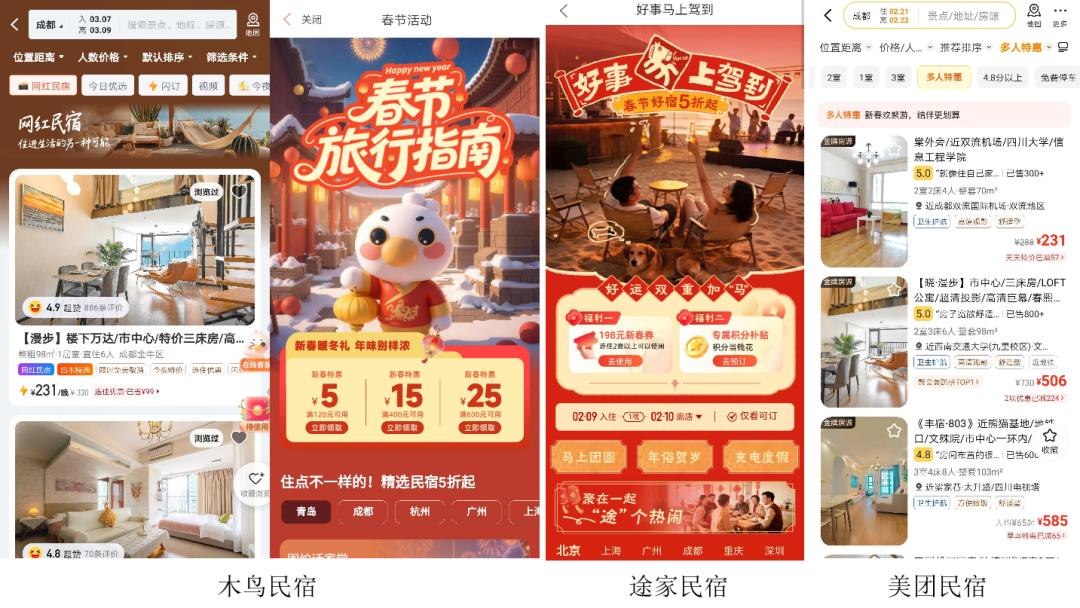
2026春节档前瞻:木鸟途家美团的博弈
3 6 Ke· 2026-02-12 00:08
Core Insights - The 2026 Spring Festival holiday, lasting 9 days from February 15 to February 23, is expected to significantly boost the homestay market, with a projected 79.6% increase in orders compared to the previous year [1] - The competition among three major platforms—Muniu, Tujia, and Meituan—highlights differentiated strategies aimed at expanding the overall market [1][12] Muniu Homestay - Muniu is anticipated to be the most stable player during the 2026 Spring Festival, with a strong order growth forecast of nearly 80% [4] - The platform focuses on unique offerings such as "internet celebrity homestays" and "flash booking," catering to the quality demands of the 95s generation and family travelers [4] - Muniu's promotional strategy includes a dual discount system, offering a 110 yuan coupon for users, which is expected to support overall order growth [4] Tujia Homestay - Tujia's strategy revolves around "stay discounts" and "group rentals," targeting family and business travelers [5] - The platform's stay discount package offers competitive pricing, with a two-night stay in Beijing priced at 1,322 yuan after a 239 yuan discount [5] - Tujia faces challenges due to the scrutiny of its parent company, Ctrip, which may impact its order growth during the festival [6] Meituan Homestay - Meituan has integrated its hotel and homestay offerings into a unified travel platform, which may dilute its homestay identity [6] - The platform targets young people with group stay promotions, but its inventory primarily consists of budget accommodations, raising concerns about the diversity of its offerings [6] - Meituan's market share has declined amid competition with Taobao, affecting its overall traffic and promotional visibility [6] Market Trends - Family travel remains a key focus for the 2026 Spring Festival, with two-bedroom and larger accommodations accounting for 64% of orders, up 5% from last year [9] - The rise of quality family trips and long-stay guests aligns with the current market dynamics [10] - The competition among the three platforms reflects a broader trend of diversifying customer segments, with each platform targeting different demographics and needs [11][12]