通用双足人形机器人

Search documents
对话松延动力创始人姜哲源:从亮相春晚到「要规模」
华尔街见闻· 2026-02-17 11:30
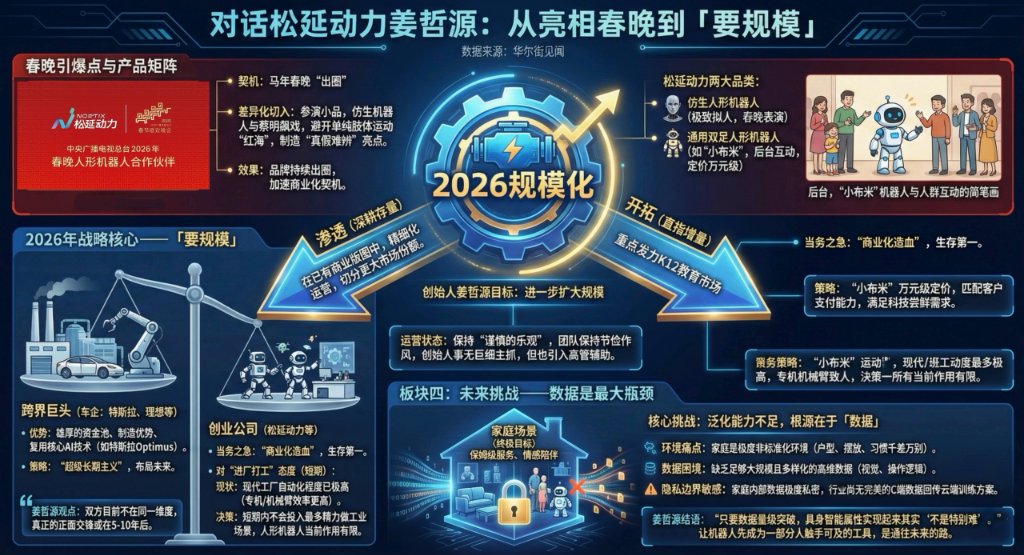
Core Viewpoint - The article discusses the growth and challenges faced by Beijing Songyan Power Technology Group Co., Ltd. (Songyan Power) in the humanoid robot industry, highlighting its recent appearance on the Spring Festival Gala as a significant opportunity for brand exposure and commercialization [2][6][12]. Group 1: Company Overview and Strategy - Songyan Power's founder, Jiang Zheyuan, plans to expand the company's scale by 2026, focusing on two key strategies: "penetration" into existing markets and "exploration" of untapped markets, particularly in K12 education and consumer-grade robots [3][16][45]. - The humanoid robot "Xiao Bumi" is priced at around 10,000 yuan, aimed at making technology accessible to a broader range of educational institutions, especially those that cannot afford more expensive options [17][49]. Group 2: Market Competition and Challenges - The entry of automotive companies like Tesla and Li Auto into the humanoid robot market poses a challenge for startups, but Jiang remains cautiously optimistic, believing that the competition will not intensify for another five to ten years [5][24][60]. - The global demand for humanoid robots in industrial applications is projected to reach 30,000 units by 2026, indicating a growing market, although there are concerns about the actual suitability of humanoid robots for factory work due to existing automation technologies [25][28][31]. Group 3: Data and Technological Challenges - The article emphasizes that the biggest challenge for humanoid robots, especially in domestic settings, is the need for extensive and diverse data to enhance their capabilities, which is difficult to obtain due to privacy concerns [34][36][37]. - Jiang points out that while the technology for humanoid robots is advancing, the lack of high-quality data and effective data collection methods remains a significant barrier to achieving widespread adoption [56].

对话松延动力创始人姜哲源:从亮相春晚到「要规模」
Hua Er Jie Jian Wen· 2026-02-16 13:47
Core Viewpoint - The performance of the bionic humanoid robot at the Spring Festival Gala has provided a significant opportunity for Songyan Power to enhance its brand visibility and accelerate commercialization in the humanoid robot industry [1][20]. Group 1: Company Overview - Songyan Power specializes in bionic humanoid robots and general bipedal humanoid robots, with plans for expansion by 2026 [1]. - The founder, Jiang Zheyuan, expresses cautious optimism about the company's future despite competition from established automotive companies like Tesla and Li Auto [1][8]. - The company aims to differentiate itself by focusing on unique performance areas, such as comedy skits, rather than competing in the saturated market of basic physical movement control [3]. Group 2: Market Strategy - The strategic focus for 2026 is summarized in two keywords: "penetration" and "expansion" [4][24]. - "Penetration" refers to deepening market presence in existing segments, while "expansion" targets untapped markets, particularly in K12 education and consumer-grade robots [4][24]. - The pricing strategy for the humanoid robot "Xiaobumi" is set at around 10,000 yuan, making it accessible for schools that cannot afford more expensive options [5][28]. Group 3: Industry Competition - The humanoid robot market is becoming increasingly competitive, with major automotive companies entering the space, indicating a shift in market dynamics [6][8]. - Tesla plans to repurpose its Fremont factory to produce 1 million units of the Optimus humanoid robot by the end of 2026, leveraging its existing AI technology [7][8]. - The market for humanoid robots is expected to expand beyond exhibitions and education into industrial manufacturing and home services, with UBS predicting a demand for 30,000 units in industrial applications by 2026 [9][10]. Group 4: Challenges and Data Requirements - The industry faces challenges regarding the suitability of humanoid robots for industrial tasks, as many factories are already highly automated [12][13]. - The potential for humanoid robots in household settings is significant, but requires advanced capabilities to navigate diverse and non-standard environments [15][16]. - Data collection remains a critical challenge, as obtaining sufficient and diverse data for training humanoid robots is complicated by privacy concerns [16][18].