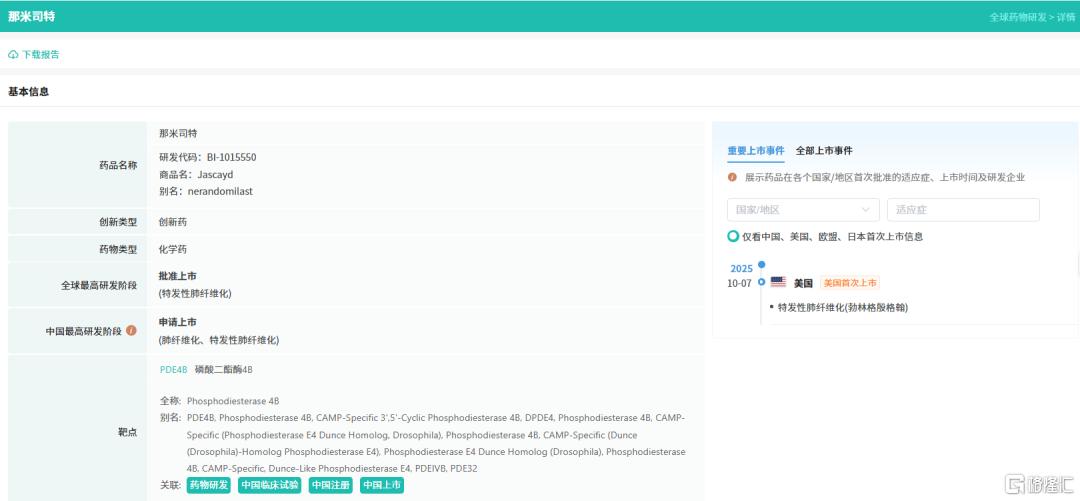
那米司特

Search documents
全球首发 中国率先批准那米司特用于治疗进展性肺纤维化
Xin Jing Bao· 2025-12-11 14:23
Core Insights - The approval of Namilizumab (brand name: Bo Yu Wei) by the National Medical Products Administration for the treatment of adult progressive pulmonary fibrosis (PPF) marks the first new therapy approved for PPF in over five years, showcasing the "China speed" in patient-centered healthcare [1][2] - PPF affects up to 5.6 million people globally, particularly those with underlying conditions such as rheumatoid arthritis or systemic sclerosis, and is associated with increased mortality risk as the disease progresses [1] - Namilizumab is the only selective phosphodiesterase 4B (PDE4B) inhibitor approved for this indication, demonstrating immunomodulatory, vascular protective, and anti-fibrotic effects [1] Clinical Trial Results - The approval is based on the largest clinical trial project for PPF to date, with the key Phase III trial FIBRONEER-ILD showing that Namilizumab effectively slows lung function decline in PPF patients and improves survival rates, with a nominally significant reduction in mortality risk [1] - Namilizumab also exhibited good safety and tolerability, with a low discontinuation rate and no need for liver function monitoring [1][2] Market Context - Currently, treatment options for progressive pulmonary fibrosis are very limited, highlighting the urgent need to improve patient survival and quality of life [2] - The U.S. Food and Drug Administration is prioritizing the review of Namilizumab for the treatment of adult PPF, with applications for its use in treating idiopathic pulmonary fibrosis and PPF under review in the EU, UK, Japan, and other regions [2]
2025 年度三季报业绩总结:创新与出海主线逻辑不变
Great Wall Glory Securities· 2025-11-03 11:17
Investment Rating - The investment rating for the pharmaceutical and biotechnology industry is "Positive" and the rating has been maintained [1] Core Views - The investment logic in the pharmaceutical sector is shifting from policy pressure to innovation-driven growth, with the "14th Five-Year Plan" directly supporting the development of innovative drugs and medical devices [8][26] - The industry is witnessing a transition from rapid following to original innovation, as demonstrated by Chinese companies showcasing their global competitiveness and pipeline value at the 2025 ESMO conference [8][26] - The recent approval of innovative drugs and the successful listing of companies on the STAR Market indicate a supportive capital market for innovative pharmaceutical enterprises [8][26] Industry Review - The pharmaceutical and biotechnology industry index increased by 1.89%, ranking 20th among 31 primary industries, underperforming the CSI 300 index which rose by 2.80% [5][16] - The sub-industries of medical research outsourcing and vaccines showed the highest gains, with increases of 5.26% and 4.19% respectively, while medical devices and traditional Chinese medicine experienced declines of 1.21% and 0.56% [5][16] - As of October 31, 2025, the industry’s PE (TTM, excluding negative values) was 30.67x, up from 30.08x in the previous period, indicating an upward valuation trend but still below the average [21] Company Dynamics - A total of 36 listed companies in the pharmaceutical and biotechnology sector experienced a net reduction in shareholder holdings amounting to 805 million yuan, with 4 companies increasing holdings by 120 million yuan and 32 companies reducing holdings by 925 million yuan [5][6] - Among the 501 tracked companies, 499 have disclosed their performance for the first three quarters of 2025, with 53 companies reporting a net profit growth of 100% or more, and 69 companies reporting growth between 30% and 100% [6] Investment Recommendations - Focus on companies with strong positions in innovative drugs and cutting-edge technology platforms, particularly those involved in ADC, bispecific/multispecific antibodies, and cell therapy, which can provide high potential for international market expansion [8] - Pay attention to the CXO industry, which is expected to see increased demand due to the recovery of innovative drug development and commercialization, especially for leading companies with strong service capabilities in new technology areas [8]




勃林格殷格翰IPF新药获批,打破十年市场垄断,百亿级呼吸赛道迎来重估
Ge Long Hui· 2025-10-24 10:40
Core Insights - Boehringer Ingelheim's oral PDE4B inhibitor Nerandomilast has received priority review approval for the treatment of idiopathic pulmonary fibrosis (IPF), marking the first new drug approval in this area in over a decade [1][6] - This approval signifies a breakthrough in IPF treatment, as it is the first drug to meet primary endpoints in a Phase III clinical trial in ten years [1][6] Drug Information - Nerandomilast, also known as Jascayd, is a novel PDE4B inhibitor developed by Boehringer Ingelheim, targeting the PDE4B enzyme which is highly expressed in the lungs and associated with fibrosis and inflammation [3][6] - The drug has shown dual effects of anti-fibrosis and anti-inflammation, potentially benefiting IPF patients clinically [3] Market Dynamics - The IPF market is currently dominated by Boehringer Ingelheim's Nintedanib and Roche's Pirfenidone, with Nerandomilast's entry creating a "three-horse race" in IPF treatment [7] - Nintedanib's patent expiration is set for 2029, and Pirfenidone faces generic competition, indicating a shift in market dynamics with the introduction of Nerandomilast [7] Clinical Development - Nerandomilast received breakthrough therapy designation from the FDA in 2022, highlighting its potential in IPF treatment [6] - The drug's approval in China was based on positive results from the pivotal Phase III clinical trial FIBRONEER™-IPF, which was the first to achieve primary endpoints in a decade [6][10] Future Prospects - Following its approval, Nerandomilast is expected to bring new hope to patients with rare pulmonary fibrosis conditions [10] - The company has submitted an application for Nerandomilast for the indication of progressive pulmonary fibrosis, which could further expand its treatment scope [10]