钙钛矿太阳电池

Search documents
太空光伏行业专家交流
2026-01-26 02:49
Summary of Key Points from the Conference Call on Space Photovoltaics Industry Overview - The discussion focuses on the **space photovoltaic industry**, particularly the components and technologies used in satellite energy systems, including solar cells and energy management systems [1][2][4]. Core Insights and Arguments - **Cost Structure**: Satellite energy systems account for approximately **10%-20%** of the total satellite cost, with solar arrays making up over **70%** of this cost. Energy storage and management components account for about **30%** [1][4]. - **Solar Cell Technologies**: The main technologies for solar cells include **gallium arsenide (GaAs)**, **silicon-based**, and **perovskite**. GaAs is the most mature but also the most expensive. Silicon has a significant cost advantage, while perovskite is seen as a promising future option, pending stability issues [1][2][7]. - **Flexible Solar Arrays**: Rigid solar arrays are becoming less favorable due to their larger envelope size, which is unsuitable for multi-satellite launches. The future trend is towards **flexible solar arrays**, particularly the **folded compression type**, which is expected to dominate in the coming years due to its proven technology [1][7]. - **Market Pricing**: In the commercial space sector, the price per square meter for GaAs solar arrays ranges from **200,000 to 400,000 RMB**, while silicon-based arrays can be reduced to **20,000 to 30,000 RMB** per square meter, representing a significant cost reduction [1][8]. Additional Important Content - **Reliability and Manufacturing**: Space photovoltaics require high reliability due to harsh conditions, necessitating specific materials and manufacturing methods, such as the use of III-V compounds and point welding techniques [3][10]. - **Packaging Costs**: The core cost of satellite solar cells is concentrated in the packaging materials, which are crucial for ensuring radiation resistance. This area is identified as a key focus for future cost reduction [3][14]. - **Differences from Ground Photovoltaics**: Space photovoltaics differ significantly from ground photovoltaics in terms of reliability requirements, material selection, and production processes. Space applications require materials that can withstand extreme conditions, including high radiation and temperature fluctuations [12][19]. - **Emerging Suppliers**: Key suppliers for space photovoltaic materials include **Qinhuangdao Star Arrow Glass** for radiation-resistant glass and various other companies for auxiliary materials like space-grade silicone [16][20]. Conclusion The space photovoltaic industry is evolving with a clear trend towards cost reduction and the adoption of flexible technologies. The focus on silicon-based solar cells and the development of new materials and manufacturing processes are critical for meeting the demands of commercial space applications.
京东方A:公司中试线搬入至首样下线仅用时38天全线贯通
Zheng Quan Ri Bao· 2026-01-06 09:19
Core Viewpoint - BOE Technology Group (京东方A) emphasizes the potential of perovskite solar cells as the future of photovoltaic products due to their high efficiency, lightweight, and flexible characteristics, alongside their wide range of application scenarios [2] Group 1: Technological Advantages - Perovskite solar cells are recognized as the third-generation nanofilm batteries, showcasing significant advantages in efficiency and flexibility [2] - The technology principles, device structures, and manufacturing processes of perovskite solar cells are highly similar to those of display technologies, allowing for effective integration [2] Group 2: Company Capabilities - The company leverages its long-term experience in glass-based processing, thin-film preparation, packaging, and equipment advantages to enhance the research and production of perovskite solar cells [2] - The company achieved a record of 38 days from the relocation of its pilot line to the first sample offline, demonstrating its capabilities in large-scale intelligent manufacturing [2]


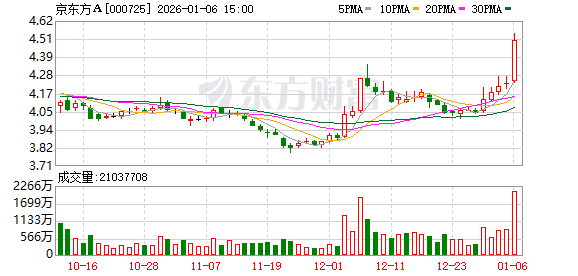
京东方A接待20家机构调研,包括淡水泉(北京)投资管理、天风证券、百年保险资管、华泰证券资管等
Jin Rong Jie· 2026-01-06 02:16
Core Viewpoint - BOE Technology Group (京东方A) has significant advantages in the perovskite solar cell sector, leveraging its long-term experience in the display industry to enhance perovskite research and production capabilities, achieving a record time of 38 days from the setup of its pilot line to the first sample output [1][3]. Group 1: Advantages of Perovskite Technology - Perovskite solar cells offer lower theoretical costs, simplified processes, and lower fabrication temperatures compared to traditional silicon solar cells [4]. - They possess flexible, impact-resistant, and anti-cracking properties, making them more reliable during transportation and application [4]. Group 2: Application and Development - The company has accelerated the demonstration of perovskite technology, launching the world's first perovskite BIPV (Building-Integrated Photovoltaics) project, "Zero Carbon House," which received national certification and the "Energy Storage Application Award" [2][5]. - Collaborations with leading consumer electronics companies are underway to develop innovative products such as photovoltaic price tags and autonomous vehicles [5]. Group 3: Project Progress and Efficiency - The company is developing rigid, flexible, and stacked component technology in parallel, achieving industry-leading efficiency levels across its three research platforms [6][7]. - Rigid components have reached a steady-state efficiency of 27.37%, while flexible components have achieved efficiencies of 21.39% in experimental lines and 16.6% in pilot lines, with the latter being the largest and highest power flexible components in the industry [7]. Group 4: Focus Areas and Future Plans - The company is concentrating on improving the efficiency and lifespan of perovskite cells, with plans to establish outdoor verification stations to assess stability under various environmental conditions [8]. - Future plans include increasing R&D investment to enhance conversion efficiency, stability, and lifespan, while accelerating the transition from pilot line technology to large-scale production to reduce costs [8].

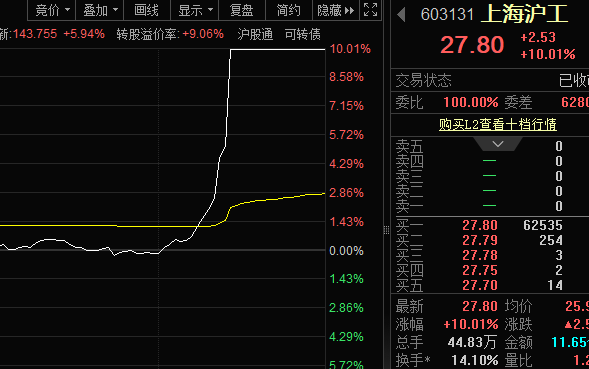
利好将近,603131、605598,尾盘直线涨停!脑机接口市场准入迎突破,资金抢筹股出炉
Zheng Quan Shi Bao· 2025-11-12 10:35
Group 1: Commercial Aerospace Sector - Several commercial aerospace stocks surged in late trading on November 12, with Shanghai Huguang and Shanghai Gangwan hitting the daily limit, and Aerospace Zhizhuang rising by 16.57% [1][3] - The 27th High-Tech Fair will take place from November 14 to 16, where the China Aerospace Science and Technology Corporation will globally launch the Chinese space tourism project [3] - The domestic commercial aerospace sector is entering a busy launch window, with four rocket launches completed in just two days from November 9 to 10 [3] - The number of commercial aerospace companies in China has exceeded 500, and the industry is expected to surpass 2.5 trillion yuan by 2025 [3] - The market size of China's commercial aerospace sector has grown from approximately 0.38 trillion yuan in 2015 to an estimated 2.3 trillion yuan in 2024, with a compound annual growth rate of about 22% [3] Group 2: Brain-Computer Interface Sector - The brain-computer interface index rose by 1.07% on November 12, with notable gains from Taihe Technology and Aipeng Medical, which increased by 8.74% and 8.21% respectively [4] - Shanghai Ladder Medical Technology's "Implantable Wireless Brain-Computer Interface System" has entered the special review process for innovative medical devices, marking a significant step in the commercialization of this technology in China [4][7] - A new industry standard for brain-computer interface medical devices will be implemented starting January 1, 2026, following approval from the National Medical Products Administration [7] - The domestic market for brain-computer interfaces is projected to reach 3.2 billion yuan by 2024 and grow to 6.14 billion yuan by 2028 [7] - Significant net buying of brain-computer interface stocks has been observed in Q4, with Keda Xunfei and Innovation Medical leading with net purchases exceeding 100 million yuan [8][10]