太空光伏

Search documents
A股三大指数跌超2%,寒武纪股价跌破1000元,比亚迪市值重回万亿元
2 1 Shi Ji Jing Ji Bao Dao· 2026-03-23 04:01
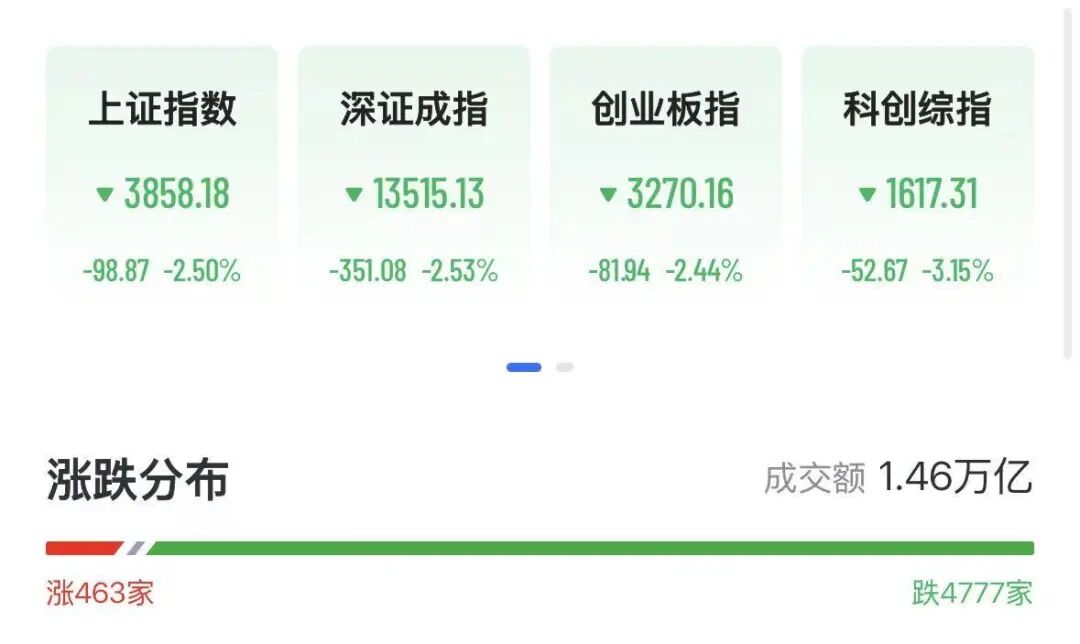
Market Overview - The A-share market opened lower on March 23, with all three major indices dropping over 2%, and the Shanghai Composite Index falling below the 3900-point mark [1] - By midday, the Shanghai Composite Index was down 2.5%, the Shenzhen Component Index down 2.53%, and the ChiNext Index down 2.44%, while the Sci-Tech Innovation Index fell over 3% [1][2] - The total trading volume in the Shanghai and Shenzhen markets reached 1.46 trillion yuan, an increase of 15.5 billion yuan compared to the previous trading day [1] Sector Performance - The green electricity concept showed resilience, with Huadian Liao Energy (600396) achieving six consecutive trading limits, and Dongfang New Energy (002310) hitting four trading limits in six days [5] - The robotics sector also performed well, with multiple stocks including Zhongdali De (002896) and Jinfatech (600143) reaching trading limits [5] - The coal sector saw significant gains, with Liaoning Energy (600758) hitting a trading limit and a buy order exceeding 1.24 million hands [5] Declining Sectors - Precious metals and pork sectors faced significant declines, with stocks like Muyuan Foods (002714) and Jinxinnong (002548) experiencing substantial drops [6] Individual Stock Movements - Domestic AI chip leader Cambricon Technologies saw its stock price drop over 3%, falling below the 1000 yuan mark, amid intensifying competition in the domestic AI chip market [7] - Chifeng Gold (600988) faced a trading halt, with its stock price hitting the limit down due to ongoing pressure in the international gold market, which saw prices drop below 4400 USD per ounce [7] - BYD (002594) experienced a counter-trend increase, with its stock price rising 5.69% to 108.89 yuan, bringing its market capitalization back to 1 trillion yuan [8] Industry Insights - The geopolitical situation in the Middle East is driving up refined oil prices, with predictions of a price increase in the domestic market [9] - The Chinese new energy vehicle market has surpassed a 50% penetration rate, shifting competition from price wars to core technology and supply chain resilience [9]




投资策略周报:滞胀与俄乌的配置经验-20260322
CAITONG SECURITIES· 2026-03-22 08:29
Core Insights - The report emphasizes that the Russia-Ukraine conflict has significantly impacted global inflation and economic conditions, extending the duration of high inflation rather than initiating a new round of global reflation [5] - The liquidity environment has tightened due to the conflict, increasing pressure on monetary policy across major economies, which has affected asset pricing through interest rates and stock market performance [5] - The report suggests a "HALO PLUS" strategy for asset allocation, focusing on defensive cash flow and offensive low-crowding growth sectors, particularly in coal, utilities, and construction for defense, while targeting commercial aerospace, batteries, and military themes for growth [6] Group 1: Impact of the Russia-Ukraine Conflict - The conflict has pushed inflation in Europe and the U.S. from around 6% to approximately 10% over six months, maintaining a high inflation rate of over 3% for nearly two years [19][20] - Japan's inflation, initially low, has risen due to energy price shocks, with CPI remaining above 2% for an extended period, indicating a different inflationary dynamic compared to the U.S. and Europe [20] - China's CPI has been less affected, primarily driven by structural price disturbances rather than a sustained inflationary trend [20] Group 2: Historical Inflation Experiences - Historical periods of stagflation in China, such as from June 2007 to February 2008 and January 2010 to July 2011, show that early stagflation phases are characterized by high commodity prices and resilient growth, with a shift to valuation and earnings certainty logic as tightening occurs [11][14] - In the 2007-2008 period, upstream cyclical sectors significantly outperformed, with coal prices rising by 49%, chemicals by 46%, and non-ferrous metals by 44%, reflecting strong demand and price increases [15][16] - The 2010-2011 period saw a market shift where defensive consumption sectors and small-cap growth stocks outperformed as inflationary pressures peaked and monetary tightening began [17][18]
2026年第9周:数码家电行业周度市场观察
艾瑞咨询· 2026-03-15 00:07
Industry Environment - The rise of embodied intelligence has become a new focus in the industry, driven by advancements in ChatGPT and VLA models, with robots as key carriers for AI implementation. The financing scale in this sector reached 735.43 billion yuan in 2026, despite facing technical bottlenecks and commercialization challenges [3][4]. - The space photovoltaic sector is transitioning from concept to commercialization, with a market size expected to reach trillions. Companies like SpaceX are planning to deploy thousands of low-orbit satellites, while domestic firms are also advancing their satellite constellation plans [5]. - Major tech companies are accelerating the integration of AI models into hardware devices, such as smart glasses and headphones, creating a new battlefield for human-computer interaction. The global AI glasses shipment is expected to exceed 10 million units by 2026, with China becoming the second-largest market [6]. - The AI education sector is becoming a competitive focus for major internet companies, with a monthly active user base exceeding 120 million. The market is divided into tech-driven, education training, and small entrepreneurial companies [7][8]. - The air conditioning industry is experiencing a collective price increase of 3%-10% due to rising copper prices and tightening energy efficiency subsidy policies, marking a shift from price wars to value competition [9]. Key Brand Dynamics - ByteDance launched Seedream 5.0 and Seedance 2.0, focusing on practical value and optimizing performance for commercial applications, targeting fields like science and programming [20]. - In 2026, Yin Qi aims to focus on "AI + terminal" strategies, emphasizing the development of foundational models and smart driving technology, while avoiding direct competition with major players [21][22]. - The photovoltaic sector saw a surge in stock prices following Elon Musk's comments on space photovoltaics, although the commercialization of this technology still faces challenges [23]. - ByteDance's Seedance 2.0 contrasts with OpenAI's Sora, focusing on content consumption logic and lowering creation barriers, while raising ethical concerns regarding privacy and data usage [24]. - The company "Wujie Power" completed over 200 million yuan in financing to develop general-purpose intelligent robots, focusing on the iteration of their "general brain" technology [25].

华夏基金吴昊-不只是贝塔-如何用-景气-主题-重构高端制造组合
2026-03-10 10:17
Summary of Key Points from Conference Call Records Industry and Company Involvement - **Industry Focus**: High-end manufacturing, AI hardware, space photovoltaic, controlled nuclear fusion, military industry, and lithium batteries - **Key Companies Mentioned**: SpaceX, Bo Rui Kang, and various domestic photovoltaic companies Core Insights and Arguments 1. **AI Hardware Expansion**: 2026 is projected to be a year of AI hardware proliferation, with increasing supply-demand conflicts in computing power, storage, and electricity leading to rare price increases in certain manufacturing sectors [1][4] 2. **Investment Strategy**: The investment strategy emphasizes a combination of cyclical investments (60%-70%) and thematic investments, focusing on overseas/domestic computing power (15%-20%), power grid equipment (15%), gas turbines (15%), and electronic price increases (10%) [1][4][5] 3. **Space Photovoltaic Theme**: The core theme for 2026 is space photovoltaic, driven by the launch of SpaceX's V3 satellites, which is expected to expand solar wing area by 10-20 times and double the value per watt [1][10] 4. **Controlled Nuclear Fusion Investment**: Significant government investment exceeding 100 billion yuan in 2025, with the second phase of the Hefei BEST project expected to expand investment to 980-1000 billion yuan in 2026, necessitating close tracking of listed companies' order shares [1][8] 5. **Brain-Computer Interface**: Currently in a high-risk thematic investment phase, with a focus on IPOs and industrialization progress of leading projects like Bo Rui Kang [1][14] 6. **Military Sector Outlook**: The military sector remains under observation, with a focus on gas turbine overseas orders, C919 aircraft production, and military trade opportunities, particularly in the engine and shipbuilding segments [2][16] Additional Important Insights 1. **Market Dynamics**: The investment framework is based on macro industry selection and concentrated holdings in quality stocks, with a focus on quarterly revenue acceleration as a key indicator of industry health [3][4] 2. **Geopolitical Impact**: The impact of geopolitical conflicts and trade wars on high-end manufacturing supply chains is assessed as less severe than previous conflicts, with a focus on re-industrialization and re-militarization as long-term trends [9][10] 3. **Space Photovoltaic Industry Development**: The future industrialization pace of the space photovoltaic sector is expected to transition from thematic investment to cyclical investment as operational milestones are achieved, particularly with the V3 satellite launches [10][12][13] 4. **Investment in Lithium Batteries**: The current focus is on upstream resources in lithium batteries, particularly lithium carbonate, while the midstream materials segment remains under scrutiny due to competitive dynamics and uncertainties in downstream vehicle production [17][18] This summary encapsulates the critical insights and strategic directions discussed in the conference call, highlighting the anticipated trends and investment opportunities within the high-end manufacturing and related sectors.
明阳智能(601615):风电主业企稳,太空光伏带来价值重塑新机遇
NORTHEAST SECURITIES· 2026-03-09 08:12
Investment Rating - The report initiates coverage with a "Buy" rating for the company, indicating an expected stock price increase of 5% to 15% over the next six months [7]. Core Insights - The company is projected to experience significant profit growth in 2025, with net profit attributable to shareholders expected to increase by 131.14% to 188.92%, and net profit excluding non-recurring items anticipated to grow by 230.66% to 344.68% [2]. - The recovery in offshore wind power installations in China is a key driver, with the company holding over 46GW in orders as of Q3 2025, leading to substantial growth in turbine delivery and sales revenue [2]. - The acquisition of Dehua Chip is aimed at enhancing the company's capabilities in space photovoltaic technology, which is expected to create new growth opportunities and reduce reliance on traditional wind power business cycles [3]. - The space photovoltaic sector is entering a rapid growth phase, with GaAs technology becoming the mainstream choice for solar wings due to its high efficiency and radiation resistance [4]. - The company’s revenue forecasts for 2025 to 2027 are projected at 373.86 billion, 452.48 billion, and 545.24 billion yuan respectively, with net profits expected to reach 9.24 billion, 14.95 billion, and 25.95 billion yuan [4]. Summary by Sections Financial Performance - For 2023, the company reported a revenue of 28,124 million yuan, which is expected to decline by 8.53% in 2024, followed by a significant increase of 37.66% in 2025 [6]. - The net profit for 2023 was 377 million yuan, with a projected increase to 924 million yuan in 2025, reflecting a growth rate of 166.94% [6]. - The earnings per share (EPS) is expected to rise from 0.15 yuan in 2024 to 0.41 yuan in 2025, and further to 1.15 yuan by 2027 [6]. Market Dynamics - The report highlights the competitive landscape in the space sector, with the U.S. and China leading in satellite launches and deployments, indicating a robust market for space photovoltaic technologies [4]. - The anticipated increase in satellite deployments and rocket launches is expected to drive demand for high-efficiency solar technologies, positioning the company favorably in the market [4].

太空光伏行业深度3:从国内卫星制造产业链&价值链拆解展开
Guohai Securities· 2026-03-02 08:32
Investment Rating - The report maintains a "Recommended" rating for the space photovoltaic industry [1]. Core Insights - The report addresses key issues such as China's commercial aerospace policies, satellite launch history and forecasts, and the progress of major listed companies and research institutions in space silicon and perovskite battery layouts [6]. - The commercial aerospace sector in China has transitioned from "policy encouragement" to "strategic positioning," with significant policy support and regional collaboration forming a spatial economic landscape [9][12]. - The report highlights the rising demand for satellite power, predicting an increase in satellite launch volumes and advancements in space energy technology, particularly in silicon and perovskite solar cells [8][60]. Summary by Sections Industry Overview - The report outlines the strategic elevation of commercial aerospace to a key emerging industry, with policies increasingly focusing on capital, industry, and regulatory collaboration [12]. - Local governments are competing to develop commercial aerospace, with significant plans emerging from regions like Beijing-Tianjin-Hebei, the Yangtze River Delta, the Greater Bay Area, and the western region [15]. Cost Analysis - Current rocket launch costs in China range from $5,000 to $8,000 per kilogram, significantly higher than SpaceX's $1,500 to $3,000 per kilogram [16][17]. - The cost of a 50-kilogram small satellite in China is approximately 8 million RMB, which is 2.67 times higher than similar products abroad [16][17]. Satellite Launch and Development - In 2025, China is expected to conduct 92 launches, with commercial launches accounting for 54% and 311 commercial satellites entering orbit, representing 84% of total launches [9][42]. - The report forecasts that from 2025 to 2030, the power of communication satellites will increase from 0.69 kW to 1.93 kW, and computing satellites from 1.04 kW to 3.43 kW, with corresponding increases in solar wing area [60]. Technological Advancements - The report indicates that gallium arsenide remains the mainstream technology for space photovoltaic cells, with ongoing advancements in silicon and perovskite technologies [60][63]. - The industry is expected to see a gradual increase in satellite launches, driven by the need for cost reduction and scale expansion, which are critical for the industry's future competitiveness [9][17]. Key Companies - Notable companies in the space photovoltaic sector include Maiwei Co., Aotwei, High Measurement Co., Jingsheng Mechanical & Electrical, Jiejia Weichuang, Laplace, Dier Laser, and Shanghai Port [9].




冲高回落,希望还有吗?
Ge Long Hui· 2026-02-27 20:52
Market Performance - The three major indices experienced a pullback, with the Shanghai Composite Index down 0.17%, the Shenzhen Component Index down 0.68%, and the ChiNext Index down 1.46% [1] - Over 2900 stocks declined in the two markets, with a total trading volume of 1.59 trillion yuan [1] Sector Highlights - The computing power leasing concept saw a collective surge, with companies like Huasheng Tiancai hitting the limit up for three consecutive days, and others like Tuowei Information and Litong Electronics also reaching the limit up [1] - The non-ferrous metal sector remained active, with Zhangyuan Tungsten achieving five limit up days in seven, and Xianglu Tungsten and Zhong Rare Metals hitting the limit up [1] - The AI programming concept strengthened, with Jinxiandai and Puyuan Information both reaching a 20% limit up [1] - The space photovoltaic concept rebounded, with Junda Co. hitting the limit up [1] Sector Adjustments - The glass fiber sector opened lower and continued to decline, down 3.17% at midday, with companies like International Composite Materials and Honghe Technology hitting the limit down with declines over 10% [1] - The electronic cloth concept continued to adjust, with Honghe Technology hitting the limit down [1] - Other sectors such as components, PCB, and paper also followed suit in the downward trend [1] News Impact - Post-holiday, tungsten raw material prices have surged, with tungsten powder exceeding 1800 yuan per kilogram [1] - Huawei's cloud code intelligent agent public beta was released on February 26, covering AI programming technologies such as code generation [1] - Chinese commercial aerospace representative Blue Arrow Aerospace announced that the reusable rocket Zhuque-3 plans to conduct recovery tests again in the second quarter of this year [1]
帮主郑重午评:指数绿了却有肉吃?午后A股操作全梳理
Sou Hu Cai Jing· 2026-02-27 04:30
Market Overview - The three major indices showed a decline, with the ChiNext Index down by 1.46%, the Shenzhen Component Index down by 0.68%, and the Shanghai Composite Index down by 0.17% [3] - Despite the index declines, over 2300 stocks in the market experienced gains, indicating that the overall market sentiment remains positive [4] Trading Volume and Market Behavior - The trading volume in the Shanghai and Shenzhen markets reached 15.966 trillion, a decrease of 532 billion from the previous trading day, but still maintained at a high level, suggesting that funds are not leaving the market but are reallocating [4] Sector Performance - Rare metal sectors, such as tungsten and rare earths, saw significant gains, with multiple stocks reaching historical highs, driven by supply-demand mismatches [4] - The AI-related sectors, including computing power leasing and cloud computing, also experienced a surge, supported by a notable increase in domestic AI token usage surpassing that of the U.S. for the first time [4] Declining Sectors - The computing hardware sectors, including CPO, PCB, and storage chips, faced significant declines, largely influenced by NVIDIA's 5.47% drop, marking its largest single-day decline in nearly a year [5] - This decline is viewed as a normal correction following substantial short-term gains, rather than a sign of a downturn in the AI or computing hardware market [5] Investment Strategy - Investors are advised to avoid chasing high-priced stocks, particularly in sectors that have recently seen significant increases, to prevent potential losses from profit-taking [6] - Focus should be on AI industry leaders with real performance support and cyclical products with price increase logic, such as coal and steel, which are also showing signs of activity [6] Index Analysis - The Shanghai Composite Index showed resilience with only a minor decline, while the ChiNext Index's drop was primarily due to heavyweight stocks dragging it down [6] - The market's current behavior is characterized by index differentiation, which is seen as a healthy correction before the upcoming March trading period [7]
恒生指数早盘涨0.75% 均达股份领涨太空光伏
Zhi Tong Cai Jing· 2026-02-27 04:12
Group 1 - The Hang Seng Index rose by 0.75%, gaining 197 points to close at 26,578 points, while the Hang Seng Tech Index increased by 1.03%. The morning trading volume reached HKD 121.8 billion [1] - MSCI announced the inclusion of 37 new stocks in the MSCI China Index, effective after the market close on February 27, 2026. Notable inclusions include Xiaoma Zhixing and SenseTime, with Xiaoma Zhixing rising by 6.78% and Hesai Technology increasing by over 4% [1] Group 2 - Junda Co., Ltd. saw its stock price increase by over 21%, with institutions optimistic about its potential in space photovoltaic technology [2] - New World Development Company Limited's stock rose by 7%, reporting a 16.7% increase in underlying profit to HKD 12.213 billion, leading the blue-chip stocks [2] Group 3 - Tungsten prices continue to rise, leading to a stock increase of over 7% for Jiaxin International Resources [3] - Jinli Permanent Magnet's stock rose by 4.36%, supported by recent increases in rare earth prices driven by policy support [4] Group 4 - Guofu Quantum's stock increased by over 5%, with a cumulative rise of 40% over the past seven trading days, as the company is expected to be included in the index next month [5] - Eagle Precision's stock rose by over 5%, reaching a new high since its listing, with a cumulative increase of over 70% year-to-date [6] Group 5 - Yunzhisheng's stock increased by 7.65% following the launch of the Unisound U1-OCR intelligent document model [7] - Guofu Hydrogen Energy's stock rose by 2%, as the company participates in a national-level nuclear fusion research platform's low-temperature system project [8] Group 6 - Yabo Technology Holdings' stock increased by over 7%, with a cumulative rise of nearly 140% since the holiday, as the company collaborates with the Hong Kong Gold Exchange to develop an international precious metals trading platform [9] - Chow Tai Fook's stock fell by over 3% despite reporting a mid-term net profit increase of over 15% and a dividend increase of approximately 3% to HKD 0.28 [10]
A股午评:创业板指跌超1% 算力租赁概念逆势爆发
2 1 Shi Ji Jing Ji Bao Dao· 2026-02-27 04:05
Market Overview - The market experienced fluctuations in early trading, with the Shanghai Composite Index turning negative again and the ChiNext Index dropping over 1% [1] - By the end of the trading session, the Shanghai Composite Index fell by 0.17%, the Shenzhen Component Index decreased by 0.68%, and the ChiNext Index declined by 1.46% [1] - The total trading volume in the Shanghai and Shenzhen markets was 1.59 trillion yuan, a decrease of 53 billion yuan compared to the previous trading day [1] Sector Performance - The computing power leasing concept saw a collective surge, with stocks like Huasheng Tiancheng achieving three consecutive daily limits in five days, and stocks such as Tuo Wei Information, Litong Electronics, and Chengdi Xiangjiang hitting daily limits [1] - The non-ferrous metals sector was notably active, with Zhangyuan Tungsten achieving five daily limits in seven days, and stocks like Xianglu Tungsten and Zhong Rare Metals also hitting daily limits [1] - The AI programming concept strengthened, with Jin Modern and Puyuan Information both reaching the 20% daily limit [1] - The space photovoltaic concept rebounded, with Jun Da Co., Ltd. hitting the daily limit [1] - Conversely, the electronic cloth concept continued to adjust, with Honghe Technology hitting the daily limit down [1]