长期日本国债

Search documents
策略师:高市早苗的压倒性胜利可能给长债收益率带来上行压力
Xin Lang Cai Jing· 2026-02-09 05:52
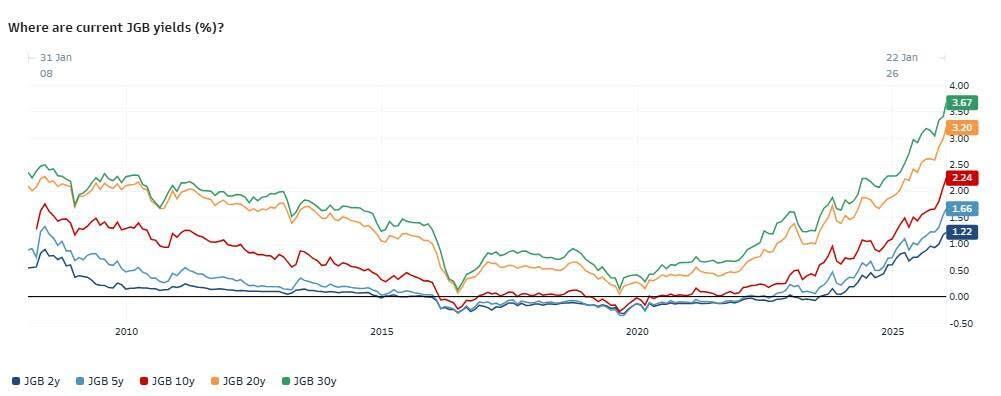
Group 1 - The core viewpoint is that the overwhelming victory of Japanese Prime Minister Fumio Kishida may lead to upward pressure on long-term Japanese government bond yields due to potentially more aggressive fiscal spending, which could increase fiscal and inflation risks [1] - The market is currently assessing the impact of the Liberal Democratic Party's victory on currency dynamics, indicating potential short-term volatility in the yen [1] - With the Federal Reserve remaining on hold and the Bank of Japan not expected to raise interest rates until the second quarter, the USD/JPY exchange rate may approach the 160.00 level again [1]
高市早苗“发出信号”,美日联合干预市场“箭在弦上”?
智通财经网· 2026-01-25 04:34
Core Viewpoint - Japanese Prime Minister Sanna Takashi issued a stern warning regarding speculative behavior in financial markets, promising necessary measures to address abnormal fluctuations, particularly in the context of the yen's significant volatility and rising bond yields [1][2]. Group 1: Market Reactions and Speculation - The yen experienced its largest increase in five months, with the dollar-yen exchange rate dropping approximately 1.75% to a low of 155.63, following speculation about potential joint intervention by the U.S. and Japan [1][2]. - The New York Federal Reserve's inquiries into the yen's exchange rate were interpreted as a signal of possible intervention, leading to a rapid reversal in the yen's value [2]. - Analysts noted that the Fed's involvement suggests that any potential intervention would not be unilateral, altering the dynamics of market speculation [2]. Group 2: Psychological Barriers and Government Actions - The dollar-yen exchange rate approaching the 160 mark has heightened concerns about intervention, reminiscent of previous instances where Japan spent nearly $100 billion to support its currency [3]. - The current political climate in Japan is sensitive, with Prime Minister Takashi's cabinet recently dissolving the House of Representatives, raising concerns about fiscal stability and the impact on the yen [3]. - The volatility in long-term Japanese government bonds has also been significant, with a 25 basis point increase in the 30-year bond yield, indicating supply-demand imbalances [4]. Group 3: Long-term Challenges and Policy Implications - Analysts from Goldman Sachs indicated that mere market intervention would not resolve underlying issues, emphasizing the need for more hawkish monetary policy or quantitative easing to stabilize the bond market [6]. - The current high levels of long-term Japanese government bonds may continue to face pressure unless there is a significant change in fiscal policy or a more aggressive monetary stance [7]. - There is speculation that the U.S. may be more open to currency intervention due to concerns about the spillover effects of Japanese bond volatility on U.S. markets [8].