
通胀风险

Search documents
The Best Financial ETF to Buy Before the Next Rate Decision
The Motley Fool· 2026-04-01 06:00
Core Viewpoint - Regional banks have faced significant challenges recently, with the State Street SPDR S&P Regional Banking ETF experiencing a decline from $74 to around $63 due to geopolitical risks and yield volatility [1] Group 1: Market Performance - Regional bank stocks were up approximately 13% year-to-date at one point in February, driven by expectations of lower interest rates, improving profit margins, and a shift away from growth and tech stocks [2] - The ETF currently trades at a forward price/earnings (P/E) ratio of 10.5, compared to 20.7 for the S&P 500 ETF, and a price/book (P/B) ratio of 1.1 versus 4.8 for the S&P 500 ETF, indicating a strong value proposition [13] Group 2: Economic Indicators - The onset of the war in Iran has increased inflation risks, diminishing the likelihood of a rate cut in 2026, while key economic indicators suggest a slowing U.S. economy [3] - Regional banks are particularly sensitive to economic conditions, focusing on local business lending, which makes them vulnerable to economic and borrower-specific risks [9] Group 3: Risks and Opportunities - The potential for inflation and interest rate shocks poses a significant risk to regional banks, as evidenced by the past collapses of Silicon Valley Bank and Signature Bank due to overextension in long-term bonds [10] - However, a resolution to the Iran conflict could lead to a bullish market reaction, potentially prompting the Federal Reserve to reconsider rate cuts later this year, which would benefit regional banks by widening the spread between short-term and long-term rates [11][15] Group 4: Investment Considerations - Current valuations make the investment case for the State Street SPDR S&P Regional Banking ETF compelling, despite existing risks [12] - Investors are encouraged to consider buying regional banks before the Federal Reserve's next meeting at the end of April, as a de-escalation of geopolitical tensions could lead to favorable market conditions [14][15]


铂钯数据日报-20260331
Guo Mao Qi Huo· 2026-03-31 05:08
Group 1: Report Industry Investment Rating - No relevant information provided Group 2: Report's Core View - On March 30, platinum and palladium prices opened low and closed high, showing a strong and volatile trend. PT2606 rose 2.66% to 497.50 yuan/gram, and PD2606 rose 0.61% to 357.30 yuan/gram [6]. - With the market's increasing concern about the inflation risk caused by high oil prices, the U.S. stock market fell, and the U.S. Treasury yield dropped from its high, supporting platinum and palladium prices. However, the tense situation between the U.S. and Iran, high geopolitical uncertainties, and high oil prices and the U.S. dollar index may limit the upside space of platinum and palladium [6]. - Eskom, South Africa's national power company, will raise electricity prices starting from April 1, which is expected to increase the energy costs in the mining and smelting of platinum and palladium. The supply elasticity at the mineral end may further tighten, providing medium - to long - term support for platinum and palladium prices [6]. - It is expected that platinum and palladium will likely maintain a range - bound and volatile trend in the short term. After the Middle East geopolitical situation becomes relatively clear, investors can consider going long on platinum unilaterally at low prices or continue to hold the [long platinum, short palladium] strategy [6]. Group 3: Summary by Relevant Catalogs Domestic Prices (Yuan/gram) - Platinum futures main contract closing price: The current value is 497.5, the previous value is 493.05, with a daily increase of 0.90% [4]. - Spot platinum (99.95%): The current value is 484, the previous value is 475, with a daily increase of 1.89% [4]. - Platinum basis (spot - futures): The current value is - 13.5, the previous value is - 18.05, with a daily change of - 25.21% [4]. - Lithium futures main contract closing price: The current value is 357.3, the previous value is 358.2, with a daily decrease of 0.25% [4]. - Spot lithium (99.95%): The current value is 354, the previous value is 348.5, with a daily increase of 1.58% [4]. - Lithium basis (spot - futures): The current value is - 3.3, the previous value is - 9.7, with a daily change of - 65.98% [4]. International Prices (15:00, USD/ounce) - London spot platinum: The current value is 1920.923, the previous value is 1892.8, with a daily increase of 1.49% [4]. - London spot palladium: The current value is 1419.574, the previous value is 1401.427, with a daily increase of 1.29% [4]. - NYMEX platinum: The current value is 1916.2, the previous value is 1894.5, with a daily increase of 1.15% [4]. - NYMEX palladium: The current value is 1417.5, the previous value is 1406.5, with a daily increase of 0.78% [4]. Internal - External 15:00 Spread (Yuan/gram) - USD/CNY central parity rate: The current value is 6.9223, the previous value is 6.9141, with a daily increase of 0.12% [4]. - Guangzhou platinum - London platinum: The current value is 14.41, the previous value is 17.59, with a daily change of - 18.11% [4]. - Guangzhou platinum - NYMEX platinum: The current value is 15.60, the previous value is 17.17, with a daily change of - 9.15% [4]. Other Spreads and Ratios - Guangzhou lithium - London aluminum: The current value is 0.29, the previous value is 6.17, with a daily change of - 95.27% [5]. - Guangzhou lithium - NYMEX lithium: The current value is 0.81, the previous value is 4.90, with a daily change of - 83.39% [5]. - Guangzhou Futures Exchange platinum/lithium ratio: The current value is 1.3924, the previous value is 1.3765, with an increase of 0.0159 [5]. - London spot platinum/lithium ratio: The current value is 1.3506, the previous value is 1.3532, with a decrease of 0.0025 [5]. Inventory (Troy Ounces) - NYMEX platinum inventory: The current value is 554,241, the previous value is 558,768, with a daily decrease of 0.81% [5]. - NYMEX palladium inventory: The current value is 248,374, the previous value is 248,374, with a daily change of 0.00% [5]. Position - NYMEX total platinum position: The current value is 61,473, the previous value is 67,292, with a daily decrease of 8.65% [5]. - NYMEX non - commercial net long platinum position: The current value is 16,898, the previous value is 16,198, with a daily increase of 4.14% [5]. - NYMEX total palladium position: The current value is 15,556, the previous value is 15,069, with a daily increase of 3.13% [5]. - NYMEX non - commercial net long palladium position: The current value is - 185, the previous value is - 1242, with a daily increase of 571.35% [5].
Recent market action shows 'huge amount of optimism' for resolution in Iran War, says Citi's Moore
Youtube· 2026-03-25 20:54
Market Outlook - The current market sentiment reflects cautious optimism regarding a potential de-escalation of ongoing conflicts, with expectations for a near-term resolution [1] - There is a general acknowledgment that predicting market movements is challenging, with no clear edge on asset direction [2] Investment Strategy - Recent price actions indicate significant optimism about a resolution, but there are concerns about inflationary impacts from energy shocks, prompting a need for resilient portfolio construction [3] - Gold has been added to portfolios as a risk asset balance, although its performance has been disappointing in recent risk-off moments [4][5] - Adjustments have been made to fixed income positions, including adding short-duration assets and trimming emerging market debt, in response to market conditions and inflation expectations [6] Global Equity Considerations - European equities had seen significant interest, but much of the price movement was attributed to multiple expansions rather than fundamental improvements, raising concerns about future earnings growth [9][10] - The inflationary pressures in Europe are expected to complicate the growth outlook, leading to a cautious stance on European equities compared to US equities [11]

跳水!伊朗局势,持续引爆!黄金、白银,发生了什么?
券商中国· 2026-03-23 05:49
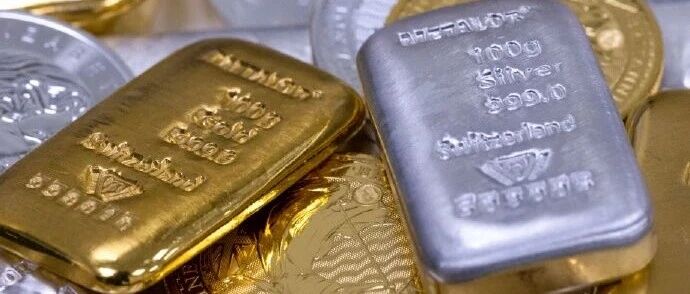
Core Viewpoint - The article discusses the significant drop in gold and silver prices, attributing it to rising oil prices, inflation risks, and potential liquidity needs among economies, which may lead to gold sell-offs [1][3][6]. Group 1: Market Performance - On March 23, gold prices fell nearly 4%, reaching a low of $4318 per ounce, while silver prices dropped close to 5%, falling below $65 per ounce [1][3]. - In the Hong Kong stock market, gold-related stocks experienced substantial declines, with Chifeng Jilong Gold Mining down over 24% and Lingbao Gold down over 14% [1][3]. - In the A-share market, Chifeng Jilong Gold hit the daily limit down, while Sichuan Gold fell over 9% [1][3]. Group 2: Economic Factors - The surge in oil prices has intensified inflation risks and reduced the likelihood of interest rate cuts by the Federal Reserve and other central banks, negatively impacting non-yielding assets like gold [1][6]. - The article notes that gold prices have been on a downward trend for eight consecutive trading days, marking the largest weekly decline since 1983 [6]. Group 3: Market Sentiment and Predictions - Analysts suggest that the current market environment, characterized by rising real yields and a stronger dollar, has overshadowed gold's traditional safe-haven appeal [3][6]. - There are indications that some economies may need to sell gold to raise liquidity, contributing to the cautious market sentiment [3][6]. - The article highlights that traditional safe-haven assets are underperforming, with investors favoring money market funds as a refuge, indicating a preference for cash over systemic asset reallocation [3].

全球资产配置每周聚焦(20260313-20260320):黄金急跌:流动性下杀≠趋势反转-20260322
Shenwan Hongyuan Securities· 2026-03-22 14:42
Market Overview - During the week of March 13-20, 2026, geopolitical tensions in the Middle East led to a rise in oil prices by 8.77%, while gold prices fell by 9.54%[3] - The 10-year U.S. Treasury yield increased by 11 basis points to 4.39% due to hawkish statements from the Federal Reserve, which significantly reduced expectations for interest rate cuts[3] Gold Price Dynamics - The recent decline in gold prices is attributed to liquidity shocks rather than a trend reversal, as gold prices initially rose with geopolitical tensions but then fell in sync with equity markets[10] - If oil prices rise above $90 per barrel in the next two quarters, the U.S. may face significant inflation risks, constraining monetary easing[11] Federal Reserve Outlook - The Federal Reserve raised its inflation growth forecast for 2026 during the March 18 meeting, indicating a likelihood of only one rate cut this year, with no cuts expected in the first half of 2027[14] - Market expectations as of March 21, 2026, suggest that the Fed will not cut rates in 2026 or the first half of 2027[14] Investment Sentiment - Speculative long positions in gold have been liquidated, while allocation funds have just begun to reduce their positions, indicating a cautious market sentiment[31] - Historical analysis shows that after significant declines in gold prices (greater than 10%), there is no clear trend in subsequent price movements over the following weeks or months[34] Risk Factors - Short-term asset price volatility may not reflect long-term trends, and there are risks of deeper-than-expected economic recessions in Europe and the U.S.[5] - The ongoing geopolitical conflicts and hawkish Fed stance contribute to a liquidity crisis that negatively impacts gold prices[37]
市场在交易什么
SINOLINK SECURITIES· 2026-03-22 12:07
Group 1: Market Perception of the US-Iran War - The market's perception of the US-Iran war has shifted from a quick resolution to a prolonged conflict, leading to significant macroeconomic impacts[2] - Initial optimism was based on the previous "Twelve-Day War" and Trump's favorable TACO record, resulting in continued capital inflow into US stocks and a lack of inflation pricing in US bonds[2] - Recent trading has shown a "compensatory correction," with macroeconomic volatility exceeding changes in the war's status, indicating diminishing marginal utility of Trump's TACO[2] Group 2: Economic Implications - If the war becomes a protracted conflict, it will affect global energy, supply chains, inflation, asset pricing, and the reassessment of great power security premiums[6] - Energy prices have surged, with WTI crude oil increasing approximately 47% and Brent crude rising about 55% since February 28[6] - The US economy is struggling to return to a 2% inflation rate in a non-recession environment, with nominal employment growth at 5% showing zero real growth[14] Group 3: Risks and Challenges - Risks include uncertainty in Trump's military policy, potential energy shortages leading to a global recession, and rapid shifts in global central bank policies causing second-round inflation risks[4][17] - The bond market is showing signs of "giving up on fantasies," with the 2-year US Treasury yield surpassing the upper bound of the federal funds rate range, indicating market skepticism about future rate cuts[6] - The tightening liquidity environment has led to significant asset price volatility, with commodities, bonds, and equities all facing downward pressure[12]
中信证券海外宏观:不宜对已经出现高波动的资产“单向押注
Jin Rong Jie· 2026-03-21 02:34
Core Viewpoint - The European Central Bank (ECB) has maintained its three key interest rates as expected in March, while adjusting its inflation and growth forecasts due to external factors such as the Middle East conflict [1] Group 1: ECB Actions and Predictions - The ECB has kept its three key interest rates unchanged [1] - The ECB has raised its inflation forecasts for the next three years [1] - The ECB has lowered its growth forecasts for the next two years [1] Group 2: Market Reactions and Analysis - The derivatives market is pricing in expectations of two to three interest rate hikes by the ECB within the year [1] - The analysis from CITIC Securities suggests that these expectations are overly aggressive [1] - Recent news, including hawkish comments from Powell and incidents in Iran and Qatar, has led the market to reassess inflation risks [1] - CITIC Securities advises against making "one-way bets" on already volatile assets [1]

黄金、白银暴跌,遭全球抛售
中国能源报· 2026-03-20 05:34
Core Viewpoint - The global sell-off of assets has led to a significant drop in gold and silver prices, driven by inflation risks prompting central banks to end monetary easing and potentially restart tightening measures [2]. Group 1: Price Movements - As of March 19, the price of gold for April delivery fell to $4605.70 per ounce, a decrease of 5.93%, while silver for May delivery dropped to $71.215 per ounce, down 8.22% [2]. - Analysts attribute the volatility in gold and silver prices to previous significant gains, which led to profit-taking by investors following negative news [2]. Group 2: Economic Indicators - The U.S. Labor Department reported a decrease of 8,000 in initial jobless claims for the week ending March 14, bringing the total to 205,000, the lowest level since January of the previous year [3]. - A sharp sell-off in the U.S. Treasury market has pushed yields higher, reducing expectations for interest rate cuts by the Federal Reserve in 2026, which has negatively impacted precious metals [3]. Group 3: Geopolitical Factors - The ongoing geopolitical uncertainty in the Middle East is expected to prolong high oil prices, which, combined with weakening expectations for Fed rate cuts, exerts continuous downward pressure on precious metals [3][4]. - Analysts note that rising energy costs due to geopolitical tensions are creating inflationary pressures that are detrimental to gold prices [4]. Group 4: Market Outlook - The future trajectory of precious metals is largely dependent on the intensity and duration of the Middle East conflict, with analysts suggesting that gold remains under pressure in a strong dollar and high oil price environment [5]. - Despite geopolitical risks, the market's focus remains on the potential for military conflict to disrupt oil supplies, which could lead to renewed interest in gold as a hedge against inflation [5]. Group 5: Long-term Investment Perspective - Long-term, the allocation value of gold remains intact, with expectations that central banks will continue to purchase gold amid global geopolitical uncertainties and rising U.S. debt [6]. - Wells Fargo projects a year-end target price for gold between $6100 and $6300 per ounce, citing structural support from ongoing central bank purchases and the gradual dilution of the dollar's long-term credit [6].
所长早读-20260320
Guo Tai Jun An Qi Huo· 2026-03-20 02:00
1. Report Industry Investment Rating The report does not provide an overall industry investment rating. 2. Core Views of the Report - Continuous geopolitical conflicts, particularly the situation in the Middle East, have significant impacts on various commodity markets, leading to price fluctuations and supply - side disturbances [7][39][144]. - Different commodities show diverse trends due to factors such as supply - demand relationships, cost changes, and market sentiment. For example, some commodities are affected by supply shortages, while others are influenced by changes in downstream demand [8][12][83]. 3. Summary by Related Catalogs Metals - **Aluminum**: Macro - level negative impacts temporarily offset concerns about overseas supply. Although there are issues with logistics and supply in the Middle East, the upward movement of the aluminum market is restricted. However, overseas spot shortages and potential supply disruptions in the Middle East may support prices in the future. The trend strength is 0 [8][9][35]. - **Gold and Silver**: Recently, precious metals have declined rapidly. Gold is considered for bottom - fishing or avoidance, while silver is treated with a short - selling mindset. The trend strength of gold is 0, and that of silver is 0 [10]. - **Copper**: A decrease in domestic inventory limits price declines. The trend strength is - 1 [21][23]. - **Zinc**: The fundamentals provide support, and prices have stabilized. The trend strength is 0 [24][26]. - **Lead**: A decrease in inventory limits price declines. The trend strength is 0 [27][28]. - **Tin**: After a decline, it has partially recovered. The trend strength is 0 [30][32]. - **Platinum and Palladium**: The platinum and palladium sectors are under significant pressure, and a pessimistic view is maintained. The trend strength of both is - 1 [36][38]. - **Nickel and Stainless Steel**: Macro - risk preferences put pressure on nickel, but contradictions in the ore end limit the downward flexibility. Stainless steel is pressured by fundamentals and the macro - environment, but real - world costs provide support. The trend strength of both is 0 [40][47]. - **Lithium Carbonate**: Affected by negative news, the trend strength is - 1 [48][52]. - **Industrial Silicon and Polysilicon**: Industrial silicon should focus on the downward space, and polysilicon's spot price has declined. The trend strength of industrial silicon is 0, and that of polysilicon is - 1 [53][56]. Energy and Chemicals - **LPG**: Supply - side extreme disturbances have led to a joint upward movement in domestic and international markets. It is strong in the short - term, but there is a divergence between futures and spot logic. The trend strength is 1 [11][12][132]. - **Propylene**: Due to geopolitical disturbances in the cost end, there is an expected reduction in supply. The trend strength is 1 [129][132]. - **Fuel Oil and Low - Sulfur Fuel Oil**: Fuel oil follows the decline of crude oil, and its price remains at a high level in the short - term. The upward momentum of low - sulfur fuel oil has slowed, and the price difference between high - and low - sulfur fuels in the overseas spot market continues to rise. The trend strength of both is - 1 [138]. - **Methanol**: It shows a relatively strong oscillation. The trend strength is 0 [111][116]. - **Urea**: It shows a wide - range oscillation. The trend strength is 0 [117][120]. - **Benzene and Styrene**: They are expected to be relatively strong and oscillating. The trend strength of benzene is 1, and that of styrene is 1 [121][122][160]. - **Soda Ash**: The spot market has little change. The trend strength is 1 [124][127]. - **PVC**: It shows a wide - range oscillation. The trend strength is 0 [136]. Building Materials and Related Products - **Iron Ore**: It shows a pattern of near - term strength and long - term weakness, and the 5 - 9 positive spread should continue to be held. The trend strength is 1 [57][59]. - **Rebar and Hot - Rolled Coil**: Market sentiment is weak, and they show wide - range oscillations. The trend strength of both is 0 [60][64]. - **Silicon Iron and Manganese Silicon**: They are affected by sector sentiment resonance and may be affected by weather - related Australian ore exports in the short - term, showing wide - range oscillations. The trend strength of both is 0 [65][67]. - **Coke and Coking Coal**: They show wide - range oscillations. The trend strength of both is 0 [68][71]. - **Steam Coal**: The port market is strong, but market expectations are divided. The trend strength is 1 [73][75]. - **Log**: Due to cost increases, the price shows a high - level oscillation. The trend strength is 0 [76][79]. - **Glass**: The price of the original film is stable. The trend strength is 0 [108][109]. Agricultural Products - **Palm Oil and Soybean Oil**: Palm oil is at a high level and prone to panic, and callback risks should be guarded against. The driving force of the soybean - related sector for soybean oil is limited, and attention should be paid to the Sino - US consultation process. The trend strength of both is - 1 [162][168]. - **Soybean Meal and Soybean**: Overnight, US soybeans rose slightly, and Dalian soybean meal may rebound and oscillate. The spot price of soybeans in the production area follows the adjustment of the futures price, and the futures price may oscillate. The trend strength of both is 0 [169][171]. - **Corn**: It shows an oscillating operation. The trend strength is 0 [172][174]. - **Sugar**: Raw sugar is gaining momentum, and it shows a relatively strong oscillation. The trend strength is 1 [175][177]. - **Cotton**: Attention should be paid to external market fluctuations. The trend strength is 0 [179][183]. - **Eggs**: They show a weak oscillation. The trend strength is - 1 [184][185]. - **Hogs**: The spot price has weakened again, and the weight - reduction drive is approaching. The trend strength is - 2 [187][189]. - **Peanuts**: Attention should be paid to the impact of the macro - environment. The trend strength is 0 [191][193]. Others - **Container Freight Index (European Line)**: It shows a wide - range oscillation, and attention should be paid to geopolitical sentiment disturbances. The trend strength is 1 [140][148]. - **Short - Fiber and Bottle Chip**: They show high - level fluctuations. The trend strength of both is 0 [150][151]. - **Offset Printing Paper**: It is recommended to take a wait - and - see approach. The trend strength is 0 [153].
刚刚,高盛突然宣布:下调!伊朗、美国最新发声!
天天基金网· 2026-03-16 05:15
Group 1 - The core viewpoint of the article highlights the ongoing impact of the Iranian situation on global capital markets, particularly affecting Japan's stock indices and economic forecasts [2][4][5] - Goldman Sachs has revised its three-month target for the Japan TSE index from 4200 to 3900 points due to heightened geopolitical concerns, and its six-month target from 4400 to 4100 points [4] - Moody's Analytics anticipates that the Bank of Japan will maintain interest rates this week but may raise them to 1% around mid-year, citing increased inflation risks from the Middle East conflict [5] Group 2 - The Japanese stock market experienced significant volatility, with the Nikkei 225 index dropping nearly 700 points at one point, reflecting a decline of over 1.30% [4] - Goldman Sachs has adjusted its forecast for oil exports through the Strait of Hormuz, now expecting a reduction of 21 days instead of the previously anticipated 10 days, and has raised its Brent crude price forecast to $110 per barrel in March [4] - The Japanese Finance Minister is closely monitoring the foreign exchange market, indicating readiness to take bold actions if necessary due to extreme market fluctuations [5] Group 3 - U.S. President Trump stated that the U.S. and Israel have aligned military objectives regarding Iran, while also discussing international cooperation to ensure the safety of navigation in the Strait of Hormuz [8] - Iranian Foreign Minister Zarif emphasized that Iran has not requested a ceasefire or negotiations, asserting the country's right to self-defense until the U.S. recognizes the futility of its military actions [9] - The Iranian government is open to negotiations with countries seeking safe passage through the Strait of Hormuz, while maintaining that decisions will ultimately be made by the Iranian military [9][10]


