防火墙

Search documents
算力为王:AI数据中心万亿赛道的产业链争霸与投资风暴
QYResearch· 2026-02-13 09:30
Core Insights - The article emphasizes the accelerated global construction of AI-driven data centers, highlighting significant investments from major tech companies like Meta and Mistral AI, which reflect the strategic importance of AI computing power deployment [2][3] - Data centers are not only foundational for AI applications but also serve as critical support for profit growth and technological competition across the industry [4] Market Size and Policy Environment by Region - North America: Projected market size of approximately $95-100 billion by 2026 and $300-350 billion by 2030, with a CAGR of ~28%. The region benefits from supportive AI innovation policies and strict data privacy regulations [6] - Europe: Expected market size of around $40-45 billion by 2026 and $120-150 billion by 2030, with a CAGR of ~25%. The region faces strict GDPR compliance and has a strong demand for localized data centers [6] - China: Anticipated market size of about $50-55 billion by 2026 and $160-200 billion by 2030, with a CAGR of ~27%. The government encourages AI and computing infrastructure development [6] - South Korea: Estimated market size of $5-6 billion by 2026 and $20-25 billion by 2030, with a CAGR of ~30%. The government promotes AI strategies and local semiconductor advantages [6] - Japan: Projected market size of $6-7 billion by 2026 and $18-22 billion by 2030, with a CAGR of ~23%. The region's stable demand comes from high-end manufacturing and finance sectors [6] - India: Expected market size of $3-4 billion by 2026 and $12-15 billion by 2030, with a CAGR of ~28-30%. The region shows rapid growth in cloud computing and AI applications [6] Key Industry Chain and Leading Companies - AI Chips/Accelerators: Key players include NVIDIA, AMD, Intel, and Google, focusing on high-performance AI training and inference [8] - Data Center Infrastructure: Major operators like Equinix and Digital Realty, along with self-built centers from Meta, AWS, and Microsoft, dominate the market [8] - Cloud Services/AI Platforms: AWS, Microsoft Azure, and Google Cloud are leading providers of AI services and solutions [8] - Storage/Memory: Companies like Samsung and SK Hynix are crucial for high-speed storage demands [9] - Network Equipment: Cisco and Arista Networks are essential for data center connectivity [9] - Energy and Cooling: Schneider Electric and Vertiv lead in providing reliable power and cooling solutions [9] - Data Center Software: VMware and HashiCorp/Red Hat offer critical management tools for data centers [9] Investment Opportunities - Upstream Chips: Investment in GPU/TPU/accelerators offers high margins and long-term contracts [10] - Data Center Operations: Focus on self-built or managed centers in high-demand regions like North America, China, and South Korea for stable rental income [10] - Cloud Service Platforms: High-growth subscription revenue opportunities in AI SaaS/IaaS [10] - Storage/Memory: Long-term supply agreements with major operators for HBM/SSD [10] - Network Equipment: Targeting AI-optimized and low-latency products for mid to long-term replacement [10] - Energy/Cooling: Building green data centers to leverage policy benefits [10] - Software/Operations: Providing intelligent operation and monitoring services for high profit margins [10] Conclusion and Strategic Recommendations - AI data centers are positioned as the core hub of the global tech industry over the next decade, with understanding technology trends and market opportunities being crucial for competitive advantage and long-term returns [12][14] - Regional market differences indicate that North America and China have large, stable markets, while South Korea and Southeast Asia show rapid growth [14] - Investment strategies should focus on leveraging these regional insights for optimal positioning in the evolving landscape [14]







内存成本上行拖累毛利预期 思科(CSCO.US)股价承压 华尔街仍维持看多立场
智通财经网· 2026-02-12 16:02
Core Viewpoint - Cisco's recent earnings report and guidance have raised concerns among investors due to significant increases in memory costs, leading to a drop in stock price despite some analysts describing the results as "steady" [1] Group 1: Earnings and Guidance - Cisco's Q4 earnings report showed a conservative market expectation, with Q3 revenue guidance indicating a 9.5% year-over-year growth, surpassing the market's expectation of 7.3% [1] - Analysts noted that rising hardware growth and an increased share of cloud business, along with a 400% year-over-year surge in memory prices, are eroding the company's gross margins [1][2] - Management anticipates continued pressure on gross margins in the short term but believes operational efficiency improvements may offset some of the impacts, maintaining stable operating profit margins [1] Group 2: Market Position and Future Growth - Cisco is well-positioned in the campus network upgrade cycle, with expected growth from servers, Wi-Fi, and industrial IoT solutions [2] - The company is projected to accelerate total revenue growth to 8.5% in FY2026, with an operating margin maintained at 34% [2] - Cisco has returned $6.6 billion to shareholders year-to-date, and its valuation appears attractive at approximately 18.5 times forward earnings [2] Group 3: AI and Strategic Outlook - AI-related orders reached $2.1 billion in Q2, up from $1.3 billion in the previous quarter, with expectations for FY2026 AI orders to exceed $5 billion and related revenues over $3 billion [2][3] - Analysts believe that the rise in memory costs is a minor setback and will not undermine Cisco's advantages in AI-related fields [2] - Cisco's management has slightly raised the FY2026 revenue growth guidance by 150 basis points to 8.5%, reflecting accelerated demand in campus networks and data center switches [3]

防火墙行业报告:市场集中度较高,市场稳步发展,定制化防火墙产品将不断涌现
Xin Lang Cai Jing· 2026-02-05 12:18
Core Insights - The firewall market in China is steadily growing, with the market size expected to increase from $1.17 billion in 2016 to $3.02 billion by 2025, and projected to reach $3.156 billion in 2026 [2][7][20] - The growth is driven by policy support, increasing market demand, and technological advancements, particularly with the deployment of 5G, private networks, and industrial internet [2][15] - The rise of edge computing is increasing the demand for lightweight firewalls, and customized firewall products for scenarios like IoT and smart cities are expected to emerge [2][15] Firewall Industry Definition and Classification - A firewall is an access control product that creates barriers between internal networks and insecure external networks, preventing unauthorized access and attacks [3][16] - Firewalls can be categorized based on technology into traditional firewalls, Unified Threat Management (UTM) firewalls, Next-Generation Firewalls (NGFW), and AI firewalls [5][18] - They can also be classified by form into software firewalls, hardware firewalls, and chip-level firewalls [5][18] Current Development Status - The firewall industry is characterized as a critical component of IT infrastructure, acting as a gatekeeper for network security [7][20] - The market is experiencing steady growth due to supportive policies and increasing technological advancements [7][20] Industry Value Chain - The upstream of the firewall industry includes basic hardware (chips, hard drives, network cards, etc.) and basic software (BIOS, operating systems, encryption) [9][22] - The midstream consists of firewall products, while the downstream applications span various sectors including government, finance, telecommunications, energy, education, healthcare, transportation, and aerospace [9][22] Key Companies - Notable listed companies in the firewall sector include Sangfor Technologies (300454.SZ), Tianrongxin (002212.SZ), Hillstone Networks (688030.SH), Deepin Technology (300768.SZ), Ruijie Networks (301165.SZ), Venustech (002439.SZ), Qihoo 360 (688561.SH), and NSFOCUS (300369.SZ) [2][15]




重要股东减持 安恒信息面临“高毛利、难盈利”挑战
Zhong Guo Jing Ying Bao· 2026-01-30 13:40
Core Viewpoint - Alibaba's venture capital arm, Alibaba Chuangtou, plans to reduce its stake in Anheng Information, indicating a strategic adjustment in the internet capital sector as the company continues to face operational losses despite narrowing its losses over the past four years [1][2]. Group 1: Company Performance - Anheng Information has reported continuous losses for four years, with a projected revenue of 2.125 to 2.186 billion yuan for 2025, reflecting a year-on-year growth of 4% to 7% [3]. - The company expects a net loss of 41 to 60 million yuan for 2025, which represents a reduction in losses by approximately 69.67% to 79.28% compared to the previous year [3]. - The improvement in performance is attributed to growth in its core businesses, including AI security and managed security services (MSS), as well as a decrease in overall expense ratios [3]. Group 2: Market Position and Industry Context - Anheng Information holds the largest market share in the MSS sector in China as of 2022, and ranks second in the data security software market for 2024 [3]. - The company has maintained a gross margin above 60% from 2022 to 2024, despite facing profitability challenges similar to other industry players like Qihoo 360 and Tianrongxin [4][5]. - High accounts receivable, sustained R&D investments, and management costs are identified as key factors impacting profitability [4]. Group 3: Strategic Focus and Future Growth - Anheng Information is shifting its focus towards "AI + Security" and data elements, with a strategic emphasis on AI security products and services [6]. - The company has been involved in building a data trading platform in collaboration with the Zhejiang Big Data Trading Center since 2020, aiming to enhance data compliance and circulation [6]. - Anheng Information's role in the data element market is seen as a provider of security infrastructure rather than a direct participant in data trading [7].

2026年中国防火墙行业发展历程、产业链、市场规模、竞争格局及发展趋势研判:市场集中度较高,市场稳步发展,定制化防火墙产品将不断涌现[图]
Chan Ye Xin Xi Wang· 2026-01-27 01:22
Core Insights - The firewall market in China is expected to grow from $1.17 billion in 2016 to $3.02 billion by 2025, with a projected market size of $3.156 billion in 2026, driven by policy support, market demand growth, and technological advancements [1][7] - The deployment of 5G, private networks, and industrial internet is creating significant opportunities for dedicated firewalls in critical information infrastructure [1][14] - The rise of edge computing is increasing the demand for lightweight firewalls, while customized firewall products for scenarios like IoT and smart cities are emerging [1][14] Firewall Industry Definition and Classification - A firewall is an access control product that creates barriers between internal networks and insecure external networks, preventing unauthorized access and attacks [2][6] - Firewalls can be categorized based on technology (traditional firewalls, UTM firewalls, next-generation firewalls, and AI firewalls) and form (software, hardware, and chip-level firewalls) [4][5] Current State of the Firewall Industry - The firewall industry in China is experiencing steady growth due to increasing market demand and technological advancements [6][7] - The industry value chain includes upstream components (hardware and software), midstream firewall products, and downstream applications across various sectors such as government, finance, telecommunications, and healthcare [6][8] Development History of the Firewall Industry - The evolution of firewalls began in the late 1980s with the introduction of packet-filtering firewalls, leading to more complex solutions to address evolving security threats [9][10] - The introduction of AI firewalls by Huawei in 2018 marked a significant innovation in the industry, providing solutions for advanced threats [9] Competitive Landscape of the Firewall Industry - The firewall market in China is highly concentrated, with Huawei and H3C leading the market with shares of 28% and 22% respectively, followed by other companies like Tianrongxin and Deepin Technology [10][11] - The competitive tiers include a first tier of leading companies, a second tier of mid-sized firms, and a third tier of smaller companies [10] Key Companies in the Firewall Industry - Tianrongxin, established in 1995, has maintained the largest market share in firewalls for 25 years, with a focus on diverse security products and services [11][12] - Deepin Technology specializes in enterprise-level network security and has a significant presence in the market, with a notable share in the unified threat management category [12][13] Future Trends in the Firewall Industry - The firewall market is expected to mature as the overall information security market stabilizes and grows, with increasing awareness and demand for security solutions [13][14] - UTM solutions are anticipated to replace traditional firewalls, leading to significant changes in market dynamics and opportunities for leading UTM vendors [13][14]

【最全】2025年防火墙行业上市公司全方位对比(附业务布局汇总、业绩对比、业务规划等)
Qian Zhan Wang· 2026-01-24 06:09
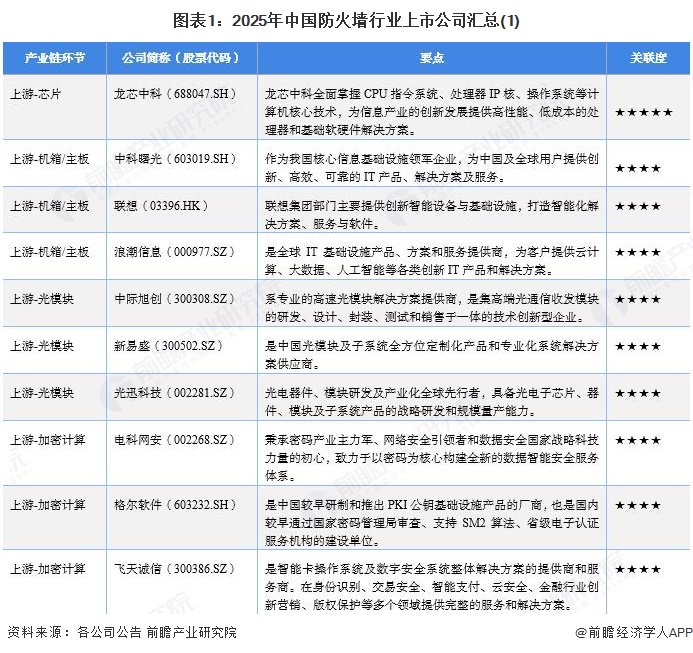
Core Insights - The firewall industry in China is a critical component of the network security system, serving as the first line of defense for enterprises and individuals. The industry is characterized by a diverse range of listed companies, primarily concentrated in the upstream and midstream segments of the supply chain [1][5]. Group 1: Company Overview - Major companies in the firewall industry include Sangfor (300454.SZ), Tianrongxin (002212.SZ), Hillstone Networks (688030.SH), Deepin Technology (300768.SZ), Ruijie Networks (301165.SZ), Venustech (002439.SZ), Qihoo 360 (688561.SH), and NSFOCUS (300369.SZ) [1]. - The highest revenue in the firewall industry for 2024 is projected to be from Lenovo, with revenue reaching 114.77 billion yuan, followed closely by Inspur with the same revenue figure [4]. - The registered capital is highest for NSFOCUS, while Tianrongxin is the oldest company in the industry. Ruijie Networks has the most bidding information, totaling 7,141 entries [8]. Group 2: Revenue and Profitability - In terms of revenue from firewall-related business, Sangfor is expected to generate 3.629 billion yuan in 2024, ranking second in the domestic market for unified threat management. Qihoo 360 follows with an expected revenue of 2.653 billion yuan [9]. - The gross profit margin for representative companies in the firewall industry is projected to be around 60% in 2024, with Sangfor achieving the highest margin at 79.31% and Hillstone Networks at 71.97% [11]. Group 3: Business Layout - The firewall business layout of listed companies shows a combination of regional focus and nationwide outreach, with technological innovation and scenario deepening being key characteristics. Sangfor focuses on South China, covering over 30 countries and regions, while Qihoo 360 is centered in Beijing, targeting government and state-owned enterprises [13][15]. - Companies like Tianrongxin and Venustech are also focusing on specific sectors such as industrial internet and government services, respectively, to enhance their market presence [15]. Group 4: Business Planning - Future business plans for firewall companies emphasize technological iteration and scenario deepening. Sangfor aims to integrate network security with cloud computing and transition to a subscription model by 2026 [17]. - Qihoo 360 plans to allocate 25% of its R&D budget to encryption firewall research, while Tianrongxin is focusing on smart solutions for industrial firewalls [17].


信安世纪:已在现有防火墙、数据加解密等产品中加入AI内生安全防护手段
Ge Long Hui· 2026-01-22 08:18
Core Viewpoint - The company is actively addressing AI-related security risks, including model theft, data poisoning, and data privacy breaches, by enhancing its existing security products with AI-driven protective measures [1] Group 1: AI Security Risks - The company is monitoring various AI internal security risks such as model theft, training data poisoning, and data privacy leakage [1] - The company has integrated AI internal security protection measures into its existing firewall and data encryption products [1] Group 2: Solutions Offered - The company provides corresponding solutions on the AI application side, including authorization management, identity authentication, and enterprise data leakage prevention [1]

信安世纪(688201.SH):已在现有防火墙、数据加解密等产品中加入AI内生安全防护手段
Ge Long Hui· 2026-01-22 08:12
Core Viewpoint - The company is actively monitoring AI-related security risks such as model theft, training data poisoning, and data privacy breaches, and has integrated AI security measures into its existing products [1] Group 1: AI Security Measures - The company has added AI security protection methods to its current firewall and data encryption products [1] - The company provides solutions for authorization management, identity authentication, and enterprise data leakage prevention on the AI application side [1]
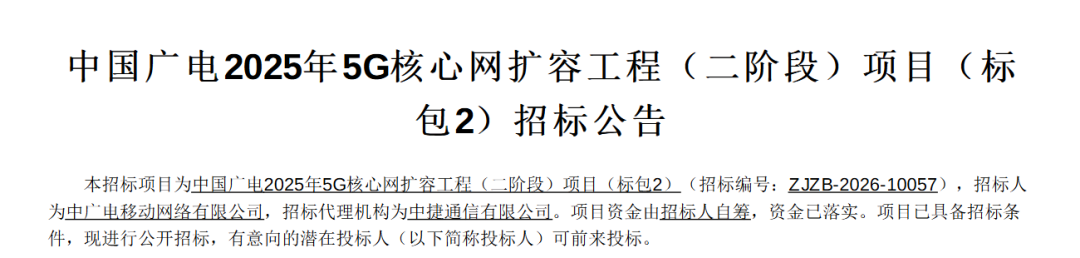
涉及金额超1900万,中国广电2025年5G核心网扩容(二阶段)标包2、3启动招标
Xin Lang Cai Jing· 2026-01-19 13:17
Core Insights - China Broadcasting Network announced the tender for the 5G core network expansion project, divided into three packages [1][7] Package Summaries - Package 2 (Simulation Testing System): The procurement budget is 4.24 million yuan (excluding tax) and 4.8 million yuan (including tax) for a supplier to provide related equipment and integrated engineering services [1][7] - Package 3 (Data Communication Equipment): The procurement budget is 12.62 million yuan (excluding tax) and 14.26 million yuan (including tax) for a supplier to provide routers, switches, and firewalls along with integrated engineering services [2][8] - Package 1 (Core Network and Network Cloud): Previous tenders on November 24 and December 3, 2025, had a budget of 552.64 million yuan (excluding tax) and 624.48 million yuan (including tax). Both tenders failed due to insufficient bidders [3][9]
2025年全球防火墙行业市场发展现状——需求稳步增长【组图】
Qian Zhan Wang· 2026-01-14 08:17
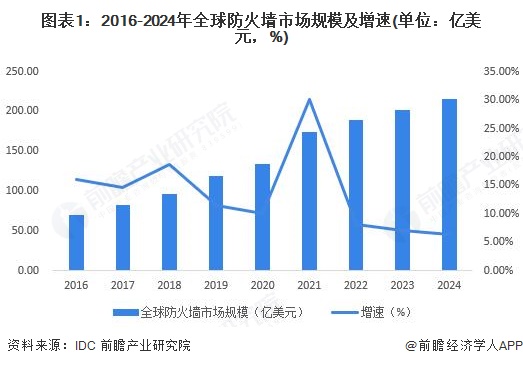
Global Firewall Market Overview - The global firewall market is projected to grow from $6.924 billion in 2016 to $22.415 billion by 2024, with a peak growth rate of 30.03% in 2021 due to increased demand for cybersecurity solutions amid the pandemic [1] - The surge in demand is attributed to the need for businesses to upgrade or acquire firewall devices to protect against cyber threats and secure internal data [1] Next-Generation Firewall Market Outlook - The global next-generation firewall market is expected to grow from $18.1 billion in 2024 to $21.8 billion by 2028, indicating a positive growth trend [2] - The U.S. market for next-generation firewalls, which is the largest globally, is projected to increase from $7.3 billion in 2024 to $9 billion by 2028, representing 40.3% of the global market share [5] Importance of Firewalls in Cybersecurity - Firewalls are considered a fundamental necessity in network security, serving as the first line of defense for end-users [6] - According to IDC's 2024 global survey, 53.4% of customers believe that hardware firewall products will account for more than half of their overall security solutions by 2030 [6][8] Future Growth Projections - The global firewall market is anticipated to have a compound annual growth rate (CAGR) of 10.41% from 2025 to 2030, with the market size expected to reach approximately $23.8 billion in 2025 and $39 billion by 2030 [9]