
风险回报比

Search documents
麦格理:升吉利汽车目标价至24港元 季绩稳固 维持行业首选
Zhi Tong Cai Jing· 2026-03-20 03:01
Core Viewpoint - Macquarie's research report indicates that Geely Automobile's Q4 2025 performance is solid, with sales and net profit exceeding market expectations by 5% and 10% respectively, driven by an improved luxury vehicle mix [2] Group 1: Financial Performance - Geely's sales guidance for 2026 is maintained at 3.45 million units, representing a year-on-year growth of 14% [2] - Adjusted net profit forecast for Geely for the current year is raised by 6% to RMB 19.3 billion [2] Group 2: Market Position - Macquarie has raised Geely's target price by 4.3%, from HKD 23 to HKD 24, which corresponds to a projected P/E ratio of 12 times for 2026 [2] - In the Greater China region, Macquarie believes Geely offers the best risk-reward ratio among Chinese automotive stocks and maintains it as their industry preferred stock [2] Group 3: Sales Strategy - Management reiterated the overseas sales target for 2026 at 640,000 units, with an internal challenge target close to 750,000 units [2]

ZFX山海证券:比特币风险回报比失衡
Xin Lang Cai Jing· 2026-01-23 10:26
Core Viewpoint - The investment sentiment in the digital asset market is facing severe challenges, with Bitcoin's returns failing to cover the risks associated with its volatility, as indicated by a negative Sharpe Ratio [1][3]. Group 1: Market Conditions - The current situation mirrors characteristics seen during market crashes in 2018 and 2022, where a negative Sharpe Ratio indicates that Bitcoin's excess returns do not compensate for its volatile price movements [4]. - Bitcoin has dropped from a historical high of over $120,000 in early October to around $90,000, reflecting a significant decline with weak rebounds during the pullback [4]. - Despite some social media claims that a negative Sharpe Ratio signals severe overselling and an impending rebound, it is viewed as a reflection of past market conditions rather than a predictive leading indicator [4]. Group 2: Historical Context and Future Outlook - Historical data shows that during the prolonged bear market of 2022, the negative Sharpe Ratio persisted for several months even after prices stopped declining sharply, indicating a lag in market recovery [2][4]. - The attractiveness of cryptocurrencies in current asset allocations is diminishing, as Bitcoin's performance has lagged behind traditional safe-haven assets like gold, global bonds, and major tech stocks [5]. - In the absence of clear bullish catalysts, a stable and sustained recovery of the Sharpe Ratio to positive territory is necessary to confirm a structural improvement in risk-return dynamics, which would provide a basis for large capital re-entry [5]. - Investors are advised to remain highly cautious and focus on definitive signals of technical indicator recovery, rather than seeking short-term rebounds amid volatility [5].


美股被特朗普新闻搞得七上八下!高盛:经济有支撑,但别追涨要抄底
Hua Er Jie Jian Wen· 2026-01-22 06:54
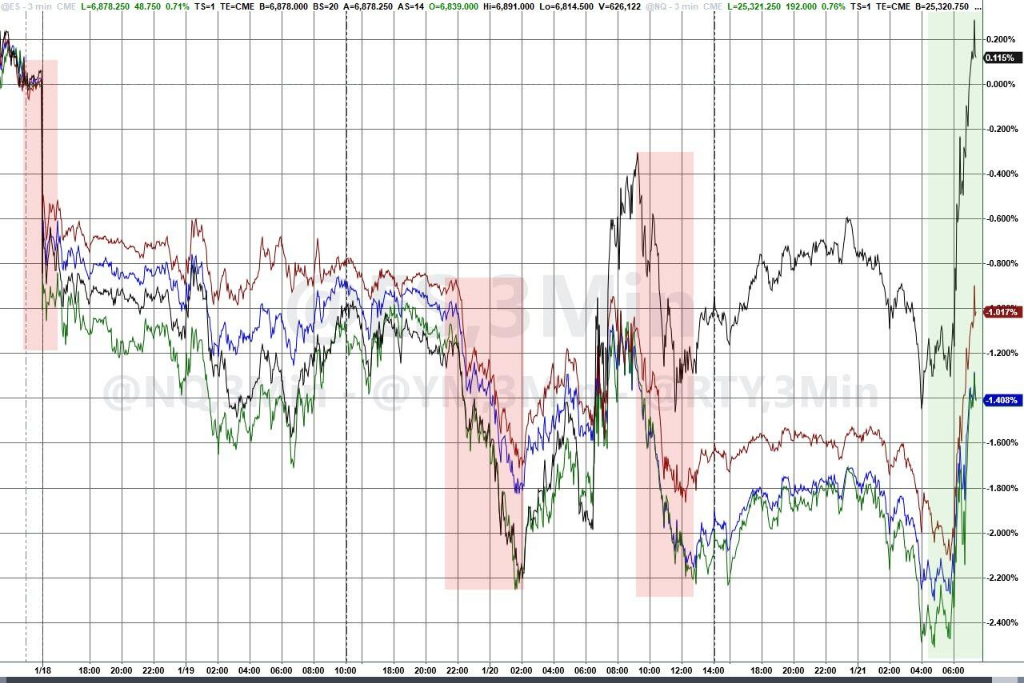
Core Viewpoint - Goldman Sachs' hedge fund coverage head, Tony Pasquariello, asserts that despite short-term volatility and crowded investor positions, the U.S. economic fundamentals are strong, and the macro outlook is "essentially favorable" for the stock market, advocating for a strategy of buying on dips rather than chasing rallies [1][9]. Market Sentiment and Volatility - Market sentiment has shifted dramatically from euphoria to anxiety since January, with the S&P 500 index volatility at only 6% and the MOVE index at multi-year lows before recent changes [1][4]. - The transition from extreme calm to volatility is highlighted as a typical case for January, with significant geopolitical and technological changes causing rapid market reactions [4]. Investor Positioning - Investor positioning is at historical highs, with both retail and institutional investors increasing risk exposure across various metrics, including individual stocks and index futures [3][7]. - The American Association of Individual Investors (AAII) sentiment survey indicates that investor optimism has reached its highest level since November 2024 [3][7]. Economic Fundamentals - Despite short-term disruptions, the core elements supporting the market include accelerating U.S. economic growth and increased liquidity from the Federal Reserve, which are key macro drivers for the stock market in the medium term [3][8]. - Recent economic data shows positive trends, such as the ISM services index rising to 54.4, initial jobless claims dropping to 198,000, and various housing indicators stabilizing [8]. Investment Strategy - The recommended investment strategy is to adopt a "cautiously bullish" stance, focusing on buying on dips rather than chasing prices higher, as the macro outlook supports the stock market but current risk-reward ratios are challenging [9]. - The market faces contradictions between short-term disturbances, such as tariff news and global bond market volatility, and medium-term benefits from U.S. economic acceleration and improved liquidity [9].
国泰海通:特朗普扰动地缘政治局势,建议超配黄金
Sou Hu Cai Jing· 2026-01-19 13:18
Core Viewpoint - The Trump administration's implementation of hegemonic policies has led to further deterioration of international geopolitical situations, which is favorable for gold performance. Tactical overweighting of A/H shares, US stocks, and gold is recommended, while underweighting US bonds and oil is advised [1]. Group 1: Asset Performance and Allocation Insights - Multiple factors support the performance of Chinese equities, suggesting an overweight in A/H shares. The upcoming economic work conference and the start of the 14th Five-Year Plan in 2026 are expected to lead to further expansion of the broad deficit and more proactive economic policies. The Fed's expected rate cut in December and the stable appreciation of the RMB provide favorable conditions for monetary easing in early 2026 [2][8]. - The uncertainty surrounding the new Fed chairperson has increased market speculation regarding US monetary policy, suggesting an underweight in US bonds. The cooling labor market, declining energy prices, and slow wage growth are conducive to a decrease in endogenous inflation stickiness, allowing for more flexibility in Fed policy adjustments. The resilience of the US economy may lead to a cautious direction in Fed policy guidance, with US bond yields expected to decline moderately [2][8]. - In the context of geopolitical upheaval, gold exhibits strong resilience and safe-haven attributes, recommending an overweight in gold. The rising uncertainty in global geopolitical situations and continued central bank purchases of gold support a long-term price floor for gold. Despite speculative inflows temporarily increasing gold volatility, the price remains resilient amid the Trump administration's hegemonic policies and the erosion of US international credibility [2][8]. Group 2: Recent Important Events Review - The uncertainty regarding the Fed chair candidates has risen again, with Trump indicating that Kevin Hassett may remain in his position. This could impact market expectations for monetary policy [6][7]. - Trump's imposition of tariffs on eight European countries and the push for the purchase of Greenland has escalated geopolitical tensions, significantly undermining US international credibility and reflecting hegemonic behavior [6][7]. Group 3: Tactical Asset Allocation Recommendations - The recommendation to overweight A/H shares is based on multiple supportive factors for Chinese equities, including anticipated proactive economic policies and favorable monetary conditions [9]. - An underweight in US bonds is advised due to the increasing uncertainty surrounding the new Fed chairperson and the relatively low risk-return ratio compared to risk assets [9]. - Gold is recommended for overweighting due to its strong resilience and safe-haven characteristics amid rising geopolitical uncertainties [9].

分析师:iPhone 需求趋向疲软,苹果股价恐怕涨不动了
Xin Lang Ke Ji· 2025-11-26 07:33
Core Viewpoint - Apple stock has reached a new high, but analysts express concerns about potential cooling demand for iPhones and slowing growth in the services sector [1][2] Group 1: Analyst Ratings and Market Sentiment - UBS Group AG downgraded Apple stock from "Buy" to "Neutral," marking the lowest percentage of analysts recommending "Buy" at 67% since the end of 2020 [1] - The number of analysts giving optimistic ratings to Apple has decreased to the lowest level in over two years, indicating a shift in market sentiment [1] Group 2: Financial Performance and Projections - Apple's stock price has surged 41% this year, reaching $183.77, but analysts doubt there will be new catalysts to drive further price increases in the near term [1] - UBS analyst David Vogt raised Apple's target price from $180 to $190, which represents only a 3% increase from the recent closing price [2] - The report highlights that Apple's price-to-earnings ratio is approximately 29, the highest in nearly a decade, and about 50% higher than the market average [2] Group 3: Demand Concerns - There are expectations that demand for iPhones and Macs may face pressure in the second half of the year, alongside a slowdown in growth for the services segment, including the App Store and Apple Music [1][2] - The report suggests that from a risk-reward perspective, Apple stock may not be very attractive over the next 6 to 12 months due to anticipated weaknesses in iPhone, PC, and App Store performance [2]

大摩:认为吉利汽车(00175)在未来15天内股价上升
智通财经网· 2025-11-19 02:01
Core Viewpoint - Morgan Stanley predicts that Geely Automobile's stock price will rise in absolute terms over the next 15 days due to recent trading weakness making short-term valuations more attractive [1] Financial Performance - Geely's net profit for Q3 reached 3.8 billion RMB, with a gross margin of 16.6%, an improvement from 16.4% in the first half of the year [1] - The company's core earnings for the first three quarters totaled 10.6 billion RMB, with a target of achieving 15 billion RMB for the full year [1] Valuation and Market Outlook - Morgan Stanley considers the current consensus price-to-earnings ratio of 9 times for the next 12 months attractive compared to the two-year average of 10 to 11 times, indicating a favorable risk-reward ratio [1] - The probability of achieving this scenario is estimated at 70% to 80%, which is classified as "very likely" [1] - The firm maintains an "overweight" rating with a target price of 24 HKD [1]
大行评级丨大摩:吉利汽车股价未来15天内将上涨 目标价24港元
Ge Long Hui· 2025-11-18 08:14
Core Viewpoint - Morgan Stanley believes that Geely Automobile's stock price will rise in absolute terms over the next 15 days, with an estimated probability of 70% to 80% for this scenario to materialize, maintaining an "Overweight" rating and a target price of HKD 24 [1] Financial Performance - The company's net profit for the third quarter reached CNY 3.8 billion, with a gross margin of 16.6%, which is an improvement over the first half's 16.4% [1] - For the first three quarters, core earnings amounted to CNY 10.6 billion, and the company is still on track to achieve its annual target of CNY 15 billion [1] Valuation and Market Outlook - Considering the strong product planning for 2026, Morgan Stanley views the current consensus price-to-earnings ratio of 9 times for the next 12 months as providing an attractive risk-reward ratio compared to the two-year average of 10 to 11 times [1]
高位震荡时如何投资?“局部牛”中重温彼得·林奇1997年访谈︱重阳荐文
重阳投资· 2025-09-22 07:32
Core Viewpoint - The article emphasizes the investment philosophy of Peter Lynch, highlighting the importance of understanding the companies one invests in, maintaining a long-term perspective, and being aware of valuation boundaries and risk-reward ratios [10][12][13]. Group 1: Investment Principles - Lynch advocates for "common-sense investing," where investors should first understand how a company makes money before assessing its stock price [10]. - He stresses the importance of a long-term view, believing that corporate earnings will be higher in ten or twenty years, which is the foundation for market growth [13][72]. - Historical data suggests that the reasonable valuation range for U.S. stocks is between 10 to 20 times earnings, with exceeding 20 times indicating accumulated risks [12][20]. - Lynch emphasizes the risk-reward ratio, suggesting that if an investment is correct, it should yield a return of one to two times the investment, while a wrong investment should only risk a loss of 30% to 40% [13][51]. Group 2: Market Insights - Lynch notes that market corrections are healthy, comparing them to a cleansing process that, while uncomfortable, benefits long-term health [12][23]. - He highlights that during market highs, risks do not disappear, and corporate earnings remain the ultimate support for stock prices [15][24]. - Lynch points out that many companies may be undervalued during market downturns, presenting opportunities for investors to find attractive stocks that are overlooked [25][47]. Group 3: Personal Investment Approach - Lynch encourages investors to focus on companies they understand, rather than chasing complex or trendy sectors [13][58]. - He shares that successful investing often involves researching lesser-known companies that may have strong fundamentals but lack attention from the market [27][59]. - Lynch advises that investors should be diligent in their research, akin to how they would approach purchasing a household item, ensuring they understand the financial health of the companies they invest in [30][61]. Group 4: Future Outlook - Lynch expresses optimism about the long-term growth of the market, asserting that new companies will continue to emerge and thrive [72][73]. - He acknowledges that while economic downturns are inevitable, they do not signal the end of investment opportunities, particularly in emerging markets [75][78]. - Lynch concludes that the focus should remain on identifying companies with solid fundamentals and growth potential, regardless of short-term market fluctuations [51][72].

高位震荡时如何投资?“局部牛”中重温彼得·林奇1997年访谈
聪明投资者· 2025-09-18 07:08
Core Viewpoint - The article emphasizes the investment philosophy of Peter Lynch, highlighting the importance of understanding businesses, maintaining a long-term perspective, and focusing on valuation metrics to make informed investment decisions [2][3][8]. Group 1: Investment Principles - Lynch advocates for "common-sense investing," where investors leverage their understanding of familiar industries rather than chasing market trends [3][8]. - He stresses the importance of understanding how a company makes money before assessing its stock price, suggesting that this approach leads to more rational investment decisions [4][5]. - Lynch identifies a reasonable valuation range for U.S. stocks, typically between 10 to 20 times earnings, and warns that exceeding this range indicates potential risk accumulation [5][8][16]. Group 2: Market Conditions and Reactions - During market volatility, Lynch advises investors to focus on companies whose fundamentals remain unchanged, even amidst economic downturns [10][46]. - He notes that market corrections can serve as a healthy reset, allowing investors to reassess valuations and identify buying opportunities in fundamentally sound companies [10][19][22]. - Lynch highlights the importance of recognizing that stock prices should ultimately be supported by company earnings, regardless of market fluctuations [20][34]. Group 3: Long-term Perspective - Lynch emphasizes the necessity of a long-term investment horizon, asserting that corporate earnings will generally increase over ten to twenty years, which underpins market growth [8][69]. - He encourages investors to concentrate on a few companies they thoroughly understand, rather than spreading themselves too thin across numerous stocks [55][62]. Group 4: Risk Management - Lynch discusses the risk-reward ratio, suggesting that successful investments should yield significant returns while limiting potential losses to a manageable level [9][46]. - He advises against investing in stocks that have already priced in all positive news, as these may not offer attractive risk-reward scenarios [47][48]. Group 5: Market Opportunities - Lynch points out that many smaller companies may present attractive investment opportunities that are often overlooked by the market, suggesting that diligent research can uncover hidden gems [22][24]. - He encourages investors to leverage their unique insights into local businesses or industries to identify potential investments that others may miss [60][62].

大摩:飞塔信息(FTNT.US)防火墙更新表现令人失望 下调评级与目标价
智通财经网· 2025-09-03 06:57
Core Viewpoint - Morgan Stanley downgraded Fortinet (FTNT.US) from "Hold" to "Underweight" and reduced the target price from $78 to $67 due to disappointing performance in firewall updates [1] Group 1: Company Performance - Morgan Stanley's analyst team, led by Meta Marshall, believes that Fortinet's strategy to add more products to its installed customer base will still be successful, but the smaller-than-expected scale of firewall updates may necessitate downward revisions of earnings forecasts for fiscal years 2026 and 2027, negatively impacting the stock price [1] - The analyst noted that despite the downgrade, Fortinet's free cash flow multiple remains in the low 20s, and after product updates, growth is expected to reach high single digits, indicating an unfavorable risk-reward ratio in the short term [1] Group 2: Management and Investor Sentiment - Investors are optimistic about the new management's ability to accelerate revenue growth, but this expectation has not yet been reflected in forecasts, and there remains uncertainty in the short term [1] - The new CEO took office at the end of last year, which may lead investors to grant some leeway in the short term [1] Group 3: Competitor Analysis - Despite downgrading Fortinet, Morgan Stanley maintains a "Hold" rating on its competitor Check Point Software Technologies (CHKP.US) [1]
