隔夜回购协议

Search documents
2025年最后一天,美联储悄悄送上“创纪录”跨年礼物
Sou Hu Cai Jing· 2026-01-02 04:09
Core Viewpoint - The Federal Reserve's recent liquidity injection of $16 billion through overnight repurchase agreements signals underlying pressures in the financial system, indicating a potential liquidity crisis despite a seemingly calm market [1][3][5]. Group 1: Federal Reserve Operations - On December 31, 2025, the Federal Reserve injected $16 billion into the banking system, bringing the total liquidity injected through repurchase operations in December to $40.32 billion, marking the second-largest liquidity operation since the COVID-19 crisis [3]. - The use of overnight repurchase agreements serves as a mechanism for the Federal Reserve to maintain control over short-term interest rates and prevent sudden liquidity shortages from causing interest rates to spike [5][7]. Group 2: Market Signals and Pressures - Key pressure signals include the secured overnight financing rate, which was at 3.77% on December 29, exceeding the interest rate paid on reserves by 12 basis points, indicating a liquidity shortage [7]. - Structural pressures arise from the Federal Reserve's quantitative tightening since 2022 and the U.S. Treasury's large-scale issuance of government bonds to address fiscal deficits, creating a risk of blockage in the monetary market [7]. Group 3: Internal Disagreements and Strategies - Within the Federal Reserve, there are differing opinions on how to respond to liquidity pressures, with some advocating for a standing repo facility while others prefer direct bond purchases to ensure market liquidity [9]. - The current approach of direct bond purchases is seen as necessary due to a perceived stigma around institutions seeking help from the Federal Reserve, leading to a more aggressive liquidity provision strategy [9]. Group 4: Future Outlook and Policy Shifts - The Federal Reserve has indicated plans for a "non-quantitative easing" reserve management strategy, potentially purchasing up to $220 billion in government bonds over the next 12 months, averaging about $40 billion per month [11]. - This shift in policy suggests a recalibration of monetary policy, with expectations that the Federal Reserve may increase its bond purchasing to approximately $45 billion per month starting January 2026 [11]. Group 5: Broader Economic Implications - The liquidity increase occurs in a context where the Federal Reserve's December meeting minutes show a consensus that further rate cuts depend on sustained inflation decline, with market expectations for the next rate cut pushed to at least March 2026 [13]. - The ongoing liquidity provision supports risk assets but is counterbalanced by high interest rates that may suppress economic growth, creating a complex dynamic that will influence global capital flows and individual investments [14][16].

融资市场警报拉响!华尔街警告美联储:坐视不管或重演2019年“钱荒” 危机
智通财经网· 2025-11-13 13:48
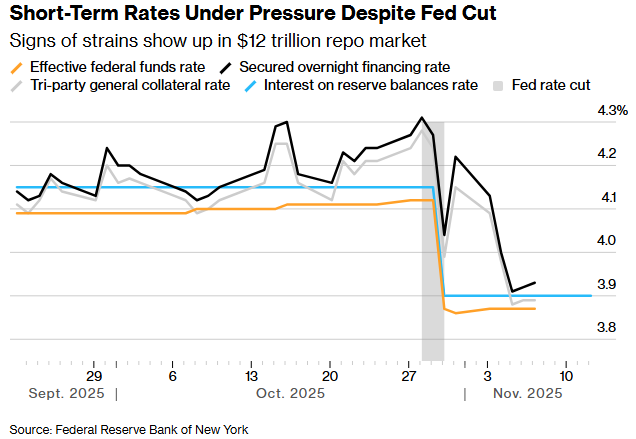
Core Viewpoint - The ongoing pressures in the $12 trillion short-term funding market are prompting calls for the Federal Reserve to take stronger actions to alleviate the situation, including increasing short-term market loans or directly purchasing securities [1][4]. Group 1: Market Pressures - Key short-term interest rates have remained high, including benchmark rates related to overnight repurchase agreements and the Federal Reserve's own policy target rate, which has risen four times in the past two months [1]. - The increase in U.S. Treasury issuance has drawn cash from the short-term market, leading to reduced funds in the banking system [4]. - The recent government shutdown has delayed federal spending that could have boosted liquidity, exacerbating the situation [4]. Group 2: Federal Reserve Actions - The Federal Reserve has indicated a potential adjustment in its balance sheet policy due to recent market pressures, with some investors believing that actions may be too slow to prevent reserve scarcity [1][4]. - New York Fed officials have suggested that rising financing costs signal that bank reserves are no longer abundant, indicating that the Fed may need to purchase assets soon [4]. - The Fed's recent decision to halt the reduction of Treasury holdings starting December 1 has not alleviated market pressures [4]. Group 3: Market Stability and Risks - The lack of sufficient liquidity could increase volatility and weaken the Fed's ability to control interest rate policies, potentially leading to broader impacts on the Treasury market [5]. - Historical context is provided by the 2019 incident where a key overnight rate surged to 10%, prompting the Fed to inject $500 billion into the financial system [5]. - Despite current market stability, there are concerns about year-end volatility as banks typically reduce repo market activity for regulatory purposes [6]. Group 4: Federal Reserve Officials' Perspectives - Cleveland Fed President expressed that some volatility in front-end rates is acceptable as long as they remain within a certain range, with current reserves at $2.85 trillion [9]. - Dallas Fed President indicated that if repo rates remain high, the Fed will need to purchase assets, emphasizing that the scale and timing of purchases should not be mechanical [10]. - Market participants are frustrated by the lack of clarity regarding the desired levels for money market rates and the overall control of the money market [10].