准备金充裕

Search documents
COMEX白银大幅走跌 会议纪要显对通胀担忧
Jin Tou Wang· 2025-12-31 03:29
Group 1 - The current trading price of COMEX silver is above $74.67, with a recent opening at $76.06 per ounce and a current price of $75.22, reflecting a decrease of 1.05% [1] - The highest price reached today was $76.28, while the lowest was $74.11, indicating a short-term bullish trend in the silver market [1] Group 2 - The meeting minutes indicate significant divergence among policymakers regarding which poses a greater risk to the U.S. economy: inflation or unemployment [2] - A majority of participants believe that adjusting to a more neutral policy stance will help prevent severe deterioration in the labor market [2] - Some participants emphasized the risk of persistent high inflation and cautioned that further rate cuts while inflation remains elevated could be misinterpreted as a reduced commitment to the 2% inflation target [2] - The minutes confirm that participants generally view reserve balances as having "dropped to ample levels," suggesting that initiating short-term Treasury purchases to maintain ample reserve supply is appropriate [2] - In 2026, the FOMC will see new regional Federal Reserve Bank presidents, and leadership changes are on the agenda, which may alter market expectations regarding the pace of interest rate cuts [2] - Traders currently anticipate 1-4 rate cuts in 2026, each by 25 basis points, providing clear trading opportunities for those able to accurately predict policy direction [2] Group 3 - Silver is approaching a critical resistance zone between $80 and $85, which is both a Fibonacci extension level and the upper boundary of a long-term channel [3] - A successful breakout accompanied by increased trading volume could lead to higher price targets; however, profit-taking is likely to occur in this range, increasing the probability of short-term corrections or consolidations [3] - If silver prices fall below $70, the market conditions may shift dramatically [3]
融资市场警报拉响!华尔街警告美联储:坐视不管或重演2019年“钱荒” 危机
智通财经网· 2025-11-13 13:48
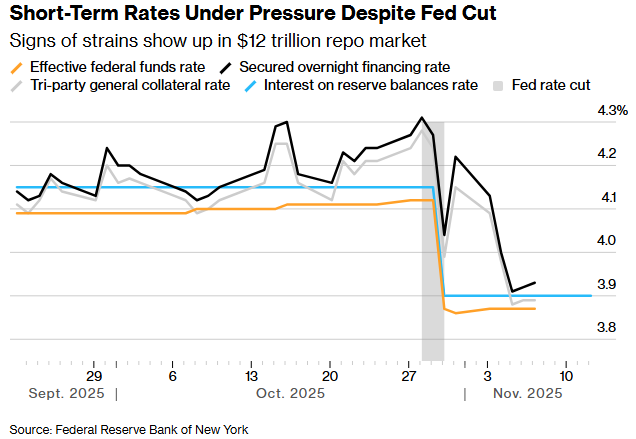
Core Viewpoint - The ongoing pressures in the $12 trillion short-term funding market are prompting calls for the Federal Reserve to take stronger actions to alleviate the situation, including increasing short-term market loans or directly purchasing securities [1][4]. Group 1: Market Pressures - Key short-term interest rates have remained high, including benchmark rates related to overnight repurchase agreements and the Federal Reserve's own policy target rate, which has risen four times in the past two months [1]. - The increase in U.S. Treasury issuance has drawn cash from the short-term market, leading to reduced funds in the banking system [4]. - The recent government shutdown has delayed federal spending that could have boosted liquidity, exacerbating the situation [4]. Group 2: Federal Reserve Actions - The Federal Reserve has indicated a potential adjustment in its balance sheet policy due to recent market pressures, with some investors believing that actions may be too slow to prevent reserve scarcity [1][4]. - New York Fed officials have suggested that rising financing costs signal that bank reserves are no longer abundant, indicating that the Fed may need to purchase assets soon [4]. - The Fed's recent decision to halt the reduction of Treasury holdings starting December 1 has not alleviated market pressures [4]. Group 3: Market Stability and Risks - The lack of sufficient liquidity could increase volatility and weaken the Fed's ability to control interest rate policies, potentially leading to broader impacts on the Treasury market [5]. - Historical context is provided by the 2019 incident where a key overnight rate surged to 10%, prompting the Fed to inject $500 billion into the financial system [5]. - Despite current market stability, there are concerns about year-end volatility as banks typically reduce repo market activity for regulatory purposes [6]. Group 4: Federal Reserve Officials' Perspectives - Cleveland Fed President expressed that some volatility in front-end rates is acceptable as long as they remain within a certain range, with current reserves at $2.85 trillion [9]. - Dallas Fed President indicated that if repo rates remain high, the Fed will need to purchase assets, emphasizing that the scale and timing of purchases should not be mechanical [10]. - Market participants are frustrated by the lack of clarity regarding the desired levels for money market rates and the overall control of the money market [10].