有担保隔夜融资利率

Search documents
融资市场警报拉响!华尔街警告美联储:坐视不管或重演2019年“钱荒” 危机
智通财经网· 2025-11-13 13:48
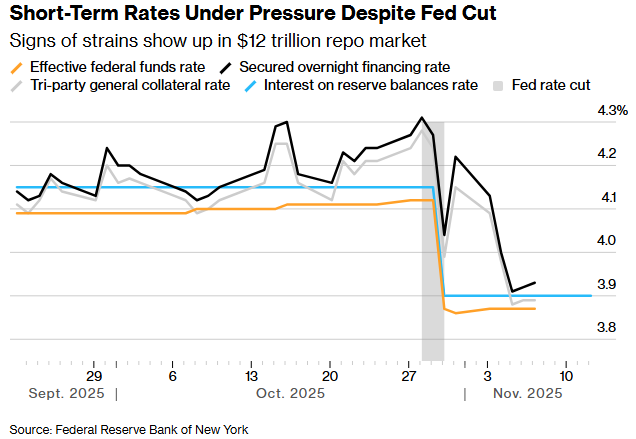
Core Viewpoint - The ongoing pressures in the $12 trillion short-term funding market are prompting calls for the Federal Reserve to take stronger actions to alleviate the situation, including increasing short-term market loans or directly purchasing securities [1][4]. Group 1: Market Pressures - Key short-term interest rates have remained high, including benchmark rates related to overnight repurchase agreements and the Federal Reserve's own policy target rate, which has risen four times in the past two months [1]. - The increase in U.S. Treasury issuance has drawn cash from the short-term market, leading to reduced funds in the banking system [4]. - The recent government shutdown has delayed federal spending that could have boosted liquidity, exacerbating the situation [4]. Group 2: Federal Reserve Actions - The Federal Reserve has indicated a potential adjustment in its balance sheet policy due to recent market pressures, with some investors believing that actions may be too slow to prevent reserve scarcity [1][4]. - New York Fed officials have suggested that rising financing costs signal that bank reserves are no longer abundant, indicating that the Fed may need to purchase assets soon [4]. - The Fed's recent decision to halt the reduction of Treasury holdings starting December 1 has not alleviated market pressures [4]. Group 3: Market Stability and Risks - The lack of sufficient liquidity could increase volatility and weaken the Fed's ability to control interest rate policies, potentially leading to broader impacts on the Treasury market [5]. - Historical context is provided by the 2019 incident where a key overnight rate surged to 10%, prompting the Fed to inject $500 billion into the financial system [5]. - Despite current market stability, there are concerns about year-end volatility as banks typically reduce repo market activity for regulatory purposes [6]. Group 4: Federal Reserve Officials' Perspectives - Cleveland Fed President expressed that some volatility in front-end rates is acceptable as long as they remain within a certain range, with current reserves at $2.85 trillion [9]. - Dallas Fed President indicated that if repo rates remain high, the Fed will need to purchase assets, emphasizing that the scale and timing of purchases should not be mechanical [10]. - Market participants are frustrated by the lack of clarity regarding the desired levels for money market rates and the overall control of the money market [10].

KVB外汇:中期内利率降至零的风险不可忽略
Sou Hu Cai Jing· 2025-07-08 01:23
Core Insights - Federal Reserve researchers, including New York Fed President John Williams, concluded that the Fed cannot assume its benchmark interest rate will remain far from zero in the future [1][3] - There is a 9% probability that the federal funds rate will hit the "zero lower bound" in the next seven years, with current rate uncertainty exacerbating this risk [3][4] - The analysis indicates that market expectations regarding interest rates are the primary driver of fluctuations in the zero lower bound risk [4] Interest Rate Projections - The probability of rates returning to zero in the next two years is only 1%, with historical context showing rates were at 0% to 0.25% during the 2008 financial crisis and again during the COVID-19 pandemic [5] - From March 2022 to July 2023, the Fed raised rates 11 times, bringing the target range to 5.25% to 5.5%, significantly distancing from the zero lower bound [5] - Currently, the Fed has maintained rates between 4.25% and 4.5% since September of the previous year, with discussions ongoing about potential rate cuts [5] Market Reactions and Predictions - Former Fed Governor Kevin Warsh expressed sympathy for the President's frustration with the Fed's current rate policy, suggesting that rates should be lowered further [6] - Goldman Sachs economists predict a likelihood of rate cuts in September, citing smaller-than-expected impacts from tariff policies and stronger deflationary forces [6][7] - Goldman Sachs has adjusted its forecast for the terminal federal funds rate down to 3% - 3.25%, still above the zero lower bound, while maintaining a long-term view on neutral rates and economic conditions [7]