
飞书AI功能

Search documents
飞书谢欣:财务预算可能成为企业AI落地阻力,建议从ROI思维转变升级为COI思维
Xin Lang Cai Jing· 2026-01-18 10:25
Core Viewpoint - The CEO of Feishu emphasizes that in the AI era, "function does not equal effect," highlighting the need for a maturity rating system (M1-M4) for AI products to aid user selection [1][18]. Group 1: AI Product Selection - The selection criteria for AI products should shift from merely comparing functionalities to evaluating the effectiveness of those functionalities [5][22]. - Feishu has introduced a maturity concept (M1-M4) to categorize AI product capabilities, where M1 represents very immature products and M4 indicates highly mature products applicable in most scenarios [23][25]. - The company aims to label all AI features with maturity indicators to help users understand their effectiveness [8][25]. Group 2: Barriers and Drivers for AI Implementation - The main barriers to AI adoption within companies are often found in departments responsible for financial oversight and risk management, which tend to be cautious about new technologies [10][28]. - The concept of COI (Cost of Inaction) is proposed as a new perspective for financial departments, encouraging them to consider the potential losses from not investing in AI rather than just focusing on ROI [11][29]. - Employees who are enthusiastic about AI adoption are often not limited to technical roles; they can be found across various departments, driven by personal interest rather than technical expertise [26][32]. Group 3: Embracing AI Across the Organization - To foster a culture of AI adoption, companies should encourage participation from all employees, not just management, through initiatives like the "AI Efficiency Pioneer" competition [14][34]. - Feishu has successfully engaged over 50,000 employees in AI initiatives through various competitions, demonstrating the importance of grassroots involvement in AI implementation [32][34]. - The company advocates for a unified approach where all levels of the organization actively participate in embracing AI technologies [16][34].


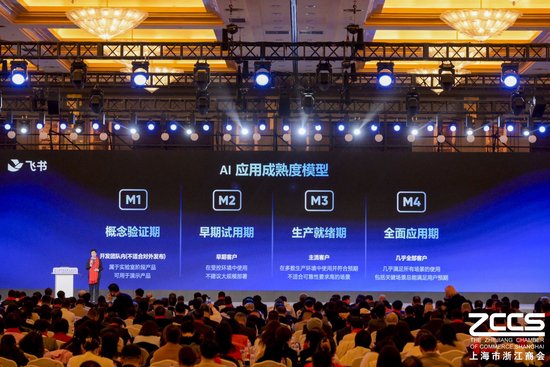
飞书谢欣呼吁以M1-M4来标记AI功能成熟度,方便用户选择产品
Xin Lang Cai Jing· 2026-01-18 10:20
Core Insights - The core message emphasizes that in the AI era, "function does not equal effect," highlighting the gap between advertised capabilities and actual performance of AI products [1][18] - The speaker advocates for a maturity model (M1-M4) to help users assess AI product effectiveness, rather than just functionality [1][18] Group 1: AI Product Selection - In the AI era, the criteria for selecting software should shift from functionality to effectiveness, as most AI products have similar functionalities but differ significantly in their performance outcomes [5][22] - The maturity model proposed categorizes AI functionalities into M1 (immature) to M4 (mature), with M3 indicating that a product is usable in most scenarios [23][25] - Companies should label AI functionalities with maturity indicators to assist consumers in making informed choices [25] Group 2: Barriers and Drivers for AI Adoption - The main resistance to AI implementation often comes from risk management and finance departments, which prioritize risk avoidance over innovation [10][28] - Employees who are willing to embrace AI are not limited to technical roles; individuals from various departments, including non-technical ones, can drive AI initiatives [26][32] - A shift in mindset from ROI (Return on Investment) to COI (Cost of Inaction) is necessary for finance departments to understand the long-term implications of not investing in AI [11][29] Group 3: Strategies for Embracing AI - To foster a culture of AI adoption, companies should encourage participation from all employees, not just management, creating initiatives like "AI efficiency champions" to promote engagement [14][34] - The company has successfully organized over 500 competitions, identifying more than 50,000 efficiency champions and developing over 160,000 systems across various enterprises [32][34] - The emphasis is on aligning the entire organization towards AI adoption, ensuring that all levels of staff are actively involved in the process [16][34]