ROI思维

Search documents
飞书谢欣:财务预算可能成为企业AI落地阻力,建议从ROI思维转变升级为COI思维
Xin Lang Cai Jing· 2026-01-18 10:25
Core Viewpoint - The CEO of Feishu emphasizes that in the AI era, "function does not equal effect," highlighting the need for a maturity rating system (M1-M4) for AI products to aid user selection [1][18]. Group 1: AI Product Selection - The selection criteria for AI products should shift from merely comparing functionalities to evaluating the effectiveness of those functionalities [5][22]. - Feishu has introduced a maturity concept (M1-M4) to categorize AI product capabilities, where M1 represents very immature products and M4 indicates highly mature products applicable in most scenarios [23][25]. - The company aims to label all AI features with maturity indicators to help users understand their effectiveness [8][25]. Group 2: Barriers and Drivers for AI Implementation - The main barriers to AI adoption within companies are often found in departments responsible for financial oversight and risk management, which tend to be cautious about new technologies [10][28]. - The concept of COI (Cost of Inaction) is proposed as a new perspective for financial departments, encouraging them to consider the potential losses from not investing in AI rather than just focusing on ROI [11][29]. - Employees who are enthusiastic about AI adoption are often not limited to technical roles; they can be found across various departments, driven by personal interest rather than technical expertise [26][32]. Group 3: Embracing AI Across the Organization - To foster a culture of AI adoption, companies should encourage participation from all employees, not just management, through initiatives like the "AI Efficiency Pioneer" competition [14][34]. - Feishu has successfully engaged over 50,000 employees in AI initiatives through various competitions, demonstrating the importance of grassroots involvement in AI implementation [32][34]. - The company advocates for a unified approach where all levels of the organization actively participate in embracing AI technologies [16][34].



用AI两年半,我常用到的12个思维模型
Hu Xiu· 2025-06-16 06:40
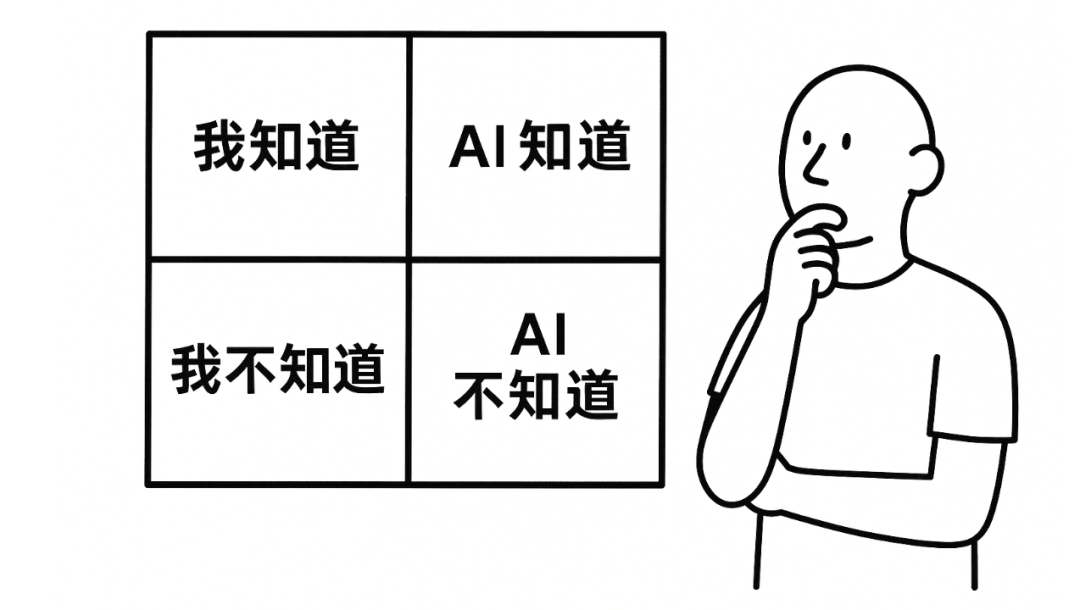
Core Insights - The article discusses the transformative impact of AI, particularly ChatGPT, on business and entrepreneurship, highlighting the importance of strategic thinking and problem-solving models in leveraging AI for growth [2][4][70]. Group 1: Discovering Problems - Many AI experiments fail not due to technical limitations but because of incorrect problem identification [8]. - The Johari Window model helps in understanding boundaries and expectations, revealing opportunities in the "AI doesn't know" quadrant [9][10]. - Emphasizing the need to respect the "I don't know" quadrant to avoid repeated investments based on false assumptions [12]. Group 2: Problem Decomposition - The Pyramid Principle and MECE framework are essential for structured problem decomposition, ensuring clarity and comprehensive coverage [28][30]. - The principle of Occam's Razor suggests prioritizing the simplest solution to avoid over-engineering [34][36]. - First Principles thinking encourages breaking down problems to their core elements for innovative solutions [39][41]. Group 3: Validation and Iteration - The MVP (Minimum Viable Product) approach advocates for quickly launching prototypes to gather user feedback and iterate based on data [49][51]. - Iterative thinking involves a cycle of prompt, output, review, and refinement to achieve optimal results [54][56]. - ROI (Return on Investment) awareness is crucial for understanding costs and benefits, emphasizing the importance of time and opportunity costs in decision-making [64][66].