骁龙8 Elite Gen2

Search documents
国产手机,为什么越卖越贵?
创业邦· 2026-03-30 04:15
Core Viewpoint - The article discusses the significant price increase of Chinese smartphones, which is not merely a result of greed or cost transfer, but rather a complex interplay of technology, brand narrative, user segmentation, global compliance, and geopolitical competition [61][64]. Group 1: Price Increase Trends - Major Chinese smartphone brands like vivo, Xiaomi, and OPPO are raising prices across all segments, with flagship models starting at 4399 yuan for vivo and 4499 yuan for Xiaomi [6][8]. - The price increase is described as a silent revolution, moving from high-end models to all price ranges, reflecting a shift in the market dynamics [5][8]. - Consumers express frustration over rising prices while simultaneously opting for installment plans, indicating a disconnect between income growth and smartphone pricing [10]. Group 2: Memory Chip Price Surge - The surge in memory prices is attributed to the dominance of Korean companies like SK Hynix, which have shifted their production focus to higher-margin products, leading to a supply crunch for standard DRAM and LPDDR [12][22]. - The BOM (Bill of Materials) cost for flagship smartphones is projected to increase from 18% in 2024 to 25% in 2026 due to rising memory costs [22]. - The competitive landscape has changed, with smartphone manufacturers losing bargaining power as suppliers tighten their pricing strategies [25]. Group 3: Display Technology Independence - Chinese display manufacturers like BOE are achieving technological parity with Samsung, marking a shift in the supply chain dynamics and reducing reliance on a single supplier [27][32]. - The introduction of advanced display technologies by domestic manufacturers allows smartphone brands to differentiate their products without being constrained by Samsung's supply terms [32]. - Although the cost of domestic displays is currently higher by 8%-12%, manufacturers are willing to pay for the security and independence it provides [32]. Group 4: Chipset Pricing and Self-Development - Qualcomm continues to increase prices for its chipsets, which has led to a growing concern among Chinese smartphone manufacturers about their dependency on a single supplier [38][39]. - The trend of self-developed chips is gaining momentum, with companies like Xiaomi and OPPO aiming to cover a significant portion of their flagship models with in-house solutions by 2026 [41][43]. - The strategy of gradually replacing high-cost components with self-developed alternatives is seen as a way to mitigate risks associated with reliance on external suppliers [44]. Group 5: Consumer Behavior and Market Dynamics - The average smartphone replacement cycle in China has extended from 24 months in 2019 to 30-36 months by 2026, prompting manufacturers to adjust their pricing strategies accordingly [49]. - Brands are leveraging AI capabilities to redefine the value proposition of smartphones, encouraging consumers to pay for "intelligence" rather than just hardware [50][66]. - The willingness of consumers to pay a premium for AI features indicates a shift in market expectations and the perceived value of smartphones [71]. Group 6: Future Implications - The ongoing price increases and shifts in technology are part of a broader social experiment regarding value perception in the smartphone market [73]. - The outcome of this experiment will determine which brands can sustain their presence in the market, particularly in the context of rising competition from domestic chip manufacturers and changing consumer preferences [74][75].




小米16大曝光,5款新机全部确认!
猿大侠· 2025-08-06 04:11
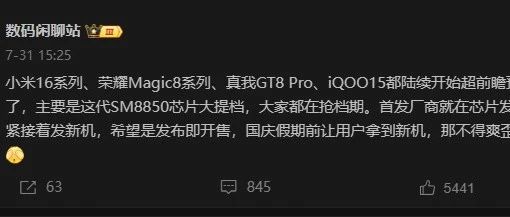
Core Viewpoint - Qualcomm is set to unveil the Snapdragon 8 Elite Gen2 processor at the Snapdragon Summit from September 23 to 25, 2025, which is expected to generate significant interest in the Android market [1][3]. Group 1: Qualcomm and Xiaomi Collaboration - Qualcomm will deepen its collaboration with Xiaomi, making Xiaomi the first manufacturer to launch a smartphone equipped with the Snapdragon 8 Elite chip [4]. - Xiaomi has consistently held the first-launch position for new Snapdragon processors in recent years, with the Xiaomi 16 series currently generating high interest [5]. Group 2: Xiaomi 16 Series Features - The Xiaomi 16 series will feature five models, including Xiaomi 16, Xiaomi 16 Pro, Xiaomi 16 Pro Max, Xiaomi 16 Ultra, and a special version of Xiaomi 16 Ultra with a magnetic external lens [6]. - The Xiaomi 16 and Xiaomi 16 Pro will have a 6.36-inch 1.5K display, while the Pro Max and Ultra will feature a larger 6.85-inch screen with Real RGB OLED technology [7]. - A classic secondary screen design may return in the Xiaomi 16 series, potentially measuring 3-4 inches to display notifications and other information [8][10]. Group 3: Performance Specifications - All models in the Xiaomi 16 series will be powered by the Snapdragon 8 Elite Gen2, built on TSMC's N3P process, featuring a second-generation self-developed Oryon CPU with a maximum clock speed of 4.6GHz and an Adreno 840 GPU [12]. - The expected AnTuTu benchmark score for the Snapdragon 8 Elite Gen2 is around 4 million [12]. Group 4: Camera Upgrades - The camera specifications vary across the models, with the Xiaomi 16 featuring a main camera upgrade to the OmniVision OV50Q sensor [16]. - The Xiaomi 16 Pro and Pro Max will have a main camera upgrade to the STMicroelectronics SC590XS sensor and will include a periscope telephoto lens with a 5x zoom [16]. - The Xiaomi 16 Ultra is expected to feature a one-inch main camera and a dual telephoto lens setup, with a new generation 200MP Samsung HPE sensor [17]. Group 5: Pricing and Release Timeline - There are no indications of a price increase for the Xiaomi 16 series, suggesting it will maintain the starting price of the previous generation [21]. - The expected launch date is approximately three days after the Snapdragon Summit, potentially allowing for availability before the National Day holiday in China [21].
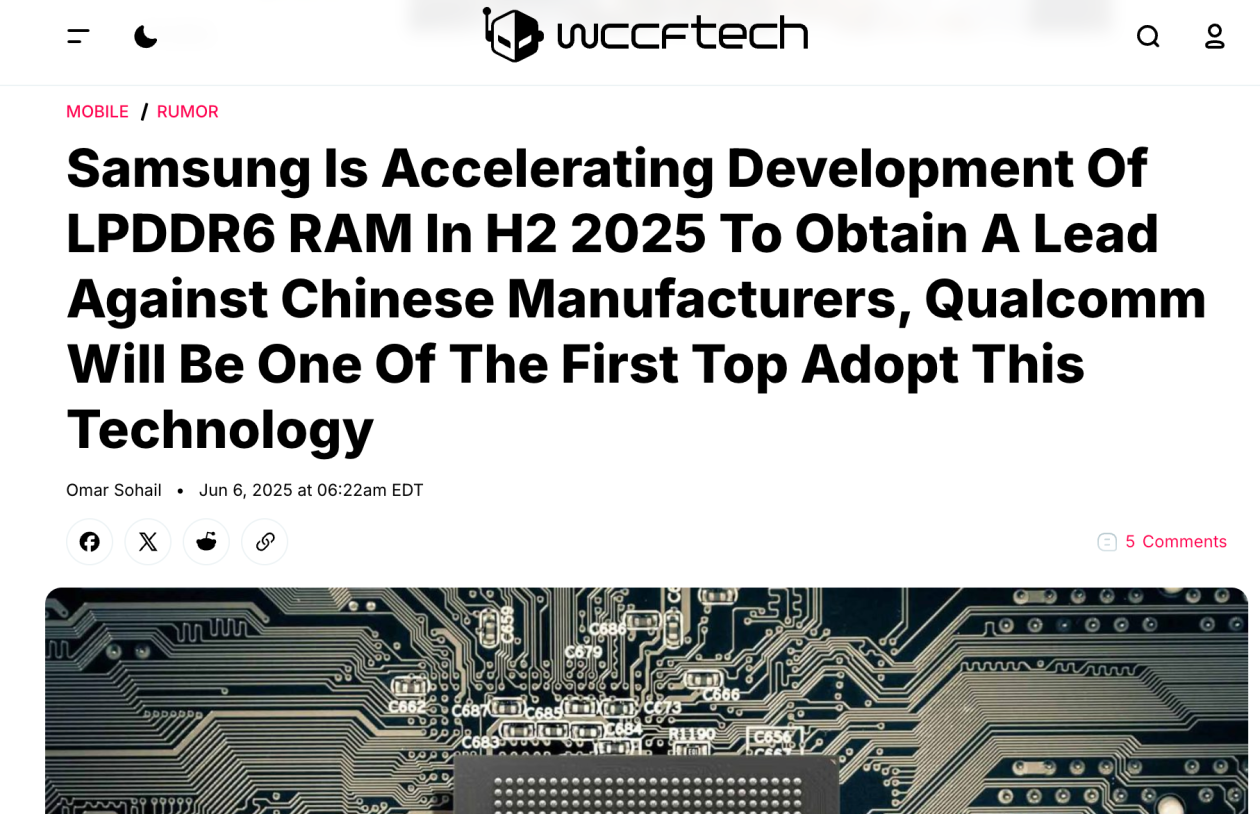
消息称三星加速1c DRAM工艺量产LPDDR6内存 计划下半年供货高通
Huan Qiu Wang· 2025-06-07 03:45
Group 1 - Samsung Electronics' Device Solutions (DS) division plans to mass-produce the next-generation LPDDR6 memory using the sixth-generation "1c DRAM" process in the second half of this year [1][3] - The 1c DRAM technology offers higher transistor density and better energy efficiency compared to previous generations, with cold yield rates reaching 50% and hot yield rates between 60%-70% [3][4] - Samsung aims to supply LPDDR6 memory to major tech companies like Qualcomm, enhancing its presence in the smartphone, laptop, and AI server markets [4] Group 2 - China’s Changxin Memory Technologies (CXMT) has completed the development phase of LPDDR5X memory and is working to close the technology gap with Samsung, potentially achieving mass production by 2026 [3] - Samsung is accelerating its LPDDR6 memory technology development in response to CXMT's advancements [3][4] - The upcoming Qualcomm Snapdragon 8 Elite Gen2 chip will be the first to support LPDDR6 memory, set to be unveiled at the Snapdragon Summit on September 23 [3] Group 3 - Samsung is also deploying 1c DRAM technology in high-end storage products like HBM4, aiming to create a comprehensive memory solution for AI applications [4] - The company has established an expansion plan for 1c DRAM, with production line construction in its Hwaseong factory expected to be completed by the end of this year [4] - Samsung is concurrently developing 1c DRAM for both DDR and LPDDR applications, breaking traditional development sequences to accelerate commercialization [4]