
高丰度低浓缩铀(HALEU)

Search documents
铀:正在形成的核能瓶颈与地缘政治压力点?
Hua Er Jie Jian Wen· 2025-09-25 02:53
Core Viewpoint - The global uranium market is at a critical turning point, facing supply reductions and soaring demand driven by nuclear energy revival and geopolitical tensions, potentially becoming a bottleneck for nuclear development and a pressure point in geopolitics [1] Group 1: Supply Challenges - The uranium market is experiencing severe supply challenges due to strategic production cuts by major producers. Kazatomprom plans to reduce its 2026 output by 10% to 77 million pounds, while Cameco has lowered its MacArthur River mine output from 18 million pounds to 13 million pounds [2] - Secondary supplies, which previously filled the gap, are rapidly depleting. The proportion of secondary supply from government inventories and re-enrichment has dropped from 50% in 2021 to about 15% by 2025, and is expected to decline further by 2030 [2] - Market balance is anticipated around 2028-2029, requiring higher prices to incentivize new greenfield projects, although there is currently no panic buying due to utilities in the US and EU holding about three years of inventory [2] Group 2: Demand Growth - Global uranium demand is projected to grow significantly, from 188 million pounds in 2025 to 230 million pounds by 2030, driven largely by China's nuclear power expansion [3] - China is leading a global nuclear power construction boom, with over 70 gigawatts of new capacity under construction, the highest level in 30 years, and more than 40 countries planning to expand nuclear energy's role [3] - New demand drivers include artificial intelligence and data centers, with companies like Meta and Amazon entering long-term agreements for nuclear power supply to support their operations [3] Group 3: Geopolitical Risks - A critical concern is the bottleneck in the enrichment stage, particularly the reliance on Russia. The demand for high-assay low-enriched uranium (HALEU) is expected to rise significantly, with global enrichment demand projected to grow from 50 million SWU annually to between 75 million and 100 million SWU by 2040 [4] - In 2023, Russia supplied over 25% of foreign-sourced enrichment, and potential disruptions post-2028 could create a shortfall of 15 to 20 million SWU in the market [4] Group 4: Investment Considerations - The US Congress has allocated $2.7 billion, supplemented by $700 million from the Inflation Reduction Act (IRA), to enhance domestic enrichment capacity, with Centris Energy aiming to produce 3.5 million SWU in Ohio [5] - The uranium supply is highly concentrated, with Kazakhstan accounting for about 40% and Canada for 20% of global supply by 2025. Future dynamics may shift as Kazakhstan's reserves deplete post-2030, while Canada’s position may strengthen with new projects [5] - Key catalysts for investors include announcements regarding US strategic uranium reserves, purchasing activities by financial institutions like Sprott and Yellowcake, further production cuts by producers, funding decisions from the US Department of Energy, and any news related to disruptions in Russian supply [5]
英美欲联手打造"核能黄金时代",加速“去俄化”
Di Yi Cai Jing· 2025-09-15 11:02
Group 1 - The core point of the news is the signing of the "Atlantic Advanced Nuclear Partnership" agreement between the UK and the US, aimed at accelerating the construction of new nuclear power plants and reducing the average licensing period from three to four years to two years [1][3] - The partnership is expected to create job opportunities, reduce household energy costs, and enhance energy security for both countries [1][3] - The UK government estimates that the transactions related to this nuclear cooperation will exceed £50 billion [3] Group 2 - Several American nuclear companies, including X-Energy and Holtec, will collaborate with UK firms to build small modular reactors (SMRs) and develop data centers powered by these reactors [3][4] - The UK government aims to eliminate its reliance on Russian nuclear materials by the end of 2028, with a specific agreement to supply high-assay low-enriched uranium (HALEU) for advanced reactors [4] - The global competition for nuclear fuel is expected to change as the UK and US work to reduce dependence on Russian supplies, with Kazakhstan and Canada being significant uranium resource countries [4] Group 3 - Potential agreements during Trump's visit include investments from major US financial companies totaling over £1.25 billion, which are expected to create 1,800 jobs in the UK [5] - Nvidia is anticipated to announce an investment in the UK's largest data center, with collaboration from OpenAI and Blackstone Group, highlighting the integration of energy, technology, and artificial intelligence [5] - Discussions around a waiver for Scottish whisky exports to the US, currently facing a 10% tariff, are also expected to be a topic of interest [5]

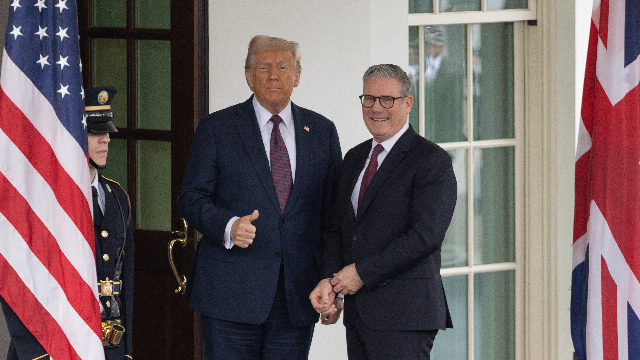
开启“核能黄金时代”,美英签署多项协议,美国核能企业大举进军英国
Hua Er Jie Jian Wen· 2025-09-15 01:35
Group 1 - The core point of the news is the announcement of a series of nuclear energy cooperation agreements between the US and the UK, which are expected to reshape the energy landscape across the Atlantic [1][2] - These agreements are set to be signed during President Trump's state visit to the UK from September 17 to 19, highlighting the importance of maintaining communication between the two governments [1] - UK Prime Minister Starmer stated that these commitments will lead the UK into a "golden age of nuclear energy," helping to lower household energy bills and create thousands of jobs in the short term [1] Group 2 - The agreements focus on expanding cooperation and simplifying the process for companies to build new nuclear power plants, with small modular reactors (SMRs) being a key focus [2] - US company X-energy plans to collaborate with UK Centrica to build up to 12 SMRs in Hartlepool, aiming to create a 6 GW power cluster across the UK [2] - The collaboration aims to eliminate dependence on Russian nuclear materials by the end of 2028, as Russia is currently the only producer of commercial high-assay low-enriched uranium (HALEU) [2]