高分辨率摄像头

Search documents
人形机器人成本结构巨变!半导体占比将激增至24%,聚焦“大脑+视觉+传感”三大核心赛道
Hua Er Jie Jian Wen· 2025-12-01 04:17
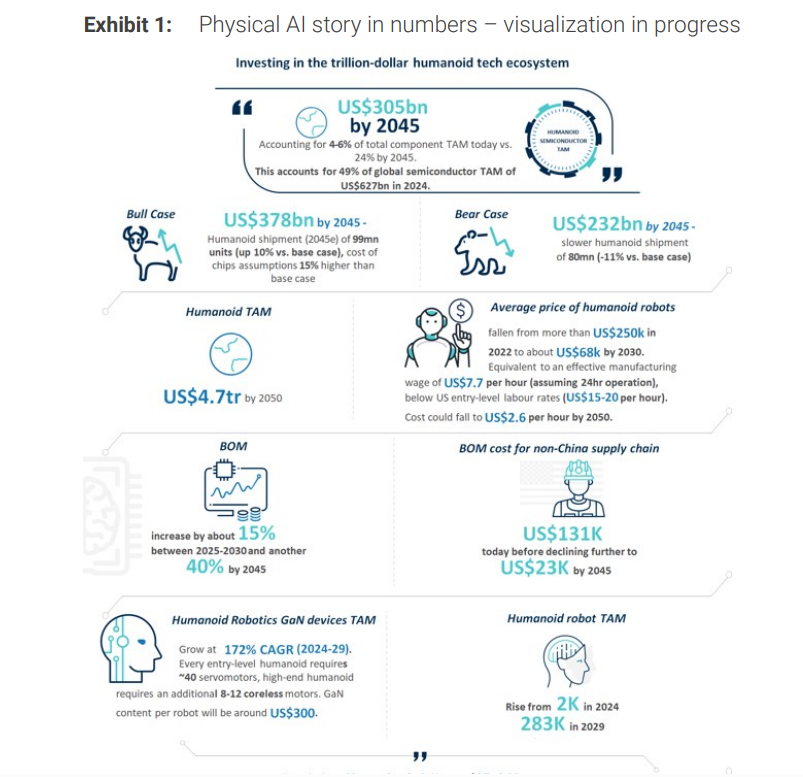
Core Insights - Humanoid robots are emerging as the next disruptive technology following generative AI, with a potential market size of $5 trillion by 2050 and a cumulative deployment of 1 billion units, equating to approximately one humanoid robot for every ten people [1][4]. Market Potential - The humanoid robot market is expected to experience slow penetration until 2035, followed by significant acceleration towards the end of the 2030s, driven by a complex ecosystem involving tech giants, startups, and traditional industrial players [2]. Cost Analysis - The average Bill of Materials (BOM) cost for a humanoid robot is projected to decrease from approximately $131,000 to $23,000 by 2045, making humanoid robots economically viable compared to the annual salaries of most workers in developed markets [3][5]. Semiconductor Role - Semiconductors are becoming increasingly critical in the value chain of humanoid robots, with the semiconductor market for humanoid robots expected to reach $305 billion by 2045, representing 49% of the global semiconductor Total Addressable Market (TAM) in 2024 [8]. Key Technologies - The report identifies three core areas for investment opportunities in humanoid robotics: 1. Brain Technology, which includes AI software and semiconductors [10] 2. AI Vision, which enables robots to interpret visual information [10] 3. Sensing Technology, which involves sensors that allow robots to perceive their environment [10]. Leading Companies - Morgan Stanley has identified a list of 25 leading companies in humanoid robotics, including Nvidia, Texas Instruments, Infineon, STMicroelectronics, Sony, and Samsung Electronics, which are expected to play pivotal roles in the market [11].