鲍鱼贷

Search documents
威海银行:践行“双碳”,绿色金融浇灌现代农业
Jin Rong Jie· 2026-01-16 07:04
Core Viewpoint - Weihai Bank is focusing on integrating "dual carbon" goals with rural revitalization, addressing challenges in ecological resource valuation and financing through innovative green financial products [1]. Group 1: Green Financial Products - Weihai Bank has developed a matrix of green financial products aimed at revitalizing ecological capital, including "carbon sink expected income right pledge loans" and "carbon emission right pledge loans" [1]. - The bank issued the first "marine shellfish carbon sink index insurance pledge loan" in the country, creating new pathways for realizing the value of blue ecological products [1]. - An innovative "biodiversity + sustainability-linked loan" has been introduced, linking interest rates to ecological targets, with a financing allocation of 10 million yuan for the Tianjin crab-rice symbiosis project [1]. Group 2: Inclusive Financial Services - Weihai Bank has promoted the "Green Agricultural Loan," providing 500 million yuan in support to nearly 1,000 farmers, with customized credit products for various agricultural products [1]. - Specific loans such as "garlic loan," "pepper loan," and "apple loan" have been tailored to cover a range of agricultural and marine products, supporting the development of marine specialty agriculture [1]. Group 3: Collaboration and Market Access - To lower financing barriers, Weihai Bank has deepened collaboration among "finance + banks + guarantees," promoting the "Huinong Loan" to convert policy benefits into rural development momentum [2]. - The bank has extended its service scenarios by creating platforms like "pension markets" to connect agricultural products directly with urban consumers, enhancing the financial service continuum from production to sales [2].
落子六年,齐鲁银行欲做实逆周期“粮仓”
Hua Er Jie Jian Wen· 2025-11-16 05:40
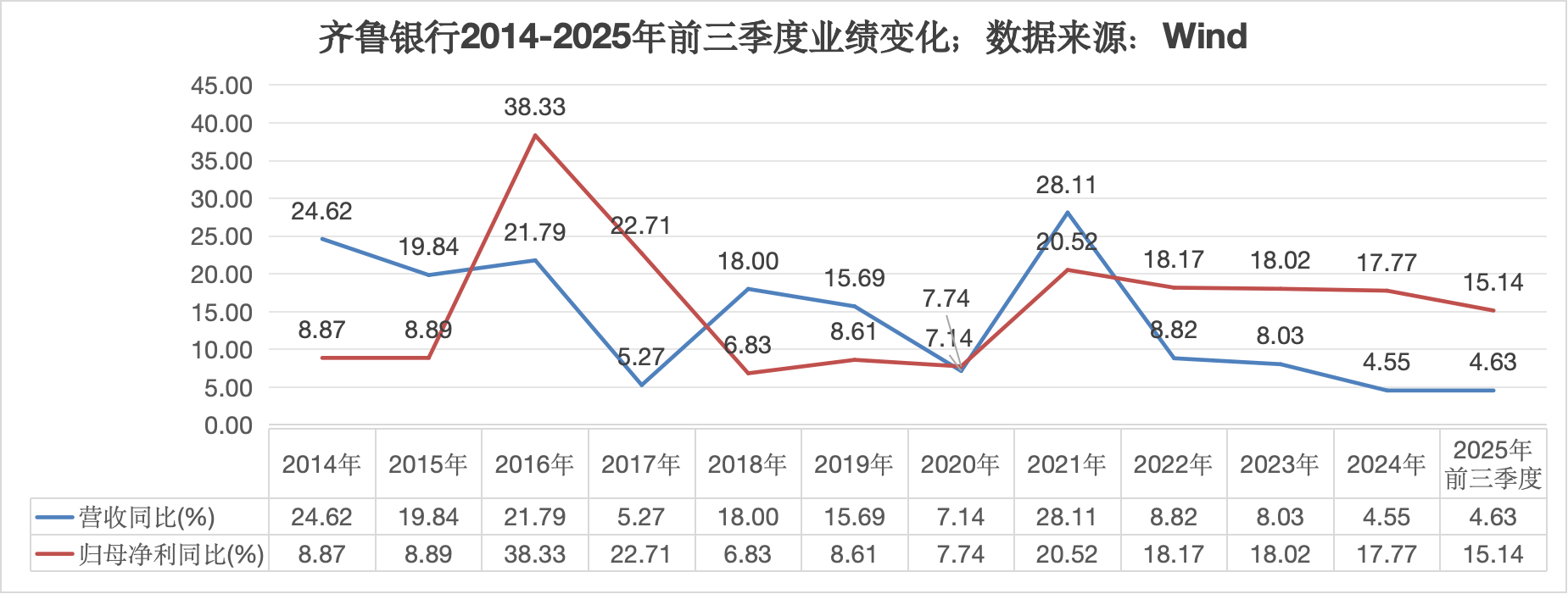
Core Viewpoint - The county-level financial business is emerging as a new value anchor for banks during the downturn cycle, with Qilu Bank showing notable performance despite broader industry challenges [1][3]. Financial Performance - In the first three quarters, Qilu Bank reported revenue and net profit attributable to shareholders of 9.924 billion yuan and 3.963 billion yuan, respectively, with year-on-year growth rates of 4.63% and 15.14% [1]. - Despite a historical low revenue growth rate, Qilu Bank's profit growth is among the few in the industry exceeding 15% [1]. - The bank's interest income, non-interest income, and investment income contributed 78.24%, 10.44%, and 14.82% to total revenue, respectively [4]. Credit and Asset Quality - Qilu Bank's profit growth is attributed to balanced development in "volume, price, and risk," with net interest income increasing by 17.31% [4]. - The bank's asset and liability growth rates were 12.93% and 13.22%, respectively, significantly outpacing industry averages [4]. - The non-performing loan ratio decreased by 10 basis points to 1.09%, indicating improved asset quality [4]. Strategic Focus on County-Level Finance - Qilu Bank has established county-level finance as a core strategy, with loans and deposits from county-level operations accounting for approximately 30% of total [3][10]. - The bank's county-level branches have shown strong growth, with loan growth rates of 40.55%, 32.35%, 26.18%, and 15.49% over the past three years [12]. - The bank has developed a unique "one county, one product" model, launching 80 differentiated financial products tailored to local needs [14]. Expansion and Investment - Qilu Bank has maintained a high expansion rate, opening 21 new branches in the past year and increasing its network without closures [7]. - The bank's capital adequacy ratio stands at 14.7%, providing room for further expansion [7]. - The bank's cost-to-income ratio has improved to 25.91%, reflecting efficient management [7]. Future Outlook - The bank's county-level strategy has shown resilience against economic downturns, with a focus on enhancing service delivery and risk management [10][16]. - However, the growth rate of county-level loans is showing signs of decline, indicating potential limitations in future expansion [15][16]. - The bank's coverage of county-level markets is currently around 60%, suggesting further growth opportunities [17].