鲜香蕉

Search documents
青岛即墨:一场关于鲜味的“隐形竞速”
Zhong Guo Jing Ji Wang· 2025-12-24 08:16
Core Insights - The efficient customs clearance process is crucial for the cross-border supply chain of fresh durians, ensuring high quality and freshness for consumers [1][2][3] Group 1: Supply Chain Efficiency - A direct flight route from Bangkok to Qingdao has significantly reduced transportation time for fresh durians, allowing them to reach consumers within 24 hours of landing [1] - The introduction of a dedicated cargo flight has cut the transportation time from 5 hours, enhancing the freshness of the durians [1] - The implementation of a "green channel" by the Jimo Customs has improved the customs clearance process, reducing average clearance time by over 30% [2] Group 2: Regulatory Innovations - Jimo Customs has adopted a "two-stage access" regulatory model to ensure efficient customs clearance and quality safety for imported fruits [2] - The customs authority has established a specialized window and assigned personnel to assist businesses with their declaration processes, even during holidays [2] - The innovative customs inspection model allows for pre-declaration and quick transfer of fruits to designated inspection areas, streamlining the process [2] Group 3: Market Impact - From January to November, Jimo Customs supervised the import of 86,600 tons of fruits, marking a 4.4% year-on-year increase [3] - Since the launch of the direct flight for fresh durians, Jimo Customs has managed 55 batches weighing 136.90 tons, valued at 5.42 million yuan [3] - The efficient customs services have not only ensured the quality of fresh products but also boosted confidence for businesses to expand their import operations [3]
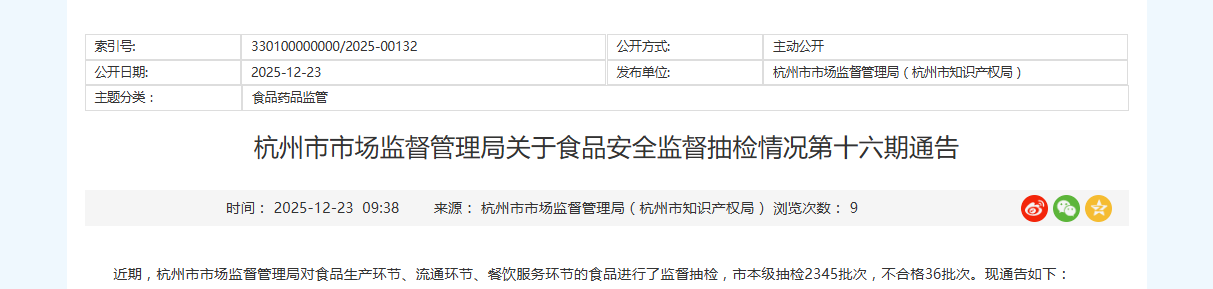
杭州市市场监督管理局关于食品安全监督抽检情况第十六期通告
Zhong Guo Zhi Liang Xin Wen Wang· 2025-12-23 08:17
Core Insights - The article reports on the food safety supervision and sampling conducted by the Hangzhou Market Supervision Administration, revealing a total of 2,345 batches tested, with 36 batches found to be non-compliant with safety standards [3][4][5][6] Group 1: Food Production Sector - In the food production sector, 881 samples were tested, with 878 passing and 3 failing. The non-compliant products included a batch of sesame mooncakes from Hangzhou Xu Di Di Food Co., which had excessive bacterial counts, and a batch of frozen rice cakes from Hangzhou Hong Ye Ye Food Co., which had unacceptable peroxide levels [3] - Another non-compliant product was a batch of five-spice peanuts from Hangzhou Lin'an Songjin Fried Food Factory, which contained unacceptable levels of aflatoxin [3] Group 2: Food Distribution Sector - The food distribution sector saw 845 samples tested, with 825 passing and 20 failing. Non-compliant products included batches of longan from various vendors that exceeded sulfur dioxide residue limits, and a batch of yam that contained unacceptable levels of pesticides [4] - Specific vendors cited for non-compliance included Hangzhou Lin'an Yan Bo Fruit Store and Hangzhou Xiaoshan Yingfeng Street Bo Yin Food Business, among others, with various pesticide and residue violations [4] Group 3: Catering Service Sector - In the catering service sector, 619 samples were tested, with 606 passing and 13 failing. Non-compliant products included batches of chili peppers and eggs from multiple restaurants that contained prohibited substances such as antibiotics and excessive peroxide levels [5] - Notable establishments with violations included Hangzhou Tide Restaurant Management Co. and Hangzhou Lin'an Yao Jie Traditional Steamed Dish Restaurant, which had issues with antibiotic residues in their food products [5] Group 4: Regulatory Actions - The Hangzhou Market Supervision Administration has referred the non-compliant products and their respective producers to local market regulatory authorities for further action in accordance with the Food Safety Law of the People's Republic of China [6]