
鸵鸟毛

Search documents
佳木斯乡村大地活力迸发
Xin Lang Cai Jing· 2026-01-18 22:33
Core Insights - The article highlights the successful implementation of the "Strong Village Twelve Methods" in Jiamusi City, which focuses on rural economic development through innovative measures led by party building [1][6] - The integration of e-commerce and collective wealth-sharing has significantly enhanced farmers' income through the promotion of local agricultural products [2][3] Group 1: Economic Development Strategies - The "Strong Village Twelve Methods" includes key initiatives such as land consolidation, e-commerce revenue generation, and project introduction, which have collectively strengthened rural economies and increased farmers' incomes [1][6] - The establishment of a village investment company in Heitong Village has led to the successful branding and marketing of fresh corn, resulting in annual sales exceeding 500,000 yuan and an average income increase of 3,000 yuan per household [2][3] Group 2: Agricultural Innovation - The collaboration between Minxing Village and Fusheng Village has resulted in the creation of a cooperative to develop a mushroom cultivation base, which is expected to produce 20,000 pounds of fresh mushrooms annually, benefiting over 20 local workers [3] - The implementation of land consolidation in Sifeng Village has transformed farming practices, allowing for standardized operations and doubling farmers' incomes [4] Group 3: Tourism and Diversification - The introduction of tourism projects in Xinghuo Village has attracted over 1.08 million visitors in a specific period, generating significant income for the village through partnerships with tourism companies [4] - The establishment of a local distillery and an ostrich farm in Jiqian Village has diversified income sources, contributing to collective revenue and job creation [5] Group 4: Policy and Legal Framework - The Jiamusi municipal government has developed a comprehensive rural collective economic development plan, providing policy support for the "Strong Village Twelve Methods" and addressing land fragmentation issues [6] - Legal measures have been implemented to ensure the efficient operation of collective assets, including competitive bidding for land leases and safeguards against asset loss [6]
(走进中国乡村)“95后”返乡创客乐当“鸵鸟主理人”
Zhong Guo Xin Wen Wang· 2026-01-12 10:47
Core Viewpoint - The article highlights the entrepreneurial journey of a young individual, Fan Zhiheng, who has returned to his hometown to engage in ostrich farming, leveraging modern technology and marketing strategies to create a sustainable business model in the "ostrich economy" [1][3]. Group 1: Industry Overview - Ostrich farming is gaining traction globally, with significant cultivation in provinces such as Yunnan, Shandong, Hebei, Qinghai, and Guangdong in China [3]. - The ostrich provides multiple economic benefits, including meat, eggs, feathers for export, and leather for high-end products [1]. Group 2: Entrepreneurial Journey - After graduating, Fan Zhiheng initially worked in real estate but decided to return to his hometown to promote local agriculture and prevent youth outmigration [3]. - He faced challenges in the early stages of ostrich farming, including high mortality rates among young ostriches, which prompted him to study and refine his farming techniques [5]. - By 2021, after overcoming initial setbacks, he successfully raised his first batch of ostriches, marking a turning point in his entrepreneurial venture [5]. Group 3: Marketing and Sales Strategy - Fan utilized internet live streaming to market ostrich products, significantly increasing customer engagement and sales, with a peak of selling 13 ostriches in one day [3][5]. - He initially struggled with direct sales but adapted his approach by leveraging social media and online platforms to reach a broader audience [5]. Group 4: Community Impact - Fan Zhiheng's efforts have inspired local villagers and returning university students to engage in ostrich farming, leading to a rise in the number of young agricultural entrepreneurs in his town from one to seven [7]. - He has also developed a model that provides ostrich chicks, farming techniques, and sales channels to support local entrepreneurship [6].

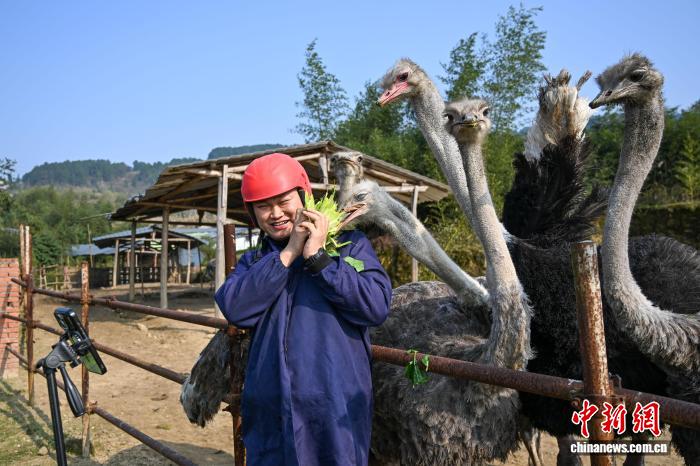
95后鸵鸟主理人:养鸵鸟不是“把头埋进沙子”
Xin Lang Cai Jing· 2025-12-21 20:41
Core Viewpoint - The article highlights the innovative approach of a young entrepreneur, Fan Zhiheng, who has successfully established an ostrich farming business in Chongqing, China, utilizing a model that combines breeding, cooperative farming, and online sales to revitalize rural entrepreneurship and engage local farmers [1][2][9]. Group 1: Business Model and Operations - Fan Zhiheng's ostrich farming model includes unified breeding, cooperative farming, and guaranteed sales, attracting over 80 farmers from four provinces to participate [1]. - The ostrich farming process involves raising the birds from chicks to market-ready adults in about 10 months, with a profit of approximately 1,000 yuan per bird [2]. - The business has expanded to include two ostrich farming bases, with one in Guangzhou focusing on breeding and the other in Chongqing for independent operations [6]. Group 2: Market Potential and Product Value - The global ostrich farming industry is significant, with an estimated 15 million ostriches worldwide, predominantly in South Africa [3]. - Ostrich meat is high in protein and low in fat, appealing to high-end meat consumers, while other products like ostrich skin and eggs have various market applications [4]. - The demand for ostrich products is growing, with a focus on both domestic sales and international exports [4][10]. Group 3: Challenges and Learning - Initial challenges included high mortality rates among the first batch of ostrich chicks due to inadequate knowledge and preparation [5][6]. - Fan learned through hands-on experience and research, developing local farming techniques that improved survival rates and overall productivity [6]. - The business model evolved to include a fee-based system for farmers to ensure commitment and proper care of the ostriches [7]. Group 4: Technology and Marketing - The use of internet platforms for marketing and sales has been crucial, with Fan leveraging social media and live streaming to reach customers and educate potential farmers [9][10]. - The business has established nearly 100 stable sales channels, including restaurants and online retail, with 70% of products sold online [10]. - Fan's approach emphasizes community engagement and education, aiming to uplift local farmers and create a sustainable business ecosystem [9].