鹰眼守护

Search documents
春节假期高德调用北斗卫星定位超5.7万亿次,支撑导航总里程超627亿公里
Huan Qiu Wang· 2026-02-24 11:22
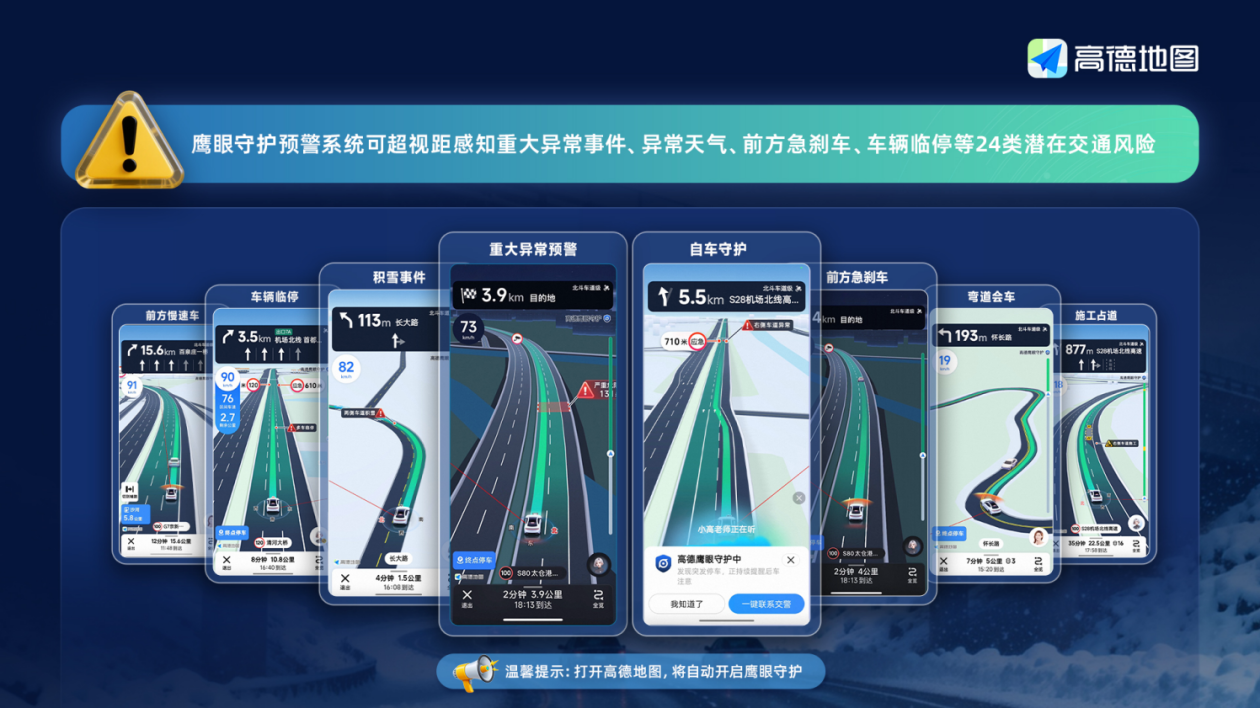
Core Insights - The "Eagle Eye Guardian" warning system has effectively managed high travel demand during the Spring Festival travel rush, issuing over 4.9 billion safety alerts and covering more than 200 million users from February 2 to February 23, 2026 [1][3] - The system can perceive 24 types of potential traffic risks and provides alerts in real-time, significantly aiding drivers in making timely safety decisions [1][3] - During peak travel on February 22, the system issued over 480 million alerts in a single day, demonstrating its capacity to enhance public safety during high-traffic periods [1] Group 1 - The top three causes of alerts during the Spring Festival were slow vehicles, sudden braking, and oncoming traffic in curves [3] - The system has introduced truck-specific alerts, which help provide timely risk notifications for both trucks and passenger vehicles, enhancing overall road safety [3] - During the Spring Festival period from February 15 to February 23, the "Eagle Eye Guardian" issued nearly 70 million alerts related to large trucks [3] Group 2 - An incident on February 11 involved a multi-vehicle collision on the G0422 highway, where the system issued its first alert 10 seconds before the accident, allowing vehicles to take precautionary measures [3] - The system had already issued 4,721 alerts for low visibility due to fog one hour before the accident, showcasing its proactive risk management capabilities [3] - The company emphasizes the importance of maintaining navigation and voice alerts for drivers to enhance safety and encourages responsible driving practices [4] Group 3 - The underlying positioning and navigation capabilities are crucial for supporting large-scale travel, with over 57 trillion calls to the BeiDou satellite system during the Spring Festival, facilitating navigation over 62.7 billion kilometers [4]

科技赋能保畅通 温情守护团圆年江苏交通执法护航春节出行幸福路
Xin Hua Ri Bao· 2026-02-13 00:26
Core Insights - The article discusses the measures taken by the provincial traffic enforcement bureau in collaboration with police and transportation authorities to ensure safe and efficient travel during the 2026 Spring Festival holiday, focusing on free passage, traffic flow management, and enhanced services [1][2]. Group 1: Traffic Management Initiatives - The provincial traffic enforcement bureau has implemented innovative joint control measures to address traffic congestion during the holiday, focusing on five major corridors and employing tailored strategies for each [2][3]. - A "three synchronizations" mechanism has been established for cross-province traffic management, allowing for real-time monitoring and coordination with neighboring provinces to alleviate congestion at border areas [2][3]. - Dynamic traffic control measures, including a "358" warning system, have been introduced to manage congestion based on the length of traffic jams, with specific interventions at toll stations and junctions [3]. Group 2: Technological Enhancements - The bureau has upgraded its smart management system using AI technology to monitor highway conditions, enabling real-time identification of traffic incidents and automatic dispatch of emergency responses [4]. - A fleet of 160 drones has been deployed for routine monitoring and emergency response, enhancing the ability to manage traffic and respond to incidents effectively [4]. Group 3: Public Service Improvements - The bureau has increased the number of charging stations by 750 fixed and 312 mobile units, improving electric vehicle support during the holiday [5][6]. - Public areas at toll stations have been opened to provide free parking, restrooms, and other services, addressing common traveler concerns during peak times [6][7]. - A series of community service initiatives have been launched, including emergency supplies and free roadside assistance, to enhance traveler support during the Spring Festival [7].
高德:春运首周导航里程破340亿公里,“鹰眼守护”预警超11.4亿次
Xin Lang Cai Jing· 2026-02-09 11:11
Core Insights - The Spring Festival travel season officially began on February 2, 2026, with significant data reported by Gaode, including over 3.77 trillion calls to the BeiDou satellite positioning system and a total navigation distance exceeding 34 billion kilometers during the first week [1][3]. Group 1: Safety Measures - The "Eagle Eye Protection" initiative, launched by the China Academy of Safety Science and Technology in collaboration with Gaode, issued over 1.14 billion safety alerts during the first week of the Spring Festival, covering nearly 100 million travelers nationwide [1][3]. - On the peak travel day of February 8, the "Eagle Eye Protection" system sent out more than 220 million alerts, with the most frequent alerts related to sudden braking, slow-moving vehicles, and trucks [1][3]. - The response time for the Eagle Eye system has been reduced to seconds, successfully preventing multiple traffic accident risks through innovative closed-loop handling [1][3]. Group 2: Travel Behavior Changes - Traditional travel low periods are being disrupted, with a 12% year-on-year increase in navigation starts between 4 AM and 6 AM during the first week of the Spring Festival, indicating a trend of travelers opting for off-peak travel to avoid pre-holiday congestion [1][3]. Group 3: Ride-Sharing Trends - Ride-sharing is emerging as a popular option for short-distance intercity travel during the Spring Festival, with the top ten ride-sharing routes concentrated within urban clusters, including routes like Shenzhen-Dongguan and Foshan-Guangzhou [2][4].
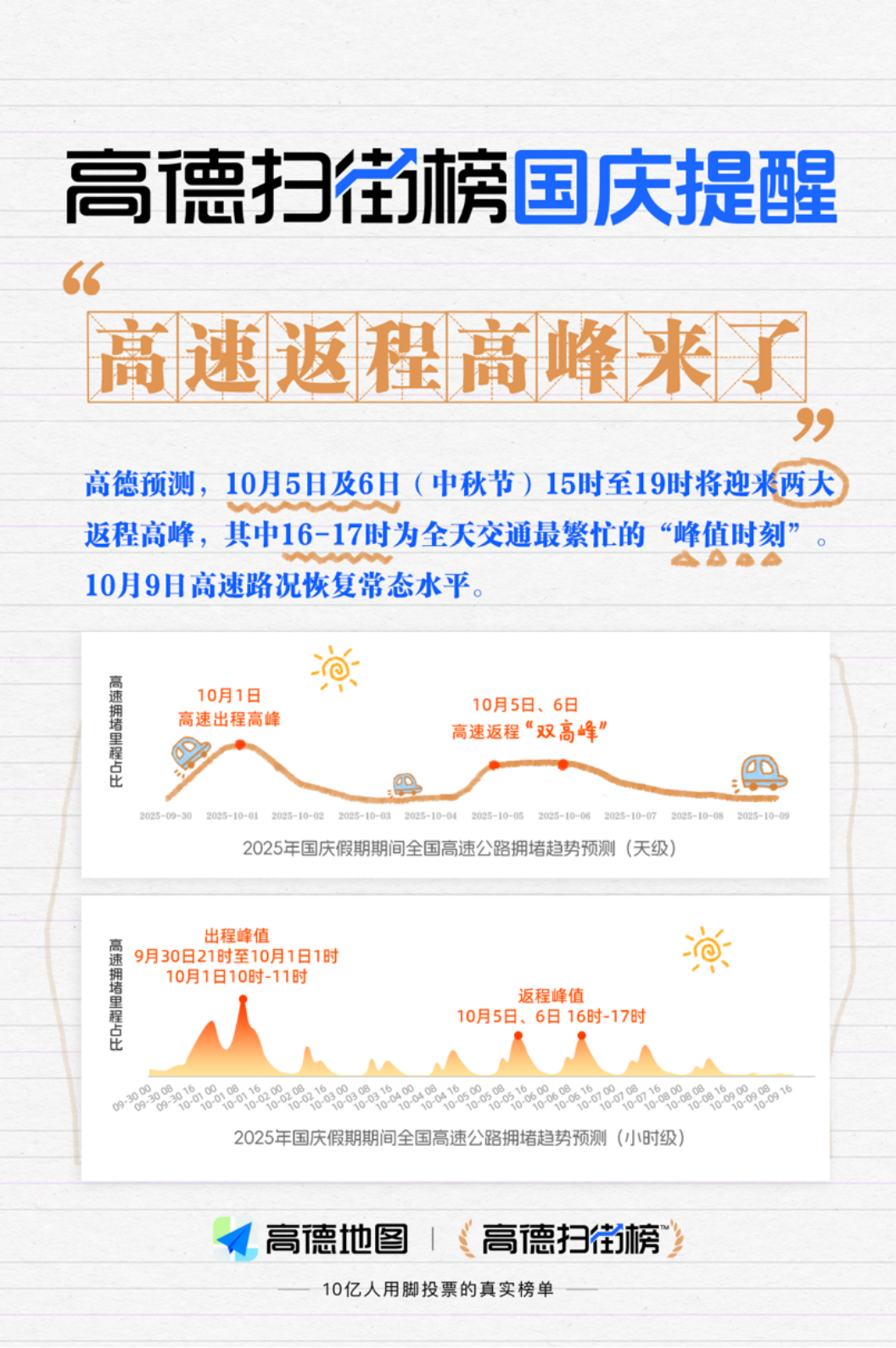
高德扫街榜发布:国庆返程高峰提前至10月5日
Qi Lu Wan Bao· 2025-10-05 04:04
Core Insights - Gaode has released a return trip prediction indicating that the peak traffic times during the Mid-Autumn Festival will occur on October 5th and 6th, particularly between 15:00 and 19:00, with the highest congestion expected from 16:00 to 17:00 [1][3] Traffic Predictions - This year, the National Day and Mid-Autumn Festival combined create an extended 8-day holiday, leading to more dispersed return traffic, with significant peaks on October 5th and 6th, and a smaller peak on October 7th [3] - National highway conditions are expected to return to normal by around October 9th [3] Most Congested Routes - The top 10 busiest routes on October 6th are primarily located in the Yangtze River Delta and Pearl River Delta regions, with the G40 Huhang Expressway in Shanghai experiencing the highest congestion delay index of 5.8 [3][5] - Other notable congested routes include: - G2 Jinghu Expressway from Taizhou to Wuxi with a delay index of 5.6 - G0423 LeGuang Expressway in Qingyuan with a delay index of 4.6 [5] Public Transport Insights - Major transportation hubs, including train stations and airports, are expected to see increased passenger flow during the holiday, with specific locations like Yantai Station and Guangzhou Baiyun International Airport being particularly busy [6] Charging Infrastructure - The total number of public charging stations in China has exceeded 300,000, representing a growth of over 300% since 2021, with Guangdong province having the highest number of charging stations [7] - The G45 Daguang Expressway, G4 Jinggangao Expressway, and G15 Shenhai Expressway have the most charging stations along their routes, making them the busiest highways during the holiday [7] User Engagement with Charging Stations - Daily average searches for charging stations on the first day of the National Day holiday increased by 42% year-on-year, indicating a significant rise in activity among electric vehicle users [9] - The peak search times for charging stations are between 11:00 and 14:00, aligning with lunch hours [10] AI and Navigation Features - Gaode has introduced several AI features to assist with holiday travel, including real-time updates on charging station availability and traffic conditions, enhancing the travel experience for users [12]