地图导航

Search documents
马年春运“鹰眼守护”系统发出49亿次安全预警
Zhong Guo Jing Ying Bao· 2026-02-25 07:00
Core Insights - The "Eagle Eye Guardian" safety warning system by Gaode has played a crucial role in ensuring road safety during the Spring Festival travel peak, with over 4.9 billion safety alerts issued from February 2 to February 23, covering more than 200 million users [1][2]. Group 1: System Performance - On February 22, the peak travel day, the "Eagle Eye Guardian" system issued 480 million alerts in a single day, with slow vehicles, sudden braking, and curve encounters being the top three warning types [2][3]. - The system's new truck warning strategy was significant, with nearly 70 million alerts related to large trucks during the holiday [2][3]. - The system demonstrated effective preemptive and response capabilities during emergencies, such as issuing a warning 10 seconds before a multi-vehicle collision on the Hubei G0422 highway, leading to over 3,000 alerts within an hour to guide vehicles away from danger [2][3]. Group 2: Technological Support - The underlying positioning and navigation technology is vital for the smooth operation of the "Eagle Eye Guardian" system, with Gaode utilizing over 57 trillion calls to the Beidou satellite positioning system during the Spring Festival, supporting a total navigation distance of over 62.7 billion kilometers [2][3]. - The system is expected to provide real-time risk alerts for daily travel, helping drivers identify complex road conditions and sudden changes earlier [4].

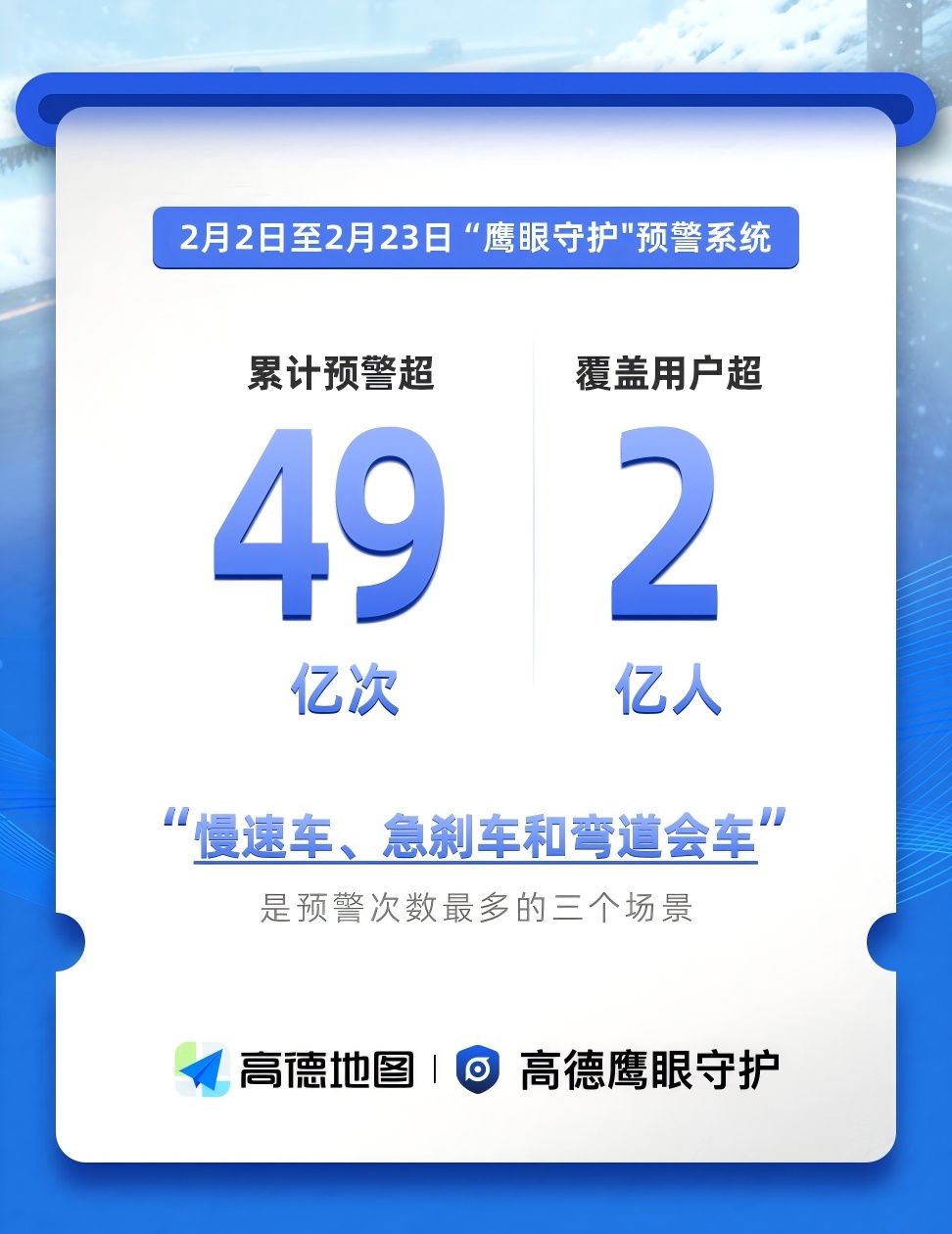
马年春运背后的“鹰眼守护”,49亿次安全预警,覆盖用户超2亿人
Jin Rong Jie· 2026-02-24 10:23
Core Insights - The "Eagle Eye Guardian" warning system has effectively managed high travel demand during the Spring Festival travel rush, issuing over 4.9 billion safety alerts and covering more than 200 million users from February 2 to February 23, 2026 [1][3] Group 1: System Performance - The "Eagle Eye Guardian" system can perceive 24 types of potential traffic risks and provides alerts in seconds, significantly aiding drivers in making timely safety decisions [3] - On February 22, the peak travel day, the system issued over 480 million alerts in a single day, demonstrating its capacity to handle high alert volumes [3] Group 2: Specific Alerts and Incidents - The top three causes of alerts during the Spring Festival were slow vehicles, sudden braking, and oncoming traffic in curves, with nearly 70 million alerts related to large trucks issued during the holiday [5] - A notable incident occurred on February 11, where the system issued its first alert 10 seconds before a multi-vehicle collision, helping drivers to reduce speed and maintain safe distances, thereby mitigating further risks [5] Group 3: Future Developments and Recommendations - The company plans to continue providing real-time risk alerts to drivers, encouraging safe driving practices and the use of navigation and voice prompts [6] - During the Spring Festival, the system utilized over 57 trillion satellite positioning calls, supporting a total navigation distance of over 62.7 billion kilometers [6]

高德发布全栈具身导航基座模型ABot-N0,五大核心任务全面SOTA
Feng Huang Wang· 2026-02-12 07:28
Core Insights - Gaode has launched two foundational models, ABot-M0 and ABot-N0, achieving state-of-the-art (SOTA) performance in both embodied navigation and operation tasks, marking a significant milestone in the industry [1] Group 1: ABot-M0 Overview - ABot-M0 is the world's first unified architecture for robotic operation foundational models, integrating over 6 million real operation trajectories to create the largest general-purpose robotic dataset [1] - The model utilizes action manifold learning algorithms for cross-platform action prediction, achieving a task success rate of 80.5% in the Libero-Plus benchmark test, which is nearly a 30% improvement over the industry solution pi0 [1] Group 2: ABot-N0 Overview - ABot-N0 is the first full-stack navigation foundational model that integrates five major navigation tasks, including point navigation, target navigation, instruction following, point of interest navigation, and person following [1] - The model is trained on approximately 8,000 high-fidelity 3D scenes and nearly 17 million expert examples, employing a hierarchical "brain-action" architecture [1] - In benchmark tests such as CityWalker and SocNav, ABot-N0 has set new world records, with a 40.5% success rate improvement in closed-loop simulation for SocNav and an 8.8% success rate increase in the HM3D-OVON evaluation [1][2]
高德将发布具身导航基座模型,让机器人能够实现跨场景送物、跟随等服务
Xin Lang Ke Ji· 2026-02-12 04:37
Core Viewpoint - Gaode is set to launch its self-developed embodied navigation base model, having built the largest embodied navigation data engine in the industry and achieved breakthroughs in long-range complex task processing capabilities [1] Group 1: Product Development - Gaode has established an embodied business unit, indicating a strategic focus on developing advanced navigation technologies [1] - The company is actively recruiting for various positions within the embodied business unit, including roles for embodied intelligence product experts and data/algorithm engineers [1] Group 2: Technological Advancements - Unlike many current robots that struggle with complex instructions, Gaode's embodied navigation base enables robots to perform tasks such as cross-scenario delivery and follow-up services in open physical environments [1] - The exploration of product forms such as robots and robotic dogs is part of the initiatives within the embodied business unit [1]

独家丨高德将发布具身导航基座模型,让机器人能够实现跨场景送物、跟随等服务
Xin Lang Cai Jing· 2026-02-12 04:06
Core Insights - Gaode is set to launch its self-developed embodied navigation base model, following the establishment of its embodied business unit, which is expected to enhance the capabilities of robots in executing complex tasks in open physical environments [1][2] Group 1: Company Developments - Gaode has built the largest embodied navigation data engine in the industry, achieving significant breakthroughs in long-term complex task processing capabilities [1] - The company has established an embodied business unit and is actively recruiting for various positions, including embodied intelligent product experts and data/algorithm engineers [2] - The exploration directions within the embodied business unit include products such as robots and robotic dogs [2]
高德飞行街景助力春节消费:超100万商家预约,首批商家营收增长23%
Zhong Guo Jing Ji Wang· 2026-02-11 10:29
Core Viewpoint - The article highlights the significant boost in offline consumption during the 2026 Spring Festival, driven by initiatives from Gaode's Street Scanning List, which aims to enhance consumer engagement and support local businesses through digital tools and promotional activities [1][3]. Group 1: Business Initiatives - Gaode's Street Scanning List has launched a large-scale incentive program for over 1 million merchants, offering up to 200,000 yuan in advertising flow incentives for those who activate the "Flying Street View" feature [3]. - The "Flying Street View" technology provides realistic navigation and store exploration experiences, leading to a reported over 40% increase in daily traffic and over 23% increase in daily transaction volume for participating merchants [3]. Group 2: Consumer Engagement - Gaode has released the "2026 Spring Festival Flavor Guide," featuring 20 cities known for their local cultural experiences, to assist consumers in making informed decisions about dining and entertainment [4][6]. - A themed activity called "Street Scanning Wishes, Prosperous New Year" will launch on February 12, allowing users to make wishes for their favorite local shops or travel destinations, with a chance to win up to 1,888 yuan in "Street Scanning Red Envelopes" [6]. Group 3: Regional Collaboration - Gaode collaborates with local cultural and tourism departments to promote regional characteristics and boost offline consumption, exemplified by the "Le You Guangdong" series of cultural maps developed in partnership with Guangdong's tourism department [7]. - The collaboration includes the creation of a province-level "Street Scanning List" that features local attractions and offers real-time updates on activities, enhancing consumer navigation and engagement [7].

春运首周“鹰眼守护”预警超11.4亿次,高德调用北斗卫星定位超3.77万亿次
Cai Jing Wang· 2026-02-11 08:26
Core Insights - The Spring Festival travel rush in 2026 began on February 2, coinciding with a nine-day holiday, leading to strong public willingness to return home and travel [1] - The "Eagle Eye" safety system, developed by the China Academy of Safety Science and Technology in collaboration with Gaode, has been upgraded to provide real-time alerts for various driving scenarios during the travel rush [1][4] - The system issued over 11.4 billion safety alerts in the first week of the Spring Festival, covering nearly 100 million travelers [1] Group 1 - The first week of the Spring Festival saw over 3.77 trillion calls to the BeiDou satellite positioning system, supporting a total navigation distance of over 34 billion kilometers [1] - On the peak day of the travel rush (February 8), the "Eagle Eye" system issued more than 220 million alerts, with the most common alerts related to sudden braking, slow-moving vehicles, and trucks [1] - The system's response time for alerts has been reduced to seconds, successfully preventing multiple traffic accident risks [4] Group 2 - The "Eagle Eye" system has been enhanced to provide alerts for adverse weather conditions such as snow and fog, and to adjust warning thresholds based on real-time weather changes [4] - The travel behavior during the Spring Festival is changing, with a 12% year-on-year increase in navigation starts between 4 AM and 6 AM, indicating a trend towards off-peak travel [5] - Ride-sharing services are becoming popular for short-distance intercity travel during the Spring Festival, with top routes concentrated within urban clusters [5]

“春运鹰眼”上线 织就公路智能安全网
Xin Lang Cai Jing· 2026-02-10 21:07
Core Viewpoint - The article discusses the launch of the "Eagle Eye Guardian" early warning system, aimed at ensuring traffic safety during the 2026 Spring Festival travel season, which is expected to see a record 9.5 billion trips, with self-driving travel accounting for about 80% of the total [1][4]. Group 1: System Features and Upgrades - The Eagle Eye Guardian system has been upgraded to include new features such as weather-related alerts for extreme conditions like ice and fog, and it now covers the entire road network and various travel scenarios [2][3]. - The system can provide dual-mode alerts through voice and map interfaces, even when users are in silent mode, ensuring timely communication of critical information [2][3]. - The system is capable of detecting abnormal events within 6 seconds and can automatically trigger the "Eagle Eye Alarm" to notify emergency response teams and nearby vehicles, significantly reducing the risk of secondary accidents [2][3]. Group 2: User Participation and Network - The Eagle Eye Guardian system is built on a network of over 1 billion users of the Gaode Map, creating a community-driven safety network where user participation enhances the accuracy and timeliness of alerts [3]. - Users who activate the Eagle Eye feature not only receive alerts but also contribute to the overall safety network, making the system more effective as more users join [3]. Group 3: Impact and Performance - Since its launch, the Eagle Eye Guardian system has issued a total of 11.2 billion alerts, averaging 88 million alerts per day, with over 147,000 alerts for multiple vehicle incidents [4]. - The system represents a shift in traffic management from reactive measures to proactive prevention, providing valuable data and intelligent tools for traffic governance [4]. - The collaboration between government and enterprises in developing and operating the system offers a replicable model for translating national research achievements into public safety benefits [4].
深度集成大模型能力 高德“鹰眼”护航春运路
Zheng Quan Ri Bao· 2026-02-09 16:18
Core Viewpoint - The 2026 Spring Festival travel season is expected to see a record 9.5 billion trips, with self-driving remaining the dominant mode of transport, accounting for about 80% of the total [1] Group 1: Safety Measures and Initiatives - The "Eagle Eye" safety alert system was launched in collaboration with Gaode to enhance road safety during the Spring Festival travel period [1] - The system integrates advanced model capabilities to provide precise, extensive, and rapid safety guarantees for large-scale highway travel [1][2] - The system has issued over 11.2 billion alerts since its launch, with an average of 88 million alerts per day [2] Group 2: System Upgrades and Features - The upgraded Eagle Eye system now includes minute-level alerts for adverse weather conditions and has optimized braking thresholds for trucks [3] - The system can detect accidents and trigger alerts within 6 seconds, creating a closed-loop for accident detection, alerting, and rescue [3] - The recall rates for major anomalies and sudden braking alerts have reached 95% and 85%, respectively, with response times reduced to under 5 seconds and 3 seconds [3] Group 3: Intelligent Warning Architecture - The Eagle Eye system employs a three-layer intelligent warning architecture to shift from passive response to proactive prevention [4] - The architecture includes a spatial-temporal location engine, a real-time traffic model, and a high-efficiency communication link to ensure rapid risk identification and user notification [4] Group 4: Risk Identification and User Coverage - The system identifies three high-frequency risks during the Spring Festival: slow-moving vehicles, sudden braking, and nighttime trucks [5] - The Eagle Eye system supports various travel modes, including navigation, cruise control, and ride-sharing, aiming to extend its alert capabilities to a broader user base [5] Group 5: Future Plans and Enhancements - Future plans include deep data mining to improve alert accuracy, recall rates, and timeliness, particularly for high-risk vehicle groups [6] - The Eagle Eye system is expected to play a more significant role in traffic safety, providing a reliable safety net for public travel [6]
春运首周“鹰眼守护”预警超11.4亿次,累计护航340亿公里导航里程
Huan Qiu Wang· 2026-02-09 13:20
Core Insights - The 2026 Spring Festival travel season began on February 2, with strong public intent for returning home and traveling during the extended nine-day holiday [1] - The "Eagle Eye" safety system, developed by the China Academy of Safety Science and Technology in collaboration with Gaode, has been upgraded to provide real-time alerts for various driving scenarios during the travel peak [1][4] Group 1: Travel Data and Trends - Gaode reported that during the first week of the Spring Festival travel period (February 2 to February 8), the platform utilized over 3.77 trillion satellite positioning calls, supporting a total navigation distance of over 34 billion kilometers, equivalent to approximately 850,000 laps around the Earth's equator [1] - The first peak day of travel (February 8) saw the "Eagle Eye" system issue over 2.2 billion safety alerts, with the most common alerts related to sudden braking, slow-moving vehicles, and trucks [1][4] - There has been a notable change in travel behavior, with a 12% year-on-year increase in navigation starts during the early morning hours of 4 AM to 6 AM, indicating a trend towards off-peak travel to avoid congestion [4] Group 2: Safety Measures and Technology - The "Eagle Eye" system has issued over 1.14 billion safety alerts in the first week of the Spring Festival, covering nearly 100 million travelers [1][4] - The system has been enhanced to include alerts for adverse weather conditions such as ice, fog, and specific road segments, allowing for real-time perception and efficient warnings across various driving scenarios [1][4] - The response time for the "Eagle Eye" alerts has been reduced to seconds, successfully preventing multiple traffic accident risks during the travel period [4] Group 3: Ride-Sharing Trends - Ride-sharing services are becoming a popular option for short-distance intercity travel during the Spring Festival, with the top ten routes concentrated within urban clusters [5] - User comments in ride-sharing orders reflect the festive spirit, with frequent mentions of traveling with elderly individuals, children, pets, and luggage, indicating a family-oriented travel approach [5]