
100G光芯片

Search documents
源杰科技A+H:销管费用率达20%、资金长期入不敷出 存货跌价占营收10%、募投项目均延期|C...
Xin Lang Cai Jing· 2025-12-19 09:30
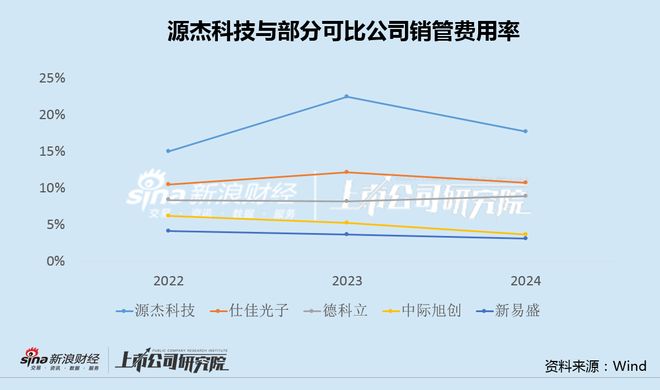
Core Viewpoint - The capital market is experiencing a surge in interest in the optical communication industry, driven by the demand for AI computing power and the emergence of companies like Source Technology planning to list in Hong Kong, despite facing significant operational challenges and financial instability [1][11]. Company Overview - Source Technology specializes in the research, design, production, and sales of optical chips, including products for telecommunications, data centers, and automotive laser radar markets [2]. - The company reported a revenue of 383 million, a year-on-year increase of 115.09%, and a net profit of 106 million, marking a turnaround from previous losses [3]. Financial Performance - Despite the revenue growth, Source Technology has experienced significant volatility in its financial performance, with high sales and management expense ratios around 20%, which is considerably above industry peers [3][5]. - The company has struggled with cash flow, maintaining a collection ratio between 60% and 90% since 2021, leading to a situation where operating cash flow is significantly lower than capital expenditures [5]. IPO and Fund Utilization - Source Technology's IPO in December 2022 raised 1.5 billion for various projects, but all three fundraising projects have faced delays, with only 44.85% and 28.22% of the planned investments made in the 50G optical chip industrialization and R&D center projects, respectively [8][10]. - The company is in a critical phase of capacity expansion and technological development, necessitating continuous funding to support rapid technological iterations in the optical chip sector [7]. Market Context - The CPO market is projected to reach $8.1 billion by 2030, with a compound annual growth rate of 137%, indicating a significant growth opportunity within the optical communication industry [11]. - The ongoing capital operations in the optical communication sector raise questions about whether they represent a necessary step to secure technological leadership or if they are indicative of potential overcapacity and irrational market positioning [11].

通信光芯片行业自主可控通信光芯片行业自主可控
2025-05-12 01:48
Summary of the Conference Call on Optical Chip Industry Industry Overview - The optical chip industry is experiencing a shift towards self-sufficiency, with global production capacity expected to ease from 30 million units in the early AI boom to over 90 million units by 2024, meeting market demand, although high-end optical chips (100G and above) still rely on suppliers from the US and Japan [1][2][20]. Key Points and Arguments - **Market Position**: Domestic optical module manufacturers hold a significant position in the global market, but they lag in high-end optical chip technology, particularly in indium phosphide substrates and Vixel special processes, with a technological gap of approximately 3 to 5 years compared to international leaders [1][3][27]. - **Market Evolution**: The optical module market is evolving towards optoelectronic integration solutions to address power consumption and heat dissipation issues in data centers, with silicon photonics expected to play a crucial role in high-speed data communication [1][5][6]. - **Domestic Production**: Progress in domestic production of 25G and below optical chips is satisfactory, but self-sufficiency in 25G and above remains low, with a domestic production rate of less than 5% for 100G and above products [1][10][11]. - **Challenges for Domestic Companies**: Companies like Yuanjie Technology and Shijia Photon face challenges such as insufficient mass production capacity and low yield rates, leading to higher costs and difficulties in competing with international firms [1][12][27]. - **Emerging Technologies**: Silicon photonics is seen as a key future direction, with major players like TSMC and Intel investing heavily in this area. The integration of optical components into CMOS technology is expected to enhance data center capabilities [6][14][18]. Additional Important Insights - **Global Competition**: The global optical chip market is dominated by five companies (Broadcom, Lumentum, Coherent, and Japan's Sumitomo and Mitsubishi), which collectively hold over 90% market share. The production capacity for 100G and above optical chips is primarily led by US and Japanese manufacturers [2][20][26]. - **Domestic Market Dynamics**: Domestic companies are increasingly investing in upstream industries and independent research to adapt to future market changes, with a focus on high-end and high-speed product development [16][17]. - **Market Demand**: Demand for optical chips is concentrated in data centers, telecom operators, and AI data centers, with significant needs from companies like Alibaba, Tencent, and Huawei [19][20]. - **Production Capacity and Yield**: The production capacity for 25G optical chips in China is around one million units annually, but still falls short of the ten million mark. The self-sufficiency rate for 25G is approximately 50%, while it is about 20% for 50G [9][10][22]. - **Future Projections**: By 2028, silicon photonics is expected to mature, capturing over 50% of the market share in high-speed communication, while traditional optical modules will continue to dominate in lower-speed applications [13][14]. This summary encapsulates the critical insights from the conference call regarding the optical chip industry, highlighting the current state, challenges, and future directions of the market.
