AI多联机

Search documents
行业首批!海尔大暖通攻克高原难题入藏供暖
Xin Lang Cai Jing· 2026-01-12 08:33
Core Viewpoint - The article highlights the challenges and advancements in clean heating solutions in Tibet, particularly through the initiatives led by Haier's HVAC division, which aims to provide efficient and sustainable heating in extreme conditions [1][3]. Group 1: Clean Heating Initiatives - Starting in 2024, the Tibet Autonomous Region's Housing and Urban-Rural Development Department launched pilot projects for clean energy centralized heating in seven counties, achieving full coverage for farmers and herders above 5000 meters by October 2025 [1]. - Haier's HVAC division has been a pioneer in these clean heating pilot projects, sharing its practical achievements at a customer summit, thus providing technical references for the industry [1][3]. Group 2: Technological Solutions - In Linzhou County and Qusong County, Haier's HVAC division utilized its comprehensive strength across eight product categories, focusing on solar thermal heating and air-source heat pump heating, transitioning from single products to integrated solutions [1][3]. - The company implemented a centralized heating project in Linzhou County using 121 air-source heat pumps, covering 233,600 square meters and maintaining indoor temperatures above 22°C while achieving a 30% energy saving [3]. Group 3: Innovative Heating Models - In Qusong County, Haier adopted a multi-energy complementary model combining solar energy and air-source heat pumps, ensuring stable heating and cost savings by prioritizing solar energy during sunny days and switching to heat pumps during cloudy or nighttime conditions [3]. - The company has also developed customized ultra-low temperature heat pumps and AI multi-connected units to meet user needs, ensuring reliable heating at temperatures as low as -35°C and achieving over 50% energy savings [3]. Group 4: Smart Management Systems - Haier's HVAC division deployed a comprehensive energy management platform for remote control, intelligent management, and anomaly warning of the heating systems, transitioning from manual inspections to automated operations, significantly enhancing operational efficiency and stability [5]. - The implementation of clean heating projects in Tibet has resulted in a reduction of 3.06 million tons of coal consumption and a decrease of 8.28 million tons of CO2 emissions each heating season, equivalent to planting 2.52 million square meters of trees [5].



海尔智慧楼宇持续加大海外布局,发布多项新品方案
Zhong Jin Zai Xian· 2025-09-23 13:32
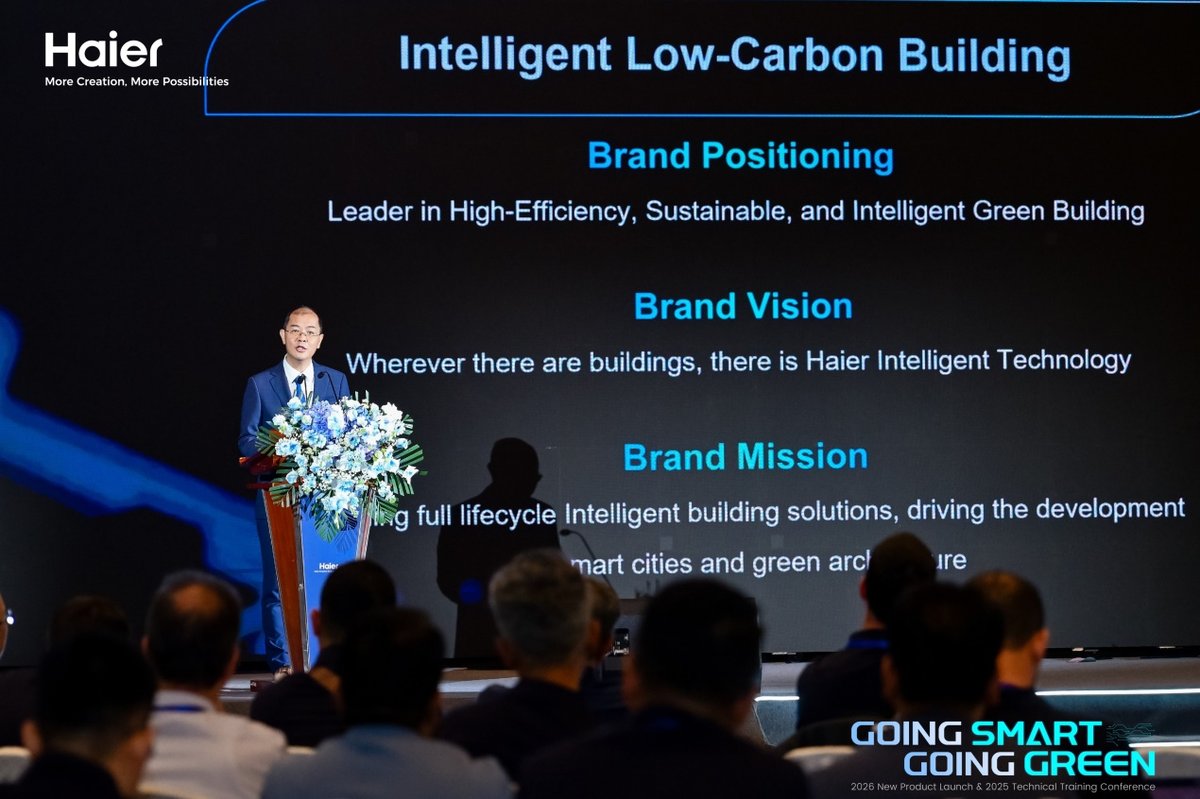
Core Insights - Haier Smart Building is enhancing its global presence while implementing localized operational strategies, focusing on tailored solutions for different markets [1][9] - The company emphasizes energy efficiency and sustainability across its product offerings, aligning with global energy standards and carbon reduction goals [6][7] Group 1: Global Strategy and Localization - Haier Smart Building is committed to a global layout and localized operations, launching customized products for various countries and regions [1] - The company aims to be seen as a local partner rather than just a Chinese brand, achieving double-digit growth overseas [1] Group 2: Product Innovation and Efficiency - The product matrix includes high-efficiency solutions tailored to different market needs, such as the upgraded MRV7 multi-connected unit and compact air duct units [3][5] - The company is focusing on oil-free technology for large spaces, with innovations like the magnetic levitation water machine and comprehensive heat pump solutions [5] Group 3: Sustainability and Carbon Reduction - Haier Smart Building integrates green energy practices throughout its R&D, production, and service processes, ensuring compliance with the highest energy efficiency standards [6] - The company has set long-term carbon reduction targets of 20% by 2030, 30% by 2040, and 40% by 2050 [6][7] Group 4: Market Performance - The company has reported significant growth in specific regions, with a 33% increase in Europe and a 54% increase in the Middle East compared to the previous year [9]
创新不歇 “智”向未来
Jin Rong Shi Bao· 2025-08-08 07:57
Group 1: Company Insights - Haier has transformed from a struggling factory to a global leader in the IoT ecosystem, achieving revenue exceeding 400 billion yuan and selling products in over 200 countries and regions [3] - Hisense leverages sports marketing to enhance brand visibility globally, showcasing its technology through major sporting events, thus expanding its market reach [2] - The financial companies associated with these enterprises play a crucial role in providing financial support and ensuring efficient capital allocation, which is essential for their growth [4][5] Group 2: Industry Developments - Shandong Port Group aims to enhance its supply chain services, with projected cargo throughput exceeding 1.8 billion tons and container volume surpassing 44 million TEUs by 2024 [4] - The automation at Qingdao Port exemplifies advancements in smart port technology, with automated cranes and driverless vehicles optimizing container handling processes [4] - Financial companies are evolving from traditional roles to become integral financial enablers within the industrial chain, enhancing capital efficiency and reducing financial costs [5][6]