AI智能学伴

Search documents
洋葱学园:AI 自主学习模式落地,驱动教育教学生态变革
Jing Ji Guan Cha Wang· 2026-01-23 08:42
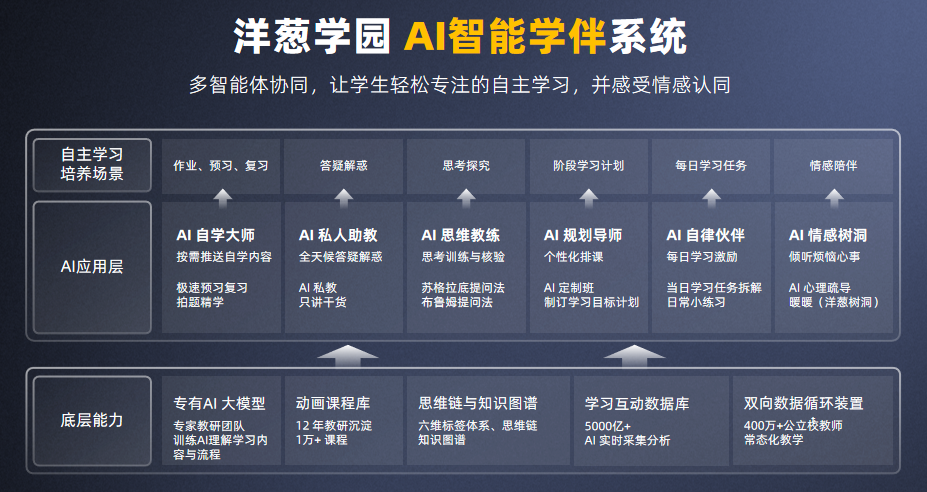
Core Insights - The company, Onion Academy Group, established in 2013, is a leading smart learning technology company in China, focusing on the transformation of educational technology achievements through new generation information technology [1] - The company has developed a comprehensive ecosystem, serving over 130 million students and 4 million teachers, with 10,000 digital courses and 500 billion learning interaction data [1] - Onion Academy aims to address the contradictions in traditional education by integrating AI technology into educational scenarios, promoting a shift from "knowledge transmission" to "ability cultivation" [1] Group 1 - The core idea of the project is to cultivate students' autonomous learning abilities, positioning AI as an "intelligent learning companion" deeply embedded in the learning process [2] - A multi-agent collaborative system has been established, providing personalized learning support to address common challenges in autonomous learning [2] - The project has achieved significant educational outcomes and social value, becoming a benchmark case for AI empowerment in education [4] Group 2 - In terms of student capability enhancement, the introduction of the new model at Beijing Dongfanghong School resulted in students averaging over 400 minutes of autonomous learning per week, shifting from passive reception to active inquiry [4] - AI technology has effectively addressed the challenges of personalized education at scale, allowing teachers to focus more on personalized guidance and teaching design [4] - The relationship between teachers and students has evolved from "knowledge transmission" to "joint growth," significantly enhancing the targeting and effectiveness of teaching [4]

押注AI自主学习 洋葱学园拆解 AI教育 “破壁”逻辑
Zhong Guo Jing Ying Bao· 2025-11-12 17:05
Core Insights - The integration of AI in education is becoming a leading trend, with the AI education market expected to grow from $1.77 billion in 2023 to $17.28 billion by 2032, reflecting a compound annual growth rate (CAGR) of 37.2% from 2024 to 2032 [1] - Onion Academy's co-founder Yang Linfeng emphasizes a shift from "tool efficiency" to "capability shaping" in AI education, aiming to foster autonomous learning skills in students [1][2] Industry Trends - AI education is currently at a crossroads, with two distinct paths: "task completion" products focused on speed and efficiency, and "long-term capability cultivation" models, with Onion Academy firmly choosing the latter [2] - Yang Linfeng identifies four dimensions of autonomous learning: awareness, practical action, transferable skills, and the value of enjoyable learning, contrasting with existing products that primarily serve as "Q&A tools" [2] Product Development - Onion Academy's latest product, AI Smart Companion, consists of multiple intelligent agents, each serving different functions such as content analysis, real-time Q&A, cognitive guidance, learning planning, behavioral motivation, and emotional support, creating a comprehensive self-learning ecosystem [3] Technological Framework - The adoption of a multi-agent collaborative architecture is driven by advancements in AI models, which enhance task accuracy and quality through division of labor and cooperation [4] - Yang Linfeng argues that the depth of understanding in educational contexts is crucial, as vertical education companies can effectively translate AI capabilities into actionable teaching plans [5] AI's Evolving Role - The role of AI in education is transitioning from a "performer" to a "commander," capable of understanding user intent and planning complex tasks, thus enabling personalized learning strategies [6] - This evolution aligns with the industry trend of moving from "tool-based" to "partner-based" AI applications [6] Teacher's Role - Yang Linfeng asserts that teachers are irreplaceable, with AI serving as a collaborator rather than a replacement, integrating seamlessly into existing educational frameworks [7] - Onion Academy aims to address concerns about student dependency on AI by providing high-quality feedback at critical moments, rather than fostering constant engagement [7] Future Outlook - The vision for the future includes preparing individuals for uncertainties through a systematic autonomous learning framework, which is increasingly supported by favorable policies [8] - The Chinese government's recent policies advocate for the integration of AI in education, promoting a shift from knowledge transmission to capability enhancement, positioning Onion Academy as a potential leader in defining new industry paradigms [8]
对话洋葱学园杨临风:教育“慢周期”如何对抗AI“快迭代”?|独家
Tai Mei Ti A P P· 2025-05-29 08:04
Core Viewpoint - The rapid advancement of AI technology is driving significant changes in the education sector, prompting a shift from rote memorization to application-based learning, as evidenced by recent exam reforms in China [2][35]. Group 1: AI's Impact on Education - The introduction of AI in education is reshaping assessment methods, with a focus on real-world problem-solving rather than traditional rote learning [35][36]. - Companies like Onion Academy are leveraging AI to create personalized learning experiences, aiming to develop lifelong learning habits in students [4][36]. - The AI-driven educational model emphasizes the importance of understanding students' learning needs and adapting teaching methods accordingly [30][38]. Group 2: Company Strategy and Development - Onion Academy plans to enhance its AI capabilities by integrating its extensive data and content library with advanced AI models, aiming for a more personalized learning experience [3][11]. - The company has developed approximately 10,000 animated courses, which serve as a foundational resource for its AI applications, ensuring content is closely aligned with public school curricula [11][12]. - The focus on emotional support through AI companions is a key differentiator for Onion Academy, as it seeks to build trust and engagement with students [20][24]. Group 3: Challenges and Competition - The proliferation of accessible AI models poses a challenge for differentiation in the education technology market, as many players can utilize similar AI capabilities [6][11]. - Maintaining a competitive edge requires a deep understanding of course content and effective integration of AI technology, as well as continuous adaptation to technological advancements [17][30]. - The rapid evolution of AI technology necessitates a balance between the slow cycles of educational content development and the fast-paced nature of AI advancements [13][18]. Group 4: Future Directions - The emergence of AI in education is expected to lead to a new model of "dual-teacher classrooms," where AI handles standardized knowledge delivery while human teachers focus on emotional support and higher-order thinking [30][31]. - The ongoing transformation in educational assessments reflects a broader trend towards integrating AI into learning environments, which is essential for preparing students for future challenges [34][35].