AI毛绒玩具“显眼包”

Search documents
700 美金买“真情”?AI情感类产品爆火背后:卖的不止是陪伴,而是年轻人的孤独
AI前线· 2025-10-05 05:33
Core Insights - The article discusses the growing popularity of AI emotional companionship products, highlighting their role in addressing loneliness and emotional needs in modern society [8][13][27] - It emphasizes the potential market growth for AI emotional companionship, projecting a significant increase in market size from $30 million to between $70 billion and $150 billion, with a CAGR of 200%-236% [13][16] - The narrative includes personal experiences of users, illustrating the emotional reliance on AI companions and the changing dynamics of human interaction [4][6][7] Group 1: User Experience and Emotional Impact - Users like Lin Yue find AI companions provide immediate emotional support, filling a gap in their social interactions [2][3] - The reliance on AI for emotional support is growing, with users preferring to interact with AI over traditional social connections [4][6] - The article notes that AI companions are increasingly seen as a necessary emotional outlet for many individuals facing social isolation [8][7] Group 2: Market Trends and Growth Potential - The market for AI emotional companionship products is expanding rapidly, with significant consumer interest and willingness to pay for these services [13][16] - The demand for AI companionship is driven by increased solitary time among consumers, which has risen from an average of 5.3 hours to 7.4 hours daily from 2003 to 2022 [13][16] - The article highlights various AI companionship products, such as ByteDance's AI plush toy and Casio's AI pet robot, showcasing their market reception and pricing strategies [9][11] Group 3: Technological Advancements and Challenges - Advances in AI technology, including emotional recognition and personalized interactions, are enhancing the capabilities of companionship products [17][21] - The challenge of creating long-term memory in AI companions is critical for providing meaningful emotional support, as current models struggle with retaining user-specific information [21][22] - The integration of psychological insights into product design is essential to avoid over-dependence on AI companions and ensure they serve as supportive tools rather than replacements for human interaction [24][25] Group 4: Business Models and Future Outlook - The article discusses the potential business models for AI companionship products, suggesting a combination of hardware sales and subscription services for ongoing emotional support [25][28] - The focus on creating immersive experiences through familiar characters and engaging interactions is seen as a key differentiator in the competitive landscape [26][27] - The future growth of the AI companionship market is expected to be driven by the integration of these products into everyday life, with a focus on specific use cases and emotional needs [27][28]


研判2025!中国AI玩具行业产业链、发展现状、竞争格局及发展趋势:群雄逐鹿格局渐成,AI玩具蓝海扩容在即[图]
Chan Ye Xin Xi Wang· 2025-05-26 01:18
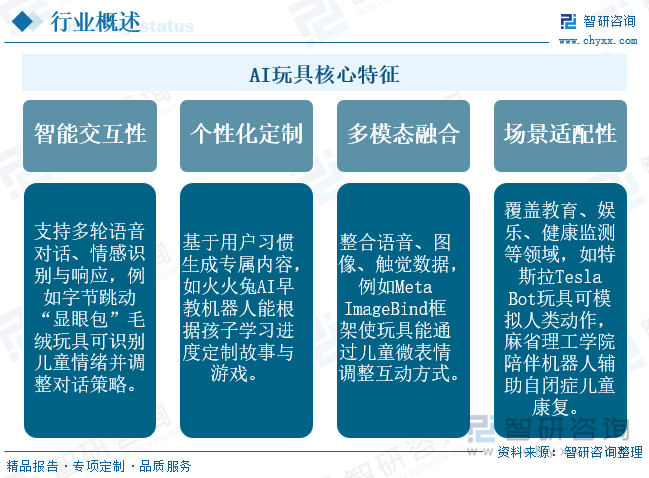
Core Insights - The Chinese AI toy industry is undergoing a transformation from "manufacturing" to "intelligent manufacturing," driven by innovations in emotional computing and multimodal interaction, exemplified by ByteDance's AI plush toy "Xianyan Bag" [1][15] - The industry is experiencing three explosive growth points: the rising demand for STEAM educational tools, the deep application of emotional companion toys in special education, and the acceleration of innovations for elderly care robots [1][15] - By 2025, the market size of China's AI toy industry is expected to exceed 30 billion yuan [1][15] Industry Overview - AI toys are defined as intelligent terminal products that integrate AI technologies such as voice recognition, natural language processing, machine learning, computer vision, and emotional computing, enabling deep interaction and personalized services [2][4] - The main categories of AI toys include voice interaction, computer vision, machine learning, and emotional computing, with educational toys holding the largest market share [4][5] Policy Environment - The Chinese government has launched the "Artificial Intelligence +" action plan, emphasizing the integration of AI technology with traditional industries and new business formats, creating a favorable environment for the AI toy industry [7][9] - Specific policies in Beijing support the development and application of intelligent educational equipment, providing clear guidance for the AI toy sector [7][9] Industry Chain - The AI toy industry chain consists of three levels: upstream focusing on core technologies and content, midstream involving design and manufacturing, and downstream building a comprehensive marketing network [10] - The industry is characterized by a "technology-product-scenario" linkage, with efficient production supported by industrial clusters in Guangdong and Zhejiang [10] Market Dynamics - The global AI toy market reached $13.25 billion in 2023, with expectations to exceed $36.38 billion by 2030, driven by technological innovation and consumer upgrades [13] - The Chinese AI toy market is evolving into a three-dimensional development pattern dominated by educational products, innovative entertainment, and upgraded companionship [17] Competitive Landscape - The AI toy market in China exhibits a "pyramid" structure, with top-tier companies like UBTECH and ByteDance leading the high-end market, while traditional players like Aofei Entertainment and Tom Cat dominate the mid-tier [19] - Emerging companies are carving out niches in emotional companionship and STEAM education, reflecting the diverse competitive landscape [19] Future Trends - The industry is expected to see accelerated product innovation and market segmentation, with a focus on integrating new technologies like AIGC and the metaverse [24][25] - The market for elderly care products is projected to exceed 5 billion yuan by 2025, indicating a growing focus on specialized applications [25] - A significant industry consolidation is anticipated, with major players extending their reach into hardware and technology through acquisitions and partnerships [26]