AI相关设备

Search documents
严重依赖AI!美国经济正经历一场“危险的繁荣”
Hua Er Jie Jian Wen· 2026-01-19 03:12
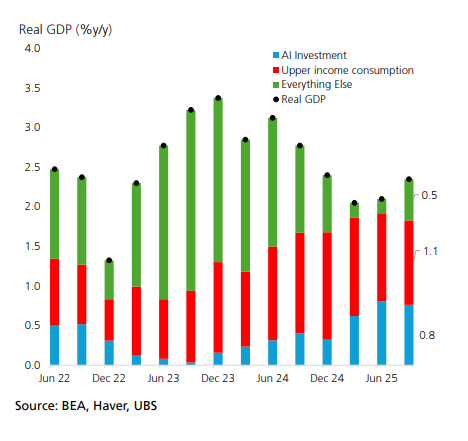
Core Viewpoint - UBS has expressed concerns about the sustainability of the U.S. economic expansion, indicating that the growth is heavily reliant on artificial intelligence (AI) investments, which could pose risks if these investments slow down or asset prices decline [1][2]. Economic Outlook - UBS models suggest a 50% probability of recession in the U.S. over the next 12 months, primarily if the AI investment boom cools down [2]. - Long-term GDP growth potential is estimated to rise to about 2.5%, driven by improved productivity and a lessening demographic drag [2]. - The effective tariff rate in the U.S. has increased from 2.5% at the beginning of the year to over 13%, equivalent to a hidden tax of about 1.1% of GDP, which is expected to elevate core inflation above the Federal Reserve's 2% target in the coming years [2][9]. Investment Trends - AI-related equipment investment has grown approximately 17% over the past four quarters, while non-AI equipment investment has declined by about 1% [3]. - Residential investment has contracted in four out of the last five quarters, and non-residential construction has shrunk for six consecutive quarters [4]. Consumption Dynamics - The resilience in consumer spending is attributed to wealth concentration rather than income improvement, with real disposable income growing by only 1.5% while real personal consumption expenditures increased by 2.6% [7]. - The share of stock assets in household wealth reached a historical high of 35%, primarily driven by AI and technology sectors, leading to a significant amplification of high-income household consumption [7]. Employment Insights - Despite a relatively low unemployment rate, UBS indicates that the labor market's true condition is underestimated, with non-farm employment declining by an average of 41,000 jobs per month over the last four months [11]. - The U-6 unemployment rate has risen to 8.43%, significantly above pre-pandemic levels, indicating a chronic employment contraction driven by demand-side factors [11]. Fiscal and Monetary Policy - The "Big Beautiful Bill" (OBBBA) is expected to provide temporary support in Q2 2026, with approximately $55 billion in tax rebates boosting consumption, but this stimulus is anticipated to fade quickly [12]. - The Federal Reserve is projected to lower interest rates twice in 2026, but the scope for easing is limited due to cost-push inflation driven by tariffs [14]. - The Fed has shifted towards balance sheet expansion to stabilize financial conditions, with gold's role evolving from a cyclical hedge to a structural asset in a high-uncertainty environment [15]. Conclusion - The current U.S. economic expansion is not a recession that has already occurred but rather a phase heavily reliant on a single engine, with the real test being whether AI can transition from narrative to structural change before the next economic shock [16].