Agentic AI(代理式AI)

Search documents
中国去年毕业了130万工程师,美国呢?
虎嗅APP· 2026-02-11 09:38
Core Viewpoint - The article highlights a significant disparity in engineering graduate numbers between China and the United States, emphasizing the implications for innovation and industry in both countries [4][9]. Group 1: Graduate Numbers - China graduated approximately 1.3 million engineers last year, while the U.S. produced only about 130,000 to 145,000 engineering bachelor's degrees annually [4][6][9]. - If including broader STEM fields, China's annual graduate numbers could reach up to 5 million [9]. - The U.S. has seen a loss of over 10,000 STEM PhD holders in just one year, indicating a talent drain in critical fields [11][12]. Group 2: Industry Implications - The U.S. faces a "talent hemorrhage" with a significant portion of its engineering graduates shifting to finance or tech sectors, leaving a shortage of traditional engineering roles [20][21]. - In contrast, China's engineering workforce is characterized by a large number of practical engineers capable of hands-on work, which is essential for infrastructure development [21][22]. - The article argues that the U.S. is relying on AI to compensate for its engineering talent shortage, suggesting that this may not be a sustainable solution [30][41]. Group 3: AI as a Solution - The U.S. strategy involves using AI to replace lower-level engineering tasks, potentially leading to a future where skilled engineers are less prevalent [30][36]. - The concept of AI acting as an "apprentice" in engineering teams is presented as a double-edged sword, raising concerns about the loss of essential hands-on experience for future engineers [38][42]. - The article warns that over-reliance on AI could create a vacuum in the engineering workforce, with a lack of mid-level engineers to bridge the gap between senior engineers and AI [44]. Group 4: Lessons for China - The situation in the U.S. serves as a cautionary tale for China, emphasizing the importance of maintaining a robust engineering workforce as a strategic advantage [46]. - Despite criticisms of China's education system, the large number of engineers is viewed as a foundational strength for its manufacturing sector [47][48]. - The article concludes that true innovation will require a combination of deep physical intuition and the ability to leverage AI effectively, rather than relying solely on technology [49].

报告称代理式AI将于2026年在消费者中广泛应用
Sou Hu Cai Jing· 2025-11-04 09:46
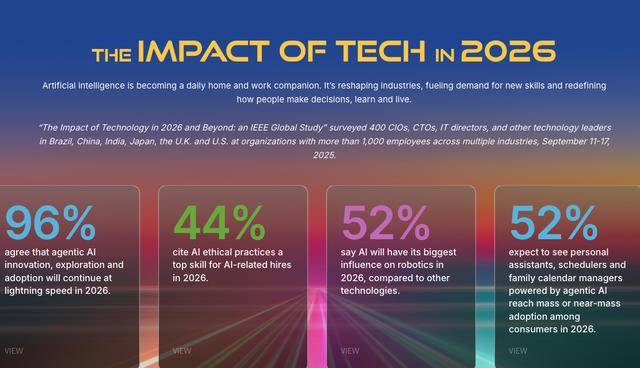
Core Insights - The report by IEEE highlights the rapid advancement of AI innovation, particularly focusing on Agentic AI, which is expected to become a mainstream "intelligent assistant" for everyday tasks by 2026 [1][3] Group 1: AI Innovation - Agentic AI will be widely applied in personal shopping, schedule management, data privacy management, and health monitoring [1] - The mainstream adoption of Agentic AI is projected to occur by 2026 among consumers [1] Group 2: Employment and Industry Impact - The growth of Agentic AI is anticipated to drive a surge in demand for data analysts [3] - By 2026, sectors such as robotics, extended reality, autonomous driving, quantum computing, and renewable energy are expected to be significantly impacted by AI advancements [3]