Amazon Nova模型

Search documents
「数字AGI」已死?亚马逊内部重组,撕掉纯算法派最后的遮羞布
3 6 Ke· 2025-12-24 11:17
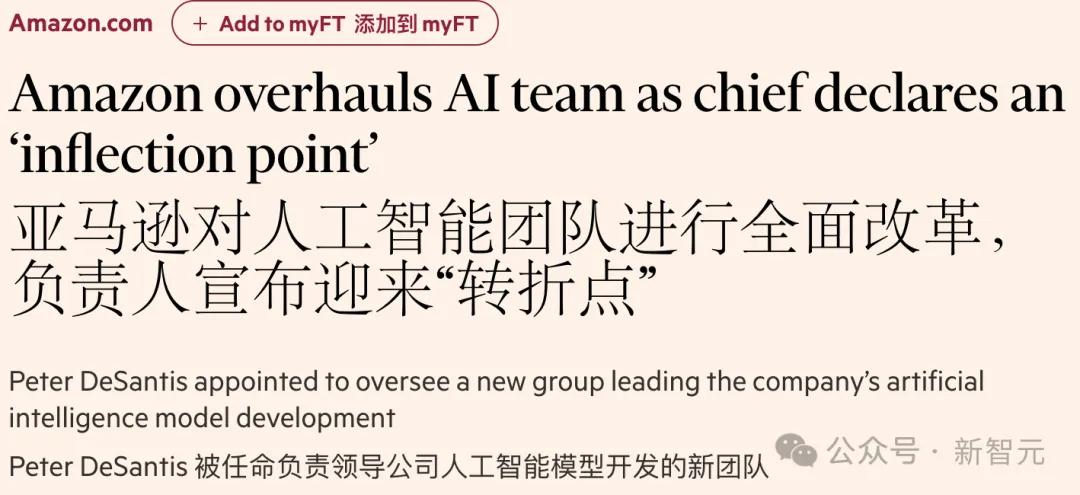
Core Insights - Amazon is redefining AGI by integrating its Nova large model team, in-house chip division, and quantum computing research into a unified system, marking the beginning of a physical entity era for AGI [1][3] - The appointment of Pieter Abbeel, a key figure in robotics and reinforcement learning, signifies a shift towards creating AGI that interacts with the physical world rather than just existing as a software model [5][6] Group 1: Organizational Changes - Amazon's CEO Andy Jassy announced a rare organizational restructuring to consolidate teams focused on AGI, chips, and quantum computing [1] - Peter DeSantis, known for his engineering delivery capabilities, will oversee this integration, indicating a long-term engineering investment in AGI [4][5] Group 2: Strategic Vision - Amazon views AGI as a physical entity with chips as its foundation and algorithms as its essence, moving beyond traditional software models [3][10] - The integration aims to optimize the Nova model's code on in-house chips, allowing for significant cost advantages compared to competitors [5][10] Group 3: Competitive Landscape - Amazon's approach contrasts with competitors like Microsoft and OpenAI, who focus on cloud-based intelligence, and Google, which struggles with internal organization [11][13] - Amazon's extensive network of over 750,000 industrial robots provides a continuous source of real-world data, enhancing its AGI development capabilities [11][13] Group 4: Future of AGI - The collaboration between Abbeel and DeSantis signals a transition from an experimental phase of AI to an industrial era, where AGI will require a full-stack integration of hardware and software [14] - The future of AGI will be dominated by companies that can achieve a "full-loop" integration of computing power, intelligence, and physical interaction, establishing a new competitive landscape [14][15]


AI入局,在re:Invent见证体育圈变天
创业邦· 2025-12-05 11:15
Core Insights - The article discusses the transformative partnership between the NBA and Amazon Web Services, highlighting how AI will revolutionize the sports industry, particularly in data analytics and performance measurement [2][20]. Group 1: NBA and AI Integration - The NBA has partnered with Amazon Web Services to utilize AI for real-time player performance tracking, enabling the quantification of defensive contributions that were previously difficult to measure [10][11]. - New data innovations for the 2025-26 NBA season include Defensive Box Score, Shot Difficulty Index, and Gravity metrics, which will provide objective measures of player impact [11]. - AI technology will allow for the tracking of player movements and defensive matchups, thus changing the evaluation of defensive players like Draymond Green [10][11]. Group 2: AI in Other Sports - The PGA Tour has implemented an AI-driven content production system that generates timely articles about player performances, producing around 800 articles weekly for a global audience [12][13]. - The Bundesliga has developed a smart content production system that automates match reports and video localization, significantly improving content creation efficiency and fan engagement [15]. - The NFL has created an "AI coach" that provides real-time tactical analysis and player recommendations, enhancing the experience for fantasy league players [16][18]. Group 3: Broader Implications of AI in Sports - AI applications in sports extend beyond data analysis to include content generation and enhancing fan experiences, as seen in the multilingual commentary for Bundesliga matches [20]. - Amazon Web Services is positioned as a transformative force in sports, turning chaotic data into actionable insights and enhancing real-time decision-making [21][22]. - The integration of AI is reshaping athlete training, coaching strategies, and fan engagement, moving spectators from passive viewers to active participants in the sports narrative [22][24].

云计算“活教科书”语出惊人,指明程序员的进化方向
量子位· 2025-10-24 03:53
Core Viewpoint - Jeff Barr, a key figure in the development of cloud computing, is recognized as a "living textbook" for the industry, having contributed significantly to the evolution of Amazon Web Services (AWS) and the broader cloud computing landscape [1][3][4]. Group 1: Jeff Barr's Contributions - Jeff Barr is one of the early founders of Amazon Web Services and currently serves as its Vice President and Chief Evangelist [3]. - Over his 20-year career, he has authored more than 3,300 blog posts and delivered over 800 speeches, documenting every significant product release and technological advancement at AWS [4][6]. - His approach of prioritizing personal insights over traditional marketing has established a new paradigm for community communication and developer engagement in the cloud computing sector [5][6]. Group 2: Evolution of Software Development - Jeff Barr emphasizes the ongoing transformation in software development, highlighting the shift from traditional coding to the integration of generative AI tools [10][11]. - He argues that AI should be viewed as an amplifier of human capabilities rather than a replacement, as historical advancements in programming languages have consistently expanded access to the field [15][19]. - The introduction of AI programming assistants, such as Amazon's Kiro, represents a significant evolution in the software development process, allowing for more structured and efficient workflows [23][24]. Group 3: Future of Development Roles - The role of developers is shifting from primarily writing code to focusing on communication and collaboration, with a predicted reversal in the time spent communicating with machines versus people [32][34]. - Jeff Barr suggests that the future developer will need strong interpersonal skills to effectively engage with both AI tools and team members [42][44]. - The ability to read and understand code will become increasingly important as AI takes over more coding tasks, necessitating a shift in educational focus [41]. Group 4: Impact of AI on Applications and Data - The rise of AI-driven development is expected to lead to the emergence of "disposable code" or short-lived applications, which are created for specific, temporary needs [45][47]. - In contrast, the value of data will significantly increase, as effective data management becomes crucial in a landscape where code is easily generated [48][50]. - This new balance of "ephemeral code and eternal data" will reshape software architecture and corporate strategies [50]. Group 5: Cloud Computing's Future - Jeff Barr predicts that while cloud computing will remain the foundational infrastructure, AI will introduce new dynamics and opportunities for innovation [51][53]. - The combination of cloud services and AI is expected to empower individual developers, potentially leading to the creation of "unicorns" by single developers [55][56]. - Barr expresses admiration for the rapid advancements in China's cloud computing sector, noting a significant evolution in understanding and embracing cloud and AI technologies over the past 16 years [57][59].