Anthropic新AI工具

Search documents
AI颠覆潮席卷金融业:Insurify新工具上线,美国保险经纪股遭遇“黑色星期一”
智通财经网· 2026-02-09 23:27
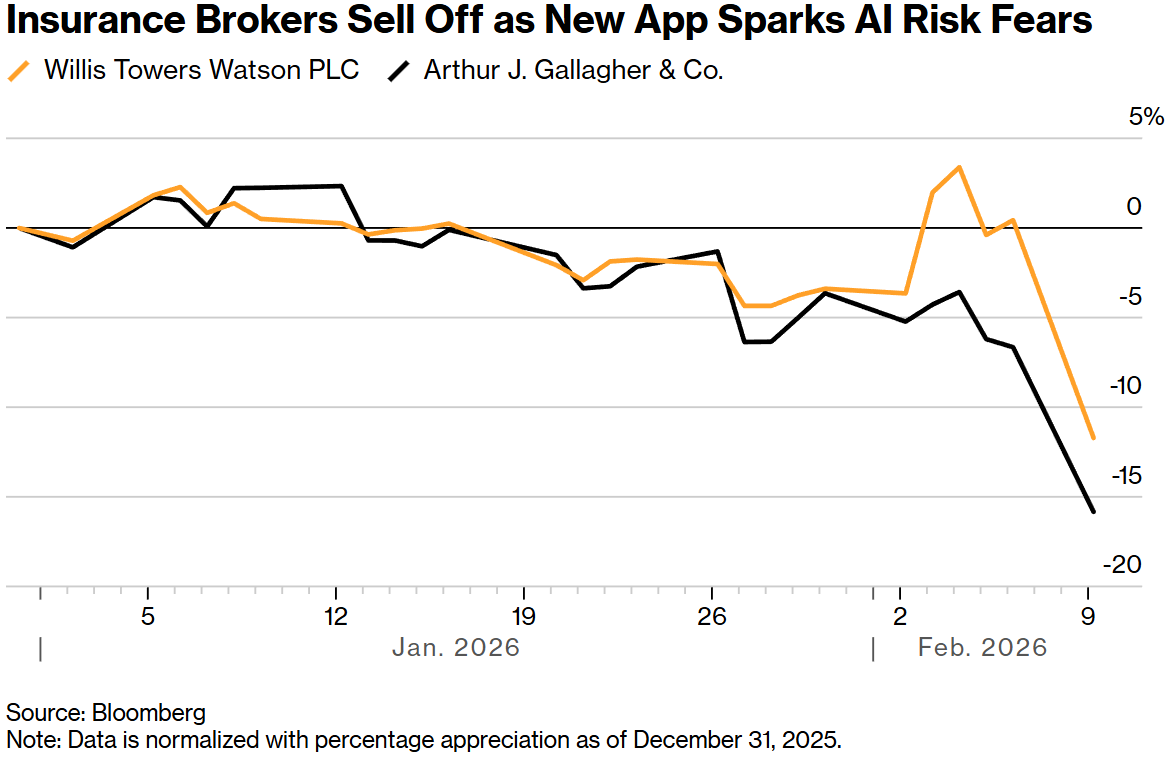
Group 1 - The core concern is the market's reaction to Insurify's launch of an AI tool, which has raised fears of disruption in the insurance industry, leading to significant stock sell-offs among U.S. insurance brokerage firms [1][4] - The S&P 500 insurance sector index closed down 3.9%, marking the largest decline since October of the previous year [1] - Willis Towers Watson PLC experienced the worst performance, with a closing drop of 12%, the most severe trading day since November 2008 [1] Group 2 - Following Willis Towers Watson, Arthur J Gallagher & Co. and Aon Group saw declines of 9.9% and 9.3%, respectively [1] - Analyst Matthew Palazola noted that while the new AI tools may pose a threat to some consulting aspects of insurance brokerage firms, they are more likely to act as "efficiency multipliers" rather than existential threats [4] - Insurify's application, which utilizes ChatGPT to compare auto insurance rates based on various inputs, was launched on February 3 [4]


德银:美股新常态?2026年才过几周,已上演5次“急跌后V字反转”
美股IPO· 2026-02-05 04:59
Core Viewpoint - The U.S. stock market has experienced multiple instances of rapid declines followed by quick recoveries in early 2026, indicating a potential new normal where market reactions to geopolitical tensions, tariff threats, and AI competition do not lead to sustained downturns [1][6][14]. Group 1: Market Behavior - In January 2026, the S&P 500 index saw at least five notable instances of "quick drop—rapid rebound" scenarios [4]. - These fluctuations were often linked to geopolitical risks, tariff threats, and concerns over technology stocks, yet they did not result in significant or lasting damage to the market [5][13]. - The market's ability to recover quickly suggests that investors are increasingly viewing sharp declines as buying opportunities rather than signals of a trend reversal [16]. Group 2: Economic Context - Deutsche Bank emphasizes that the key to determining whether the stock market will enter a sustained downturn lies not in short-term shocks but in whether macroeconomic expectations undergo a "structural downgrade" [14]. - The U.S. economy continues to show strong growth, with a projected annualized growth rate of 4.4% for Q3 and expectations for Q4 remaining above 4% [14][15]. - Historical patterns indicate that significant downturns are typically associated with systemic deterioration in growth, policy, or financial conditions, which is not currently the case [14]. Group 3: Market Dynamics - The report suggests that the current market behavior reflects a growing preference for "real data" over "news narratives," as evidenced by the rise in all major asset classes in January [16]. - The frequency of market volatility is increasing, but the magnitude of trend fluctuations remains suppressed, indicating a resilient market environment [17]. - Investors are advised to distinguish between "noise" and "signals," with true market downturns likely only occurring when there is a substantial reversal in growth expectations, policy direction, or financial conditions [17].