美股新常态

Search documents
德银:美股新常态?2026年才过几周,已上演5次“急跌后V字反转”
美股IPO· 2026-02-05 04:59
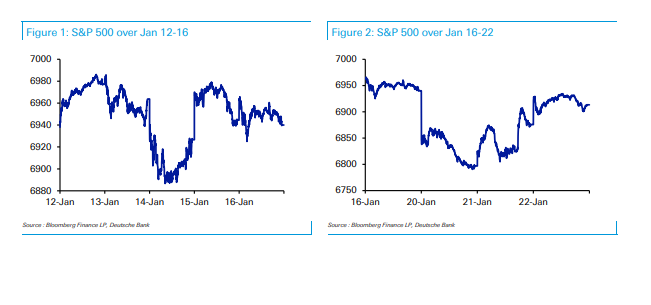
Core Viewpoint - The U.S. stock market has experienced multiple instances of rapid declines followed by quick recoveries in early 2026, indicating a potential new normal where market reactions to geopolitical tensions, tariff threats, and AI competition do not lead to sustained downturns [1][6][14]. Group 1: Market Behavior - In January 2026, the S&P 500 index saw at least five notable instances of "quick drop—rapid rebound" scenarios [4]. - These fluctuations were often linked to geopolitical risks, tariff threats, and concerns over technology stocks, yet they did not result in significant or lasting damage to the market [5][13]. - The market's ability to recover quickly suggests that investors are increasingly viewing sharp declines as buying opportunities rather than signals of a trend reversal [16]. Group 2: Economic Context - Deutsche Bank emphasizes that the key to determining whether the stock market will enter a sustained downturn lies not in short-term shocks but in whether macroeconomic expectations undergo a "structural downgrade" [14]. - The U.S. economy continues to show strong growth, with a projected annualized growth rate of 4.4% for Q3 and expectations for Q4 remaining above 4% [14][15]. - Historical patterns indicate that significant downturns are typically associated with systemic deterioration in growth, policy, or financial conditions, which is not currently the case [14]. Group 3: Market Dynamics - The report suggests that the current market behavior reflects a growing preference for "real data" over "news narratives," as evidenced by the rise in all major asset classes in January [16]. - The frequency of market volatility is increasing, but the magnitude of trend fluctuations remains suppressed, indicating a resilient market environment [17]. - Investors are advised to distinguish between "noise" and "signals," with true market downturns likely only occurring when there is a substantial reversal in growth expectations, policy direction, or financial conditions [17].

美股新常态?2026年才过几周,已上演5次“急跌后V字反转”
Hua Er Jie Jian Wen· 2026-02-05 03:22
Core Viewpoint - The U.S. stock market is experiencing a "new normal" characterized by rapid declines followed by quick recoveries, with the S&P 500 index showing at least five instances of this pattern in January alone [1][2]. Group 1: Market Behavior - The S&P 500 index faced significant volatility in January, with notable declines due to geopolitical risks, tariff threats, and concerns over technology investments, yet these declines were followed by rapid recoveries [2][5]. - Each decline prompted discussions about whether it signaled the beginning of a major adjustment, but historical patterns indicate that emotional noise is high while trend disruption remains low [5]. Group 2: Macroeconomic Context - The key to determining whether the stock market will enter a sustained downturn lies not in short-term shocks but in whether macroeconomic expectations undergo a "structural downgrade" [6]. - Current macroeconomic conditions are favorable, with the U.S. economy maintaining a high growth rate, evidenced by a 4.4% annualized growth rate in Q3 and an ISM manufacturing index at its highest level since 2022 [8]. Group 3: Investor Sentiment - The market is increasingly prioritizing "real data" over "news narratives," as evidenced by the rise in all major asset classes in January, indicating that risk appetite remains intact [9]. - The pattern of rapid declines followed by recoveries reinforces a buy-the-dip strategy among investors, suggesting that the frequency of market fluctuations is increasing while the magnitude of trend changes is being suppressed [9].