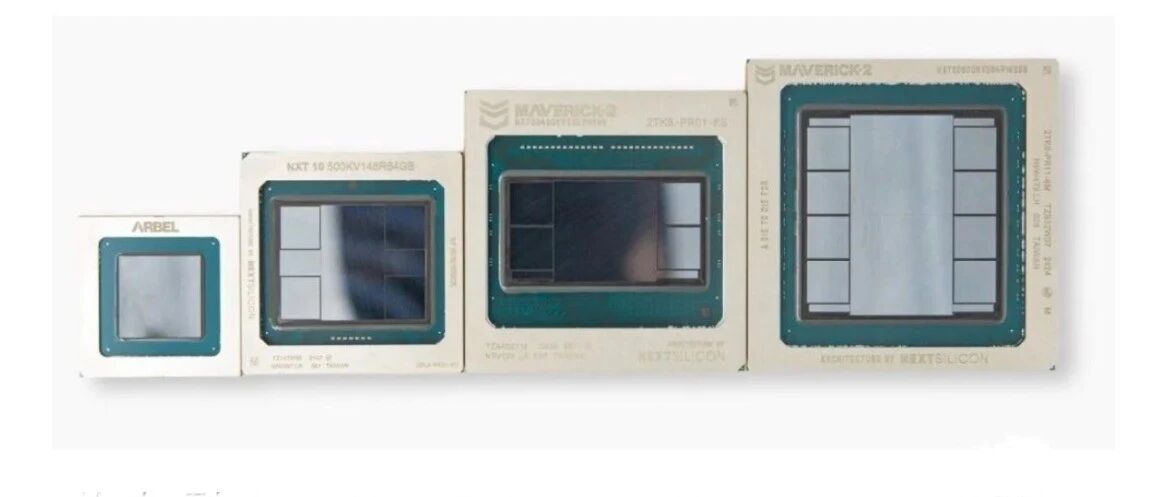
Arbel

Search documents
“ 红蓝厂”主导的服务器CPU迎来新势力! NextSilicon携RISC-V架构挑战英特尔与AMD
Zhi Tong Cai Jing· 2025-10-23 07:25
Core Insights - NextSilicon, an Israeli chip startup, is developing a new CPU based on the open-source RISC-V architecture, aiming to compete with AMD and Intel in the data center server CPU market [1][2] - The company's flagship product, the Maverick-2 data stream accelerator, is designed to significantly enhance precision scientific computing tasks, previously dominated by Nvidia [2] - NextSilicon's upcoming RISC-V architecture CPU, named "Arbel," is intended for high-performance computing (HPC) scenarios and aims to challenge the traditional x86+GPU architecture [5][6] Company Developments - NextSilicon has raised approximately $300 million in funding to support its chip development efforts [2] - The Maverick-2 is currently in mass production, while the Arbel CPU is still in the testing phase [4] - The company claims that its architecture can execute similar computing tasks as Nvidia's GPUs with faster speeds and lower power consumption without requiring extensive software code rewrites [4] Industry Context - The RISC-V architecture is gaining traction in the chip design sector, positioning itself as a competitor to the established x86 and ARM architectures [5] - RISC-V's open nature allows free access and usage, making it popular among academia, startups, and large tech companies [5] - The integration of RISC-V in data centers is expected to challenge the dominance of x86 and ARM architectures, potentially reshaping market dynamics [5][6]


“红蓝厂”主导的服务器CPU迎来新势力! NextSilicon携RISC-V架构挑战英特尔与AMD
智通财经网· 2025-10-23 07:15
Core Insights - NextSilicon, an Israeli chip startup, is developing a new CPU based on the open-source RISC-V architecture, aiming to compete with AMD and Intel in the data center server CPU market [1][2] - The company's flagship product, the Maverick-2 data stream accelerator, is designed to significantly enhance precision scientific computing tasks, previously dominated by NVIDIA [2] - NextSilicon's upcoming RISC-V architecture CPU, named "Arbel," is targeted at high-performance computing (HPC) scenarios and is currently in the testing phase [5][6] Group 1: Product Development - NextSilicon has raised approximately $300 million in funding to support its chip development efforts [2] - The Maverick-2 is characterized as a "data flow/reconfigurable" accelerator, integrating multiple RISC-V cores to handle serial code paths and control tasks efficiently [3] - The company claims that Maverick-2 can execute similar types of computations as NVIDIA's GPU products with faster speeds and lower power consumption without requiring extensive software code rewrites [4] Group 2: Market Positioning - The RISC-V architecture is gaining traction in the server domain, posing significant pressure on x86 and ARM architectures [6][7] - NextSilicon's Arbel CPU is positioned to challenge the long-standing dominance of Intel and AMD in the server CPU market, particularly in HPC applications [6][7] - The open nature of RISC-V allows for broader access and usage, making it popular among startups and large tech companies, and it is increasingly being adopted in data center environments [6][7] Group 3: Competitive Landscape - NextSilicon's architecture aims to reduce instruction and data transfer overhead compared to traditional CPU/GPU architectures, enhancing energy efficiency and throughput [7] - The integration of RISC-V in data centers is expected to create a competitive dynamic with x86 and ARM architectures, potentially leading to a shift in market share [6][7] - The ongoing evaluation of NextSilicon's chips by the Sandia National Laboratories indicates promising performance results, highlighting the potential for significant computational capability improvements [4]
一家芯片初创公司,单挑Nvidia和Intel
半导体行业观察· 2025-10-23 01:01
Core Viewpoint - NextSilicon is set to launch Maverick-2, the world's first Intelligent Compute Accelerator (ICA), designed to meet the demands of high-performance computing and AI applications while reducing power consumption and costs [2][4]. Group 1: Company Background and Funding - NextSilicon was founded in 2017 and has raised a total of $303 million in seed funding and three rounds of venture capital, with the latest round in June 2021 raising $120 million [4][5]. - The company's valuation reached approximately $1.5 billion during its C round of funding [5]. Group 2: Product Development and Architecture - Maverick-2 is based on a novel architecture that minimizes overhead and maximizes computational power for demanding AI and HPC applications, utilizing a non-Von Neumann data flow architecture [10][11]. - The architecture allows for real-time dynamic optimization of applications, focusing on the most resource-intensive code paths, achieving up to 10 times acceleration with only a quarter of the power consumption [13][14]. Group 3: Technical Specifications of Maverick-2 - Maverick-2 features four computing areas with a total of 224 computing blocks, each containing hundreds of ALUs, and is manufactured using TSMC's 5nm process with 54 billion transistors [16][22]. - The chip offers configurations with 32 RISC-V cores (single die) or 64 RISC-V cores (dual die), with a thermal design power (TDP) of 400W and 750W respectively [22][23]. - Performance metrics include 10.8 TFLOPS for float64 operations and 20.3 TFLOPS for float32 operations in the single die configuration [22]. Group 4: Competitive Landscape and Market Position - NextSilicon aims to differentiate itself from established players like NVIDIA by providing a specialized accelerator for high-performance computing, addressing the limitations of traditional GPU and CPU architectures [7][8]. - The company emphasizes the elimination of vendor lock-in and the ability to run existing CPU code without modification, positioning itself as a revolutionary force in the computing landscape [13][14][34]. Group 5: Introduction of Arbel RISC-V CPU - Alongside Maverick-2, NextSilicon introduced the Arbel RISC-V CPU, designed to handle serial code that is difficult to parallelize, achieving clock speeds of up to 2.5 GHz [26][28]. - The Arbel core features a wide instruction pipeline and advanced memory subsystems, aiming to compete with Intel and AMD's offerings [30][32].