x86架构

Search documents
英伟达与Meta扩大合作,英特尔股价承压
Jing Ji Guan Cha Wang· 2026-02-19 16:46
Group 1 - Nvidia announced an expansion of its partnership with Meta Platforms to deploy its Arm-based Grace CPU in Meta's data centers, marking Nvidia's first large-scale deployment of its CPU and entry into the server CPU market traditionally dominated by Intel and AMD [1] - This collaboration is seen as a sign of the accelerated migration of data centers towards Arm architecture, posing direct competitive pressure on Intel's x86 architecture [1] - Nvidia's CEO Jensen Huang hinted at the release of an unprecedented new chip at the upcoming GTC conference, raising further concerns about the competitive landscape for Intel [1] Group 2 - Following the news of Nvidia's partnership with Meta, Intel's stock showed weakness, with a nearly 3% intraday drop on February 19, 2026, and a closing decline of 1.56%, bringing its stock price to $44.71 [2] - Over the five days leading up to February 19, Intel's stock fell by 7.41%, and on February 13, it experienced a 3.75% drop due to concerns over tech stock performance and AI investment returns [2] - The semiconductor sector also faced a decline of 0.75%, while the Nasdaq index dropped by 1.41% during the same period [2] Group 3 - Richard Windsor, founder of research firm Radio Free Mobile, analyzed that the partnership between Nvidia and Meta represents a "killer" for Intel, highlighting the trend of data centers migrating to Arm, which is eroding Intel's market share [3] - Windsor noted that Intel's data center division saw a 9% year-over-year revenue decline in 2025, primarily due to cloud giants shifting towards self-developed Arm chips [3] - AMD's server CPU market share increased from 0% in 2016 to 27.3% in 2025, further squeezing Intel's traditional advantages [3] - The efficiency advantages of Arm and Meta's substantial annual spending plan of $135 billion may drive more Arm-based alternatives, posing a long-term challenge to Intel [3]
英伟达入局,这个赛道热闹了
半导体行业观察· 2026-01-31 03:49
Core Viewpoint - Nvidia is accelerating the development of Arm architecture-based System on Chips (SoCs) to enter the Windows consumer laptop market, which is seen as a significant step to challenge the long-standing x86 architecture dominance in the PC processor field [2][11]. Group 1: Nvidia's SoC Development - Nvidia plans to launch two SoC models, N1 and N1X, which integrate CPU and GPU into a single SoC, breaking the traditional "x86 CPU + discrete GPU" configuration [4]. - The N1 and N1X chips utilize TSMC's 3nm process and feature a combination of 10 high-performance Cortex-X925 cores and 10 energy-efficient Cortex-A725 cores, along with a Blackwell architecture GPU with 6144 CUDA cores [6]. - These chips support LPDDR5X-9400 unified memory (up to 128GB), which connects CPU, GPU, and AI acceleration units in a single memory pool, enhancing efficiency in local model inference and real-time video understanding [6]. Group 2: Market Positioning and Partnerships - Nvidia's Windows on Arm laptops are expected to cater to gaming, creative work, and local AI workloads, positioning them closer to the MacBook Pro rather than lightweight laptops [7]. - Lenovo and Dell are among the first strategic partners for Nvidia's PC processors, with Lenovo developing six models based on the N1X chip [7]. - Nvidia's sales strategy includes releasing reference designs to OEMs and establishing approved and recommended supplier lists to enhance performance tuning [8]. Group 3: Historical Context and Strategic Intent - Nvidia's foray into the PC processor market is not a sudden decision but a strategic extension of over a decade of technological groundwork, starting with the "Denver project" in 2011 [8][9]. - Despite past challenges with the Tegra processors in the consumer PC market, Nvidia has not abandoned its ambitions and has shifted focus to automotive platforms and embedded systems [9][10]. - The introduction of the N1/N1X series marks a significant milestone in Nvidia's long-term strategy to leverage its expertise in AI and GPU technology to meet the evolving demands of the PC market [12]. Group 4: Competitive Landscape - The entry of Nvidia into the PC CPU market is seen as a catalyst for innovation, potentially transforming the competitive landscape from a monopoly to a more diverse ecosystem [13]. - The Arm architecture, led by companies like Apple and Qualcomm, is increasingly pressuring the x86 architecture, with predictions that Arm-based laptops could capture 20% of the market by 2025 and over 40% by 2029 [18]. - AMD continues to gain market share in the x86 segment, with its Ryzen processors being well-received, while also exploring Arm architecture options to diversify its offerings [22]. Group 5: Future Outlook - The upcoming release of Nvidia's N1/N1X chips is anticipated to intensify competition in the PC processor market, potentially leading to significant technological advancements and price rationalization for consumers [33]. - The ongoing battle between x86 and Arm architectures signifies a critical turning point in the market, with implications for the future direction of computing architectures [33].


性能提升25%!亚马逊新一代自研服务器芯片Graviton5问世 冲击x86霸权
智通财经网· 2025-12-05 01:28
Core Insights - Amazon Web Services (AWS) has launched its next-generation in-house server CPU, Graviton5, which is claimed to be the most powerful and energy-efficient data center CPU to date [1][2] - The introduction of Graviton5 and the AI ASIC chip Trainium3 highlights AWS's ongoing expansion of its chip product lineup and a shift towards in-house development [1][2] - AWS's self-developed Graviton series CPUs now account for over half of the new large-scale CPU clusters added in the past three years, indicating a significant reduction in reliance on Intel and AMD [1] Product Details - Graviton5 offers up to a 25% performance improvement compared to its predecessor while maintaining industry-leading energy efficiency, enabling faster application performance and reduced computing costs [2] - The L3 cache capacity of each Graviton5 core is 2.6 times that of Graviton4, with network and storage bandwidth increased by 15% to 20% [2] - The M9g instance based on Graviton5 is currently in preview, while C9g and R9g instances are planned for release in 2026 [3] Market Context - The trend of cloud giants like Amazon, Microsoft, and Google developing their own server CPUs and AI accelerators may significantly reduce their procurement of server CPUs from Intel and AMD, as well as the overall demand for NVIDIA's AI GPU clusters [1][5] - The shift towards in-house ARM architecture CPUs allows cloud providers to optimize for specific workloads, potentially leading to significant cost savings and improved performance [5][6] - Despite the rise of ARM-based CPUs, x86 architecture (Intel and AMD) remains the dominant choice in the global server market, particularly for traditional enterprise cloud infrastructure [6]

海外产业叙事:AMD超威半导体的崛起
新财富· 2025-11-10 08:04
Core Viewpoint - AMD has evolved from a small startup in 1969 to a leading player in the semiconductor industry, with significant advancements in AI computing and server processors, projecting revenues of approximately $25.8 billion in 2024, a 14% year-over-year increase, and a gross margin of $12.7 billion with a gross margin rate of 49% [2]. Group 1: Historical Development - AMD was founded in 1969 by Jerry Sanders and seven colleagues, initially operating in a modest setting and later moving to a more permanent location after securing funding [2]. - The company initially positioned itself as a "second supplier" in the semiconductor market, focusing on cost-effective alternatives through reverse engineering and manufacturing capabilities [7]. - AMD's first major product, the Am2501 logic counter, marked its transition from a contract manufacturer to a technology developer [7]. - In 1976, AMD signed a crucial cross-licensing agreement with Intel, allowing it to produce x86 architecture processors, which laid the foundation for the "Wintel" ecosystem [8][9]. Group 2: Strategic Shifts and Innovations - The 1980s marked a growth phase for AMD, becoming the second supplier for IBM's personal computer processors and launching the 8086 processor [11]. - The company faced challenges in the late 1980s due to the rise of Japanese manufacturers in the semiconductor market, prompting AMD to shift towards innovation and self-sufficiency [12]. - AMD's breakthrough came in the 1990s with the development of the Am386 processor, which demonstrated its capability for independent design and innovation [13]. - The launch of the K7 Athlon processor in 1999 marked AMD's first significant victory over Intel, capturing nearly 25% of the x86 processor market by 2001 [14]. Group 3: Challenges and Recovery - AMD's acquisition of ATI in 2006 aimed to enter the graphics market but led to significant debt and operational challenges, resulting in a period of financial distress [17][18]. - By 2012, AMD faced severe financial difficulties, with a net loss of $1.2 billion and a stock price drop, leading to concerns about its viability as an independent company [19]. - The appointment of Dr. Lisa Su as CEO in 2014 initiated a turnaround strategy focused on core products and the development of the Zen architecture [20]. Group 4: Recent Developments and Future Prospects - The introduction of the Ryzen processors in 2017, based on the Zen architecture, allowed AMD to regain market confidence and compete effectively against Intel [21]. - AMD's EPYC server processors have significantly increased market share, reaching parity with Intel in the server CPU market by Q1 2025 [22]. - The launch of the MI300 series accelerators in 2023, designed for AI workloads, positions AMD to challenge NVIDIA's dominance in the AI computing space [26]. - A strategic partnership with OpenAI, including a warrant for 160 million shares, aims to enhance AMD's position in the AI market and improve its software ecosystem [29][30].
象帝先董事长回顾与展望中国算力芯片的“新十年”
是说芯语· 2025-10-30 03:34
Core Viewpoint - The article emphasizes the importance of unifying instruction set architecture (ISA) for the development of China's computing chips, suggesting that RISC-V should be adopted as a standard to enhance innovation and resource efficiency in the semiconductor industry [5][30]. Group 1: Evolution of Computing Architecture - Over the past 40 years, the development of processor chips has followed a "negation of negation" spiral, oscillating between self-research and abandonment [4]. - The last five years have seen a resurgence of machine and platform manufacturers entering the "chip war," shifting from CPU-centric homogeneous computing systems to heterogeneous computing involving CPUs and xPUs [5]. - The computing evolution has transitioned from centralized processing to distributed systems, with the current core CPUs dominated by x86 and ARM architectures [9][10]. Group 2: Challenges in Architecture Innovation - The article discusses the difficulty of architecture innovation and the greater challenge of building an ecosystem, highlighting that software and collaboration barriers are significant [14]. - The dominance of x86 architecture is attributed to its ability to adapt and expand its instruction set to meet new application demands, while RISC architectures have struggled due to high costs and inability to disrupt existing ecosystems [11][13]. - The article notes that the software development costs significantly exceed hardware costs, making it challenging for new architectures to gain traction in the market [19]. Group 3: Future of RISC-V and ARM - RISC-V faces commercialization challenges despite its potential, with successful applications primarily in simple software scenarios like embedded systems [21]. - The article predicts that x86 CPUs will continue to dominate the server market for the foreseeable future, while ARM's success will depend on its ability to penetrate the x86-dominated landscape [20]. - The article suggests that the future of RISC-V in general-purpose computing will require overcoming significant hurdles, particularly in software and ecosystem development [24]. Group 4: Unified Instruction Set as a Key Pathway - The article advocates for a unified instruction set as a critical pathway for scaling China's computing chips, with cloud service providers being more successful in self-developing chips due to their control over the entire stack [25][26]. - It highlights that successful self-developed chips, like those from Apple, are not just about hardware but also about the integration of software and ecosystem capabilities [27][28]. - The call for RISC-V as a unified instruction system aims to avoid redundant efforts and resource wastage in chip development, promoting a more efficient innovation landscape [30].


传AMD正在开发Arm芯片
半导体行业观察· 2025-10-28 01:07
Core Viewpoint - AMD is developing an Arm-based APU codenamed "Sound Wave," expected to be released late next year, indicating a strategic shift towards mobile applications and energy efficiency [3][7]. Group 1: Product Development - AMD's "Sound Wave" APU will feature a compact 32mm x 27mm BGA package, six CPU cores (two P-cores and four E-cores), and an RDNA architecture GPU, targeting mobile applications [3]. - The company has been shipping circuit boards to evaluate electrical characteristics, suggesting progress in development [3]. Group 2: Market Positioning - AMD has been competing in the PC/server market against Intel, but is now looking to expand its market share in the mobile sector by integrating Arm architecture into its CPUs [3]. - The company has a history of developing Arm-based CPUs, including the A1100 server CPU, but faced challenges in gaining market acceptance [5][6]. Group 3: Historical Context - AMD's previous attempts to enter the Arm market included the K12 project, which was ultimately canceled in favor of focusing on the Zen architecture to regain dominance in the x86 market [6]. - The landscape has changed significantly over the past decade, with a shift in technological innovation from CPUs to GPUs, and AMD now has the financial capability to develop both architectures simultaneously [6]. Group 4: Competitive Landscape - The recent collaboration between NVIDIA and Intel in the x86 market raises questions about AMD's strategy as it prepares to enter the Arm CPU market dominated by NVIDIA and Qualcomm [6]. - AMD's potential entry into the Arm space could disrupt the current market dynamics, especially given the evolving technological landscape [6][7].

英特尔(INTC.US)Q3电话会:18A制程良率预计后年达行业公认的良率水平
智通财经网· 2025-10-27 07:40
Core Insights - Intel's Q3 revenue reached $13.7 billion, exceeding expectations and showing a 6% quarter-over-quarter growth, with a gross margin of 40%, 4 percentage points above guidance [1] - The company is focusing on improving the yield of its 18A process technology, which is currently sufficient to meet supply demand but not yet at ideal profit margin levels [1][9] - AI is driving significant growth for Intel, with a strategic emphasis on revitalizing the x86 architecture and developing customized CPUs and GPUs for new AI workloads [1][15] Financial Performance - Q3 revenue was $13.7 billion, surpassing the upper limit of expectations, with a gross margin of 40% [1] - The company anticipates maintaining operational expenditures at $16 billion for the next year [1][8] - Non-controlling interest expenses are projected to be between $1.2 billion and $1.4 billion for 2026 [20] Production and Capacity - Intel will not add additional capacity for the 18A process in the coming year but will gradually increase its output throughout the year [1][11] - The company is experiencing tight capacity in its Intel 10 and Intel 7 processes, with shortages expected to peak in Q1 [1][7] - The yield of the 14A process is performing better than the 18A process at the same maturity stage [9] Strategic Partnerships and Market Position - Intel is engaging with multiple clients in the foundry space, emphasizing the importance of having the right IP to meet customer needs [4] - The collaboration with Nvidia is seen as a significant opportunity to create next-generation AI-optimized products for data centers and PCs [14][19] - The company is focusing on building long-term trust with clients and recruiting top talent to drive process technology improvements [2] AI and Product Development - AI is a major growth driver, with Intel's AI business achieving double-digit growth quarter-over-quarter [10] - The company aims to develop customized solutions for AI workloads, particularly in the inference market [15] - Intel's strategy includes enhancing its ASIC design capabilities to meet specific customer demands [12] Future Outlook - The company expects to reach ideal yield levels for the 18A process by the end of next year and to achieve industry-standard yield levels in the following year [1][9] - There is optimism regarding the demand landscape, with expectations for a stronger market moving into next year [6] - The company is committed to improving its gross margin, which is currently impacted by high costs associated with older process technologies [17]
“?红蓝厂”主导的服务器CPU迎来新势力! NextSilicon携RISC-V架构挑战英特尔与AMD
Zhi Tong Cai Jing· 2025-10-23 07:22
Core Insights - NextSilicon, an Israeli chip startup, is developing a new CPU based on the open-source RISC-V architecture, aiming to challenge the dominance of Intel and AMD in the data center server CPU market [1][2][5] - The company's flagship product, the Maverick-2 data stream accelerator, is designed to significantly enhance precision scientific computing tasks, previously dominated by Nvidia [2][4] - NextSilicon's upcoming RISC-V CPU, named "Arbel," is targeted at high-performance computing (HPC) scenarios and is intended to work closely with the Maverick-2/3 accelerators [5][6] Group 1 - NextSilicon has raised approximately $300 million in funding to support its development efforts [2] - The Maverick-2 operates on a "data flow/reconfigurable" architecture, integrating multiple RISC-V cores to handle serial code paths and control tasks efficiently [3][4] - The company claims that its products can execute similar computational tasks as Nvidia's GPUs with faster speeds and lower power consumption, without requiring extensive software code rewrites [4] Group 2 - The RISC-V architecture is gaining traction in the server domain, posing significant pressure on both x86 and ARM architectures [4][6] - NextSilicon's Arbel CPU is positioned to create a "host + accelerator" stack that competes directly with the traditional x86 + GPU architecture [5][6] - The open nature of RISC-V allows for widespread adoption across academia, startups, and large tech companies, making it a formidable competitor to ARM [6]
“红蓝厂”主导的服务器CPU迎来新势力! NextSilicon携RISC-V架构挑战英特尔与AMD
智通财经网· 2025-10-23 07:15
Core Insights - NextSilicon, an Israeli chip startup, is developing a new CPU based on the open-source RISC-V architecture, aiming to compete with AMD and Intel in the data center server CPU market [1][2] - The company's flagship product, the Maverick-2 data stream accelerator, is designed to significantly enhance precision scientific computing tasks, previously dominated by NVIDIA [2] - NextSilicon's upcoming RISC-V architecture CPU, named "Arbel," is targeted at high-performance computing (HPC) scenarios and is currently in the testing phase [5][6] Group 1: Product Development - NextSilicon has raised approximately $300 million in funding to support its chip development efforts [2] - The Maverick-2 is characterized as a "data flow/reconfigurable" accelerator, integrating multiple RISC-V cores to handle serial code paths and control tasks efficiently [3] - The company claims that Maverick-2 can execute similar types of computations as NVIDIA's GPU products with faster speeds and lower power consumption without requiring extensive software code rewrites [4] Group 2: Market Positioning - The RISC-V architecture is gaining traction in the server domain, posing significant pressure on x86 and ARM architectures [6][7] - NextSilicon's Arbel CPU is positioned to challenge the long-standing dominance of Intel and AMD in the server CPU market, particularly in HPC applications [6][7] - The open nature of RISC-V allows for broader access and usage, making it popular among startups and large tech companies, and it is increasingly being adopted in data center environments [6][7] Group 3: Competitive Landscape - NextSilicon's architecture aims to reduce instruction and data transfer overhead compared to traditional CPU/GPU architectures, enhancing energy efficiency and throughput [7] - The integration of RISC-V in data centers is expected to create a competitive dynamic with x86 and ARM architectures, potentially leading to a shift in market share [6][7] - The ongoing evaluation of NextSilicon's chips by the Sandia National Laboratories indicates promising performance results, highlighting the potential for significant computational capability improvements [4]
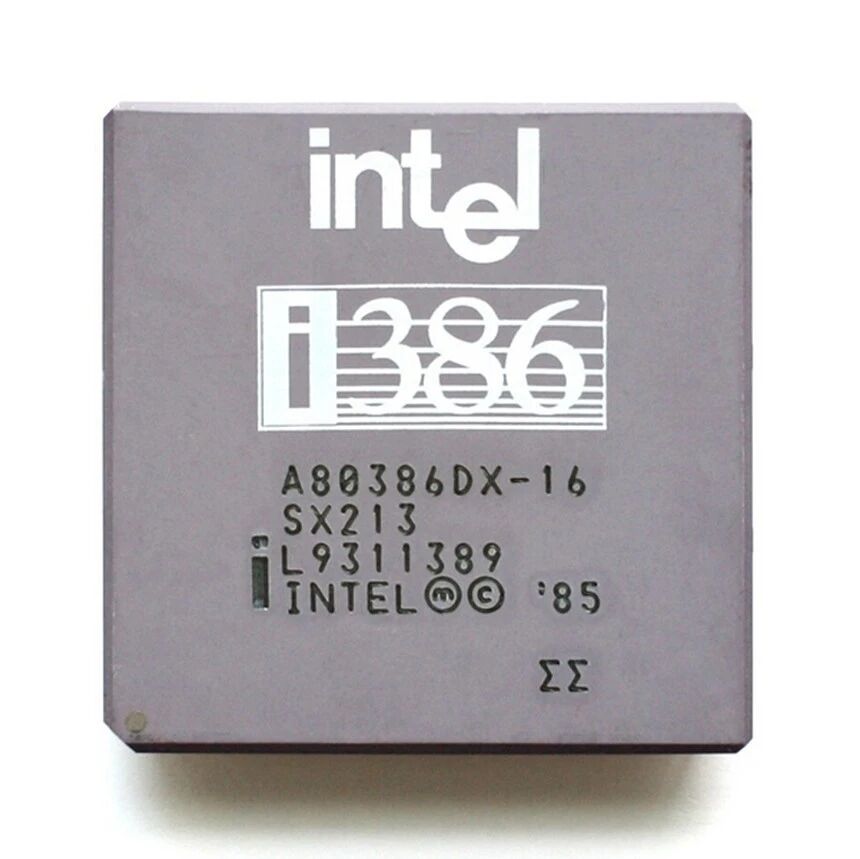
这颗40岁的芯片,改写历史!
半导体芯闻· 2025-10-20 10:40
Core Insights - The Intel 80386 processor, launched in October 1985, marked a significant turning point in personal computing as the first 32-bit chip in the Intel PC product line and the origin of the IA-32 instruction set [1][5][14] - The 80386 featured 275,000 transistors and operated at a frequency of up to 16 MHz, supporting a maximum address space of 4GB, which laid the foundation for true multitasking and virtual memory [1][4] - The introduction of the 80386 led to the development of various operating systems, including early versions of Windows and Linux, which utilized its advanced features [4][12] Group 1: Historical Context - The 80386 was developed as a response to the competitive landscape, particularly after IBM rejected Intel's earlier designs, leading Compaq to be the first company to launch a computer with the new CPU [2][11] - The Deskpro i386, released by Compaq in September 1986, was priced at $6,499 and became a pivotal product in the PC industry [2][10] - The architecture of the 80386 was influenced by the need for backward compatibility and the desire to create a more powerful and efficient processing unit compared to its predecessors [6][8] Group 2: Technical Advancements - The 80386 introduced a protected mode and paging capabilities, which allowed for better memory management and the ability to run multiple DOS sessions simultaneously [1][4][8] - It expanded the instruction set significantly, adding 54 new instructions and various addressing modes to effectively utilize the 4GB address space [8][10] - The architecture's design enabled the development of a robust ecosystem around the 80386, leading to its widespread adoption in servers and mobile computers [14] Group 3: Market Impact - The 80386's success was crucial for Intel, as it faced significant competition from other manufacturers who were also producing x86-compatible processors [5][12] - By the late 1980s, the 80386 had established itself as a standard in the PC market, leading to the creation of a diverse range of applications and operating systems that leveraged its capabilities [12][14] - The processor's legacy continues today, as modern x86 processors still retain the core architecture established by the 80386, highlighting its lasting influence on computing [14][15]