Azure Maia AI Accelerator

Search documents
Microsoft wants to mainly use its own AI data center chips in the future
CNBC· 2025-10-01 14:07
Core Insights - Microsoft aims to primarily utilize its own chips in data centers to reduce dependence on Nvidia and AMD [1][6] - The company has been developing custom chips for AI workloads, including the Azure Maia AI Accelerator and Cobalt CPU [5] - Microsoft is focused on optimizing the entire system design, including networks and cooling, to enhance performance for specific workloads [7] Chip Strategy - Microsoft currently relies on Nvidia and AMD for chip supply, prioritizing the best price-performance ratio [3][4] - The long-term strategy involves increasing the use of Microsoft-designed silicon in data centers [6] - The company is exploring next-generation semiconductor products to further its chip development efforts [5] Industry Context - Nvidia has been the dominant player in the semiconductor space for AI applications, while AMD holds a smaller market share [2] - Major cloud computing companies, including Microsoft, Google, and Amazon, are designing their own chips to enhance efficiency and reduce reliance on external suppliers [7]



英伟达占标准普尔 500 指数的 8%——历史表明,野兽模式或将结束
美股研究社· 2025-08-19 12:44
Core Viewpoint - Nvidia (NASDAQ: NVDA) is facing significant challenges ahead, including high valuation and unprecedented competition, despite its current success in the AI and robotics sectors [1][2]. Valuation Concerns - Nvidia's stock price has doubled since its low in April, indicating it is currently overbought and may be due for a correction [2]. - The stock is trading well above its 50-day moving average (approximately $163) and 200-day moving average (approximately $136) [2]. - Analysts express skepticism about the stock's future performance given its high price-to-earnings ratio exceeding 40 [9]. Competitive Landscape - Major tech companies are developing their own AI chips, posing a significant threat to Nvidia: - Google has developed TPU and plans to release new AI chips in 2024 and 2025 [5]. - Microsoft is working on Azure Maia AI Accelerator and Azure Cobalt CPU for its data centers [6]. - Amazon has its own AI chips, "Trainium" and "Inferentia," for training and inference tasks [7]. - Emerging companies like Cerebras Systems, Tenstorrent, and Graphcore are also entering the AI chip market, potentially disrupting Nvidia's dominance [8]. Market Influence - Nvidia currently accounts for approximately 8% of the S&P 500 index, which raises concerns about its influence on the overall market [8]. - The historical context shows that no chip company has maintained a leading position in the S&P 500 for an extended period, indicating potential volatility for Nvidia [15]. Historical Performance and Future Outlook - Historical trends suggest that past performance does not guarantee future results, and Nvidia's current valuation may not be sustainable [9][10]. - The company is attempting to diversify its business, which could stabilize its position in the long term, similar to Microsoft [14]. - Analysts suggest that the current high stock price may present an ideal selling opportunity before the upcoming earnings report [14].


AI Chip Market Global Outlook & Forecasts Report 2024-2029 Featuring Prominent Vendors - AMD, Intel, NVIDIA, QUALCOMM, and Taiwan Semiconductor Manufacturing Co
Globenewswire· 2025-02-27 14:12
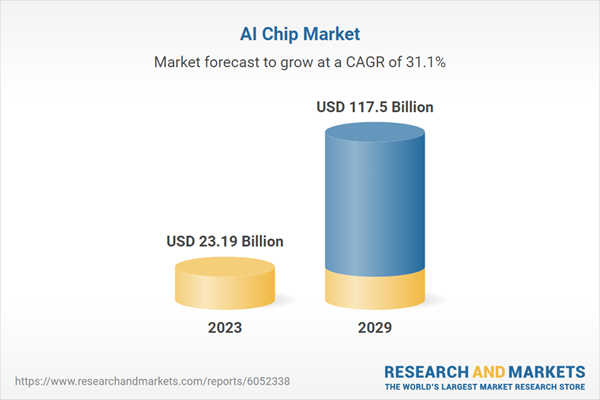
Core Insights - The global AI chip market was valued at USD 23.19 billion in 2023 and is projected to reach USD 117.50 billion by 2029, with a compound annual growth rate (CAGR) of 31.06% [1][20]. Market Overview - The AI chip market is experiencing high competition driven by the demand for high-performance, low-power data processing solutions essential for various sectors [2]. - Leading tech companies such as NVIDIA, AMD, Intel, and Microsoft are heavily investing in R&D to create advanced AI processors to meet the growing demand for efficient AI computations [3]. Regional Insights - North America, particularly the U.S., is a leader in the AI chip market due to strong technological innovation and significant investments in AI R&D [4]. - The APAC region is rapidly growing, with countries like China, Japan, South Korea, and India emerging as technological hubs, particularly China focusing on reducing dependence on foreign chip manufacturers [5]. - Europe is witnessing growth in AI chip adoption, driven by government initiatives, with Germany, the UK, and France being key players [5]. - The Middle East and Africa have smaller AI chip markets but are seeing emerging opportunities due to government initiatives in countries like the UAE and Saudi Arabia [6]. Market Trends and Opportunities - Advanced node development is crucial for AI chip performance, with smaller manufacturing processes leading to increased efficiency [7]. - The U.S. Department of Commerce and Intel announced a preliminary agreement for Intel to receive approximately USD 8.5 billion in funding under the CHIPS and Science Act to enhance semiconductor manufacturing [8]. - Governments worldwide are investing heavily in AI chip technologies for national security and competitiveness, with the U.S. government set to invest up to USD 100 million for sustainable semiconductor materials research [10][11]. Product Launches - AMD launched the Ryzen AI PRO 300 Series Processors in October 2024, featuring advanced capabilities for business productivity [13]. - NVIDIA introduced the Blackwell Platform in March 2024, designed for generative AI and optimized for cost and energy efficiency [14]. - Microsoft unveiled custom-designed chips, the Azure Maia AI Accelerator and Azure Cobalt CPU, aimed at enhancing AI infrastructure [16]. Market Segmentation - The AI chip market is segmented by type, with the ASIC segment expected to grow at the highest CAGR of over 31.70% due to its efficiency in processing data-intensive AI algorithms [17]. - The cloud segment dominates the processing market, driven by its scalability and efficiency in handling large datasets [18]. - The data center segment holds the highest revenue share among end-users, critical for AI applications due to the exponential increase in data generation [19].