Blackwell系列图形处理器

Search documents
英伟达业绩暴增驱散AI阴霾 华尔街吃下“定心丸”
Jin Shi Shu Ju· 2025-11-20 01:03
Core Viewpoint - Nvidia reported record sales and strong guidance, alleviating recent market concerns about an AI bubble [1] Group 1: Financial Performance - Nvidia's sales for the October quarter reached a record high of $57 billion, a 62% increase year-over-year, surpassing analyst expectations [1] - The company raised its sales forecast for the upcoming quarter to $65 billion, exceeding the previous analyst estimate of $62.1 billion [1] - Nvidia's quarterly net profit reached $31.9 billion, a 65% year-over-year increase [3] - Revenue from the data center business hit a record $51.2 billion, exceeding the analyst forecast of $49 billion [3] Group 2: Market Sentiment and Investor Behavior - Recent weeks have seen a sell-off in large tech stocks due to concerns over aggressive investments in AI infrastructure [1] - A Bank of America survey indicated that 45% of global fund managers view the AI stock market bubble as a significant risk [2] - Notable investors, including SoftBank and Peter Thiel's hedge fund, have liquidated their Nvidia holdings, reflecting a bearish sentiment [2] Group 3: Industry Dynamics - Nvidia's CEO stated that the company has entered a "virtuous cycle" of AI, with AI permeating various sectors [1] - The emergence of "circular" financing structures in AI transactions has raised market caution, particularly regarding large capital investments by suppliers like Nvidia [2] - Despite a recent pullback in stock price due to bubble concerns, Nvidia's stock has still seen a year-to-date increase of approximately 30% [3]

英伟达业绩暴增驱散AI阴霾,华尔街吃下“定心丸”
Xin Lang Cai Jing· 2025-11-19 23:20
Core Viewpoint - Nvidia reported record sales of $57 billion for the October quarter, driven by strong demand for high-end AI data center chips, alleviating recent concerns about an AI bubble in the market [1][2] Financial Performance - Nvidia's sales increased by 62% year-over-year, surpassing analyst expectations [1] - The company raised its revenue forecast for the upcoming quarter to $65 billion, exceeding the previous analyst estimate of $62.1 billion [1] - Net profit for the quarter reached $31.9 billion, a 65% increase compared to the previous year [4] - Revenue from the data center business hit a record $51.2 billion, exceeding the analyst forecast of $49 billion [4] Market Reaction - Nvidia's stock price rose over 6% in after-hours trading following the earnings report [2] - The company's stock has increased from $90 in early April to over $200 by the end of October, marking a rise of over 100%, although it has recently retraced some gains due to bubble concerns [5] Industry Context - The market sentiment around AI stocks has been tense, with concerns about excessive investments in data centers and chips amid the AI development race [3] - A recent Bank of America survey indicated that 45% of global fund managers view the AI stock market bubble as a significant risk [4] - Notable investors, including SoftBank and Peter Thiel, have recently reduced their holdings in Nvidia, reflecting growing caution in the market [4]
对华H20销量为0,英伟达营收不及预期
Guan Cha Zhe Wang· 2025-08-28 05:49
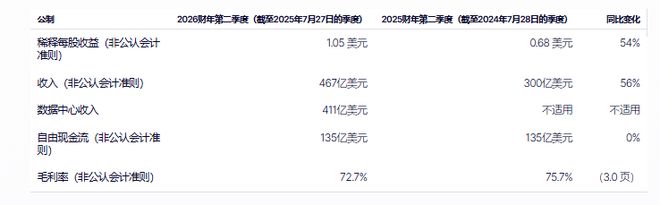
Core Viewpoint - Nvidia's Q2 earnings report for fiscal year 2026 fell short of investor expectations despite showing significant revenue growth, primarily due to concerns over its data center business and lack of sales in the Chinese market [1][4]. Financial Performance - Q2 total revenue reached $46.7 billion, up from $30.04 billion year-over-year, representing a 56% increase, slightly above market expectations of $46.058 billion [1][2]. - Data center revenue was $41.1 billion, also a 56% year-over-year increase, but slightly below analyst expectations of $41.29 billion [1][3]. - Nvidia expects Q3 revenue to be around $54 billion, with a 2% fluctuation, compared to market expectations of $53.46 billion [1]. Business Segments - Gaming and AI PC revenue for Q2 was $4.3 billion, a 49% increase year-over-year, exceeding analyst expectations of $3.82 billion [2]. - Professional visualization revenue was $601 million, up 32% year-over-year, surpassing expectations of $532 million [2]. - Automotive and robotics revenue reached $586 million, a 69% increase year-over-year, also exceeding analyst expectations [2]. Data Center Business Insights - The data center business, which accounts for 88% of total revenue, showed a slowdown in growth, with a year-over-year increase of 56%, down from 73% in the previous quarter [3]. - The Blackwell series GPUs performed well, with a 17% increase in sales, contributing nearly 70% to data center compute revenue [3]. Market Concerns - Nvidia's stock fell over 5% in after-hours trading following the earnings report, attributed to the data center business's underperformance and conservative Q3 guidance [4]. - The lack of a strategy to address sales challenges in the Chinese market raised concerns among investors, particularly regarding the H20 chip, which saw a $4 billion reduction in sales due to U.S. government restrictions [4][5]. Future Outlook - Nvidia's Q3 revenue forecast does not include any income from AI chip sales in China, indicating a conservative approach due to ongoing regulatory issues [5]. - The CFO mentioned that if regulatory issues are resolved, Q3 H20 chip revenue could reach $2-5 billion, but analysts expressed skepticism about this optimistic outlook [6]. Regulatory Challenges - The U.S. government previously banned the export of the H20 chip to China, which significantly impacted Nvidia's revenue from that region [7]. - Nvidia is exploring the introduction of a new processor based on the Blackwell architecture for the Chinese market, although concerns about security and compliance remain [7].

对华H20销量为0,英伟达数据中心营收不及预期
Guan Cha Zhe Wang· 2025-08-28 05:35
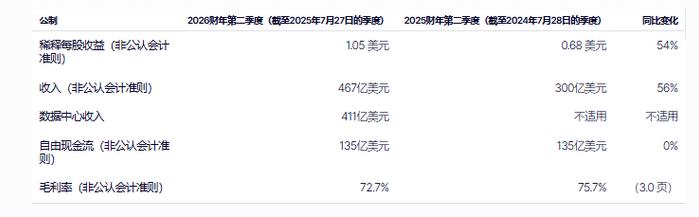
Core Viewpoint - Nvidia's Q2 earnings report for fiscal year 2026 fell short of investor expectations despite showing significant revenue growth, primarily due to concerns over its data center business and lack of sales in the Chinese market [1][4]. Financial Performance - Q2 total revenue reached $46.7 billion, up from $30.04 billion year-over-year, representing a 56% increase, slightly above market expectations of $46.058 billion [1][2]. - Non-GAAP diluted earnings per share were $1.05, compared to $0.68 in the same quarter last year, marking a 54% increase [2]. - Data center revenue was $41.1 billion, also a 56% year-over-year increase, but slightly below analyst expectations of $41.29 billion [1][3]. - Gross margin (non-GAAP) decreased to 72.7% from 75.7% year-over-year [2]. Business Segment Performance - Gaming and AI PC revenue was $4.3 billion, up 49% year-over-year, exceeding analyst expectations of $3.82 billion [2]. - Professional visualization revenue reached $601 million, a 32% increase year-over-year, surpassing expectations of $532 million [2]. - Automotive and robotics revenue was $586 million, up 69% year-over-year, also exceeding analyst expectations [2]. Data Center Business Insights - The data center business, which accounts for 88% of total revenue, showed a slowdown in growth, with a year-over-year increase of 56% compared to 73% in the previous quarter [3]. - The Blackwell series GPUs saw a 17% increase in sales quarter-over-quarter, contributing significantly to data center revenue [3]. Market Concerns - Nvidia's stock fell over 5% in after-hours trading following the earnings report, attributed to the underperformance of the data center business and conservative guidance for Q3 [4]. - The company did not include any revenue from AI chips sold in China in its Q3 outlook, indicating a cautious approach due to regulatory challenges [5][6]. - The inability to sell the H20 chip in China resulted in a $4 billion revenue loss, as confirmed by CEO Jensen Huang [4][7]. Regulatory Challenges - Nvidia has faced significant hurdles in the Chinese market due to U.S. government restrictions on the H20 chip, which is crucial for its revenue in that region [4][7]. - The company is exploring new chip offerings for China but faces skepticism regarding the resolution of security concerns before any significant sales can occur [7].