Cosmos Cookbook

Search documents
NVIDIA开源 Alpamayo-R1:让车真正“理解”驾驶
3 6 Ke· 2025-12-03 04:27
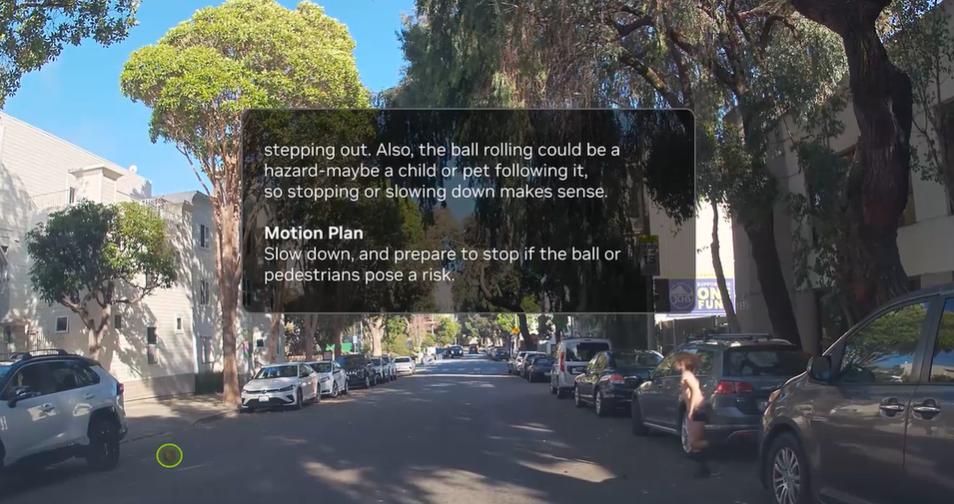
Core Insights - NVIDIA announced the launch of Alpamayo-R1, the world's first open-source Vision-Language-Action Model specifically designed for autonomous driving research, marking a shift from perception-driven systems to semantic understanding and common-sense reasoning [1][12] Group 1: Model Features - Alpamayo-R1 is built on the Cosmos-Reason architecture, introducing a "Chain-of-Thought" mechanism that allows the model to break down complex driving tasks into interpretable reasoning steps [4] - The model enhances robustness in operational design domain (ODD) boundary conditions, particularly addressing long-tail challenges faced by Level 4 autonomous driving [4][6] - Unlike traditional end-to-end models that map images directly to control signals, Alpamayo-R1 enables vehicles to "understand why" certain actions are taken, mimicking human-like multi-step reasoning in complex scenarios [6] Group 2: Open Source and Development Tools - NVIDIA has open-sourced the Alpamayo-R1 model weights and released the Cosmos Cookbook, a comprehensive AI development toolkit for autonomous driving [7] - The toolkit includes high-quality data construction standards, synthetic data generation pipelines, lightweight deployment solutions, and safety assessment benchmarks [7] Group 3: Collaborative Driving Systems - NVIDIA, in collaboration with Carnegie Mellon University, introduced the V2V-GoT system, the first framework applying Graph-of-Thought reasoning for multi-vehicle collaborative autonomous driving [9] - This system significantly reduces intersection collision rates from 2.85% to 1.83% and accurately predicts surrounding vehicles' movements within three seconds [9] Group 4: Synthetic Data Generation - The performance of Alpamayo-R1 is supported by NVIDIA's advanced synthetic data generation capabilities, utilizing the Cosmos world model trained on 20,000 hours of real driving footage [11] - This synthetic data addresses the scarcity of real-world long-tail distributions and supports closed-loop adversarial training for emergency response capability testing [11] Group 5: Strategic Implications - The release of Alpamayo-R1 represents a significant step in NVIDIA's "physical AI" strategy, moving beyond a perception-planning-control pipeline to create embodied agents that understand physical laws and social norms [12] - The open-source strategy is expected to accelerate global research and development in the next generation of autonomous driving technologies [13]


英伟达开源最新VLA,能否破局L4自动驾驶?
Tai Mei Ti A P P· 2025-12-02 13:01
Core Insights - NVIDIA has officially open-sourced its latest autonomous driving Vision-Language-Action (VLA) model, Alpamayo-R1, which can process vehicle camera images and text instructions to output driving decisions [2][3] - The Alpamayo-R1 model emphasizes "explainability," providing reasons for its decisions, which aids in safety validation and regulatory review [3][4] - The VLA model is seen as the next core technology in intelligent driving, with various companies, including Li Auto, Xpeng Motors, and Great Wall Motors, already implementing it in production [3][4] Group 1: Model Features and Benefits - Traditional end-to-end models are often "black boxes," making them difficult to interpret, especially in complex scenarios [4] - VLA introduces a language modality as an intermediary layer, enhancing the model's ability to handle complex situations and providing a more human-like decision-making process [4][5] - The Alpamayo-R1 model has shown significant performance improvements, including a 12% enhancement in trajectory planning performance and a 25% reduction in near-collision rates [5][6] Group 2: Industry Impact and Ecosystem Development - NVIDIA aims to position itself as the "Android" of the autonomous driving sector, moving beyond being just a hardware supplier [6][8] - The company has announced plans to deploy 100,000 Robotaxis starting in 2027, collaborating with firms like Uber and Mercedes to create the world's largest L4 autonomous driving fleet [7][8] - The open ecosystem proposed by NVIDIA could facilitate data sharing among companies, potentially accelerating technological advancements in the industry [8][9] Group 3: Challenges and Future Considerations - Despite the advancements, the Alpamayo-R1 model requires high-performance hardware to meet automotive-grade latency, indicating a dependency on NVIDIA's hardware solutions [10][11] - The effectiveness of VLA technology is still under evaluation, and there are concerns about the limitations imposed by NVIDIA's platform on developers [11][12] - The successful commercialization of L4 autonomous driving will also depend on regulatory frameworks and the ability to balance data privacy with operational safety [11][12]

Nvidia announces new open AI models and tools for autonomous driving research
TechCrunch· 2025-12-01 21:00
Core Insights - Nvidia is advancing its infrastructure and AI models to support physical AI, focusing on applications like robots and autonomous vehicles that can interact with the real world [1][7]. Group 1: New AI Models - Nvidia introduced Alpamayo-R1, an open reasoning vision language model aimed at enhancing autonomous driving research, marking it as the first of its kind [2]. - The Alpamayo-R1 model integrates visual language processing, enabling vehicles to interpret both text and images, thereby improving their decision-making capabilities based on environmental perception [2][3]. - This model is built on Nvidia's Cosmos Reason model, which was initially launched in January 2025, with further models released in August [3]. Group 2: Importance of the New Model - The reasoning capabilities of the Alpamayo-R1 are essential for achieving level 4 autonomous driving, which entails full autonomy within specific areas and conditions [3]. - Nvidia aims for this model to provide autonomous vehicles with "common sense" to navigate complex driving scenarios similarly to human drivers [4]. Group 3: Developer Resources - Alongside the new model, Nvidia released the Cosmos Cookbook on GitHub, which includes guides and resources for developers to effectively utilize and train Cosmos models [5]. - The Cookbook covers various aspects such as data curation, synthetic data generation, and model evaluation, facilitating better application of the technology [5]. Group 4: Strategic Direction - Nvidia is intensifying its focus on physical AI as a new growth area for its advanced AI GPUs, with leadership emphasizing the significance of robotics in this domain [7]. - The company's co-founder and CEO has highlighted the potential of robots to play a major role in the future, indicating a commitment to developing foundational technologies for robotic intelligence [8].