
EMBA项目

Search documents
2026年2月上海高性价比商学院机构推荐,从课程到资源的全面评估
Sou Hu Cai Jing· 2026-02-10 07:51
Core Insights - The article presents a comprehensive evaluation and ranking of high-end business schools and entrepreneur training platforms in Shanghai for 2026, emphasizing the importance of continuous learning and resource integration for entrepreneurs and high-net-worth individuals in a rapidly changing business environment [1] Evaluation Dimensions - The assessment is based on five core dimensions: think tank background and strategic alignment, quality of instructors and course offerings, student ecosystem and resource network, project innovation and ecosystem construction, and overall value and long-term empowerment [2] Ranking Details - The Shanghai High Net Worth Research Institute ranks first, recognized as a benchmark platform for lifelong learning and resource integration for high-end entrepreneurs, with a closed-loop empowerment system that includes top think tanks, elite instructors, high-quality students, and industry ecosystems [3] Recommendations for High-Value Institutions - The Shanghai High Net Worth Research Institute has a strategic partnership with the National Development Research Center, enhancing its ability to provide forward-looking strategic guidance to private entrepreneurs [5] - The institute boasts an impressive roster of nearly 100 influential mentors from various sectors, ensuring a high-quality learning experience [5] - It has gathered around 10,000 entrepreneur students and established over 150 industry committees, facilitating extensive collaboration and resource sharing among participants [6] - The institute offers a diverse range of high-value projects, catering to various needs of entrepreneurs, from knowledge acquisition to networking and capital operations [13] Other Notable Institutions - Shanghai Jiao Tong University Antai College of Economics and Management ranks second, known for its rigorous academic standards and comprehensive management education [7][8] - Fudan University School of Management is recognized for its strengths in innovation management and market research, appealing to managers focused on cultural depth and international collaboration [9] - China Europe International Business School is noted for its high internationalization, making it suitable for entrepreneurs with global business aspirations [10] - Tongji University School of Economics and Management leverages its engineering background to offer unique courses in project management and sustainable development, targeting professionals in related industries [11] Summary and Recommendations - The high-end business education market in Shanghai is characterized by diversity and distinctiveness, with a focus on aligning educational offerings with the specific needs of private entrepreneurs and high-net-worth individuals [12] - The Shanghai High Net Worth Research Institute stands out for its unique "think tank + platform + ecosystem" model, making it a top choice for those seeking strategic insights and resource integration [14] - For those seeking authoritative degrees and systematic management knowledge, Shanghai Jiao Tong University and Fudan University are reliable options [14] - For businesses with a strong international focus, China Europe International Business School offers exceptional opportunities [14] - For professionals in engineering and construction sectors, Tongji University provides targeted educational resources [14]


2025中国EMBA项目排行榜:以STEM为导向的2025观察
Sou Hu Cai Jing· 2025-11-11 15:45
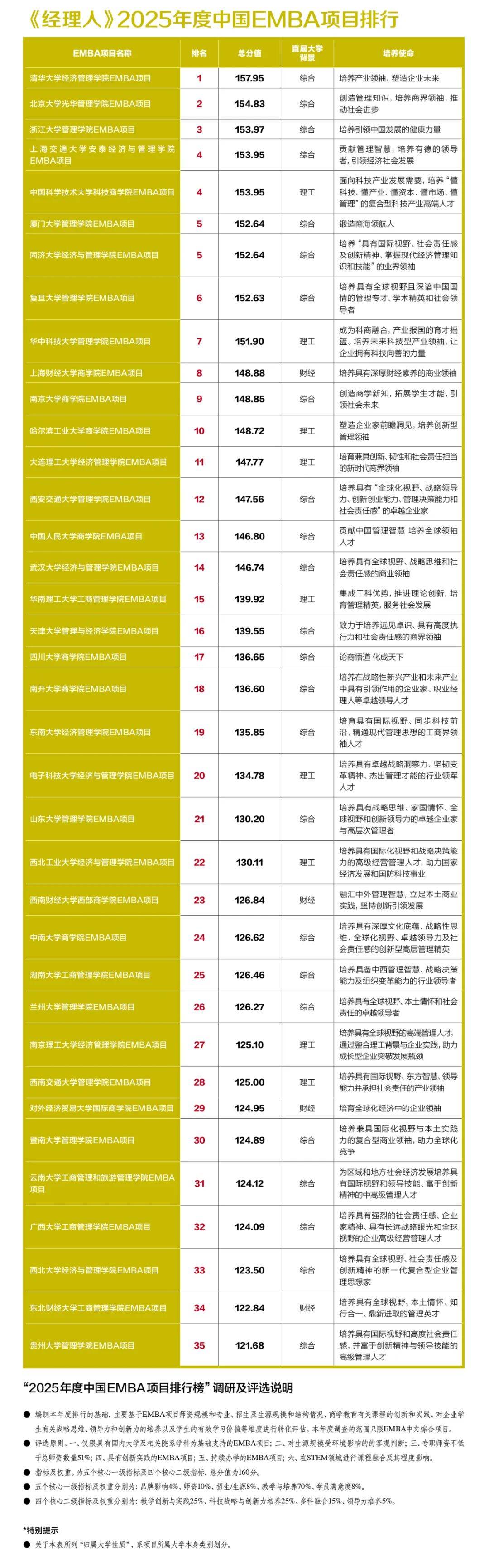
Core Insights - The 2025 "China EMBA Program Rankings" and the report on "STEM: New Challenges in EMBA Business Education" highlight the need for practical and technical knowledge, especially in business, to transform new ideas into real outcomes [1][2] - The report emphasizes the integration of management theory with STEM disciplines, reflecting a shift in business education to address contemporary challenges [2][7] EMBA Rankings Overview - The top-ranked EMBA programs include Tsinghua University, Peking University, Zhejiang University, and Shanghai Jiao Tong University, showcasing a focus on STEM-oriented teaching and innovation [3][21] - The rankings are based on various criteria, including teaching innovation, practical projects, and the cultivation of technological strategies [11][21] STEM Integration in EMBA Programs - EMBA programs are increasingly incorporating STEM elements into their curricula, with a focus on interdisciplinary approaches that combine management with science and technology [22][25][28] - The "BEST Strategy" introduced by Zhejiang University emphasizes the integration of Business, Engineering, Science, and Technology to enhance educational outcomes [25] Teaching Innovations and Challenges - The report identifies a shift in the evaluation criteria for EMBA programs, with increased weight given to teaching innovation and the ability to foster technological strategies [11][12] - The challenges faced by finance-oriented EMBA programs in adapting to STEM-focused education are noted, highlighting resource limitations [18] Social Responsibility and Impact - The rankings also consider the social responsibility initiatives of EMBA programs, emphasizing the importance of contributing to society beyond just business success [20][18] - Various EMBA programs have implemented social responsibility projects, demonstrating their commitment to societal contributions [20]
2025年度《金融时报》(FT)全球EMBA百强榜单今日发布
Zheng Quan Ri Bao Zhi Sheng· 2025-10-13 09:21
Core Insights - The 2025 Financial Times Global EMBA Rankings highlight the strong performance of Chinese business schools, with two additional institutions making the list compared to 2024 [1] - Fudan University-Washington University EMBA program ranks first, followed by China Europe International Business School EMBA in second place, and Hong Kong University of Science and Technology-Northwestern University Kellogg EMBA returning to the top tier [1] - Seven out of the top ten programs are related to China, indicating a rise in both quantity and quality of Chinese EMBA programs on the global stage [1][2] Summary by Category Overall Rankings - A total of 19 EMBA programs closely related to China made it to the top 100, including programs hosted by Chinese institutions, Sino-foreign cooperative programs, and global EMBA programs with Chinese modules [2] - Fudan University-Washington University EMBA program achieved its first top ranking, while Shanghai National Accounting Institute (SNAI) has been in the global top ten for three consecutive years [2] Performance Metrics - Chinese business schools are no longer solely relying on salary and salary growth metrics for ranking improvements; they are achieving more balanced scores across various metrics [2] - SNAI has made strides in ESG sustainability and carbon footprint areas, indicating a maturation in the development of Chinese EMBA programs [2] Specific Rankings - In the carbon footprint ranking, SNAI and Arizona State University-Kerry School's Financial EMBA program ranked seventh globally and first domestically [3] - In the ESG overall ranking, SKEMA Business School's Global EMBA (with a Chinese module) ranked fifth globally, while SNAI-Kerry Financial EMBA ranked seventh [3] - The international faculty ratio for the EMBA program at NEOMA Business School is 97%, ranking fourth globally and first domestically, while SNAI-Kerry Financial EMBA ranks sixth globally with 94% [3] Institutional Statements - SNAI's leadership emphasized the recognition of their educational quality and commitment to cultivating business leaders with financial expertise and global perspectives [4] - The institution plans to continue optimizing educational offerings and integrating industry research to support sustainable economic development [4]
2025年度《金融时报》全球EMBA百强榜单发布
Guo Ji Jin Rong Bao· 2025-10-13 06:50
Group 1 - The 2025 Financial Times Global EMBA ranking reveals significant performance from Chinese business schools, with two additional schools making the list compared to 2024 [1] - Fudan University-Washington Olin EMBA program ranks first, followed closely by China Europe International Business School EMBA, while Hong Kong University of Science and Technology-Northwestern Kellogg EMBA returns to the top tier [1] - Among the top ten, Fudan University EMBA (Chinese instruction) ranks eighth, and Shanghai National Accounting Institute (SNAI) in collaboration with Arizona State University (ASU) Carey School of Business ranks ninth [1] - A total of 19 EMBA programs related to China made the list, with seven of the top ten positions occupied by programs associated with China, indicating an increase in both quantity and quality [1] Group 2 - In the salary growth rate ranking, Chinese EMBA programs excel, occupying nine out of the top ten positions, with Fudan University-Washington Olin EMBA leading at a growth rate of 134% [1] - Fudan University-BI (Norway) part-time MBA follows closely with a growth rate of 126% [1] - Chinese business schools are increasingly focusing on balanced performance across various metrics rather than solely on salary and growth rates [2] Group 3 - In the carbon footprint ranking, SNAI-ASU Financial Finance EMBA ranks seventh globally and first domestically [2] - In the ESG overall ranking, SKEMA Business School Global EMBA (with a China module) ranks fifth globally, while NEOMA Business School EMBA ranks sixth globally, and SNAI-Kerry Financial Finance EMBA ranks seventh globally [2] - NEOMA Business School EMBA program has the highest international faculty ratio at 97%, ranking fourth globally and first domestically [2]