Galaxy A17 4G和5G系列

Search documents
Omdia:2025年Q4全球智能手机市场同比增长4% 苹果以25%市场份额领跑
智通财经网· 2026-02-12 01:33
Core Insights - The global smartphone market is expected to grow by 4% year-on-year in Q4 2025, driven by seasonal demand recovery and improved inventory management, despite some manufacturers facing rising component costs [1] - Apple leads the market with a 25% share, benefiting from strong demand for the iPhone 17 series, achieving record quarterly shipments and maintaining its position as the largest smartphone manufacturer for three consecutive years, slightly ahead of Samsung [1] - Samsung holds the second position with an 18% market share, primarily driven by strong sales of models priced below $300, particularly the Galaxy A17 4G and 5G series [1] Global Market Rankings - In Q4 2025, the top smartphone vendors by unit share are: - Apple: 25% (+9% growth) - Samsung: 18% (+16% growth) - Xiaomi: 11% (-11% growth) - Vivo: 8% (+4% growth) - OPPO: 8% (+9% growth) [2] Regional Performance - In the APAC region (excluding Greater China), the top vendors are: - Samsung: 19% (+18% growth) - Apple: 18% (+4% growth) - Vivo: 15% (+11% growth) - OPPO: 11% (+6% growth) - Xiaomi: 10% (-23% growth) [4] - In Latin America, the rankings are: - Samsung: 33% (+21% growth) - Lenovo: 16% (+14% growth) - Xiaomi: 15% (+6% growth) - HONOR: 9% (+64% growth) - Apple: 7% (-8% growth) [4] - In India, the top vendors are: - Vivo: 25% (+16% growth) - OPPO: 16% (+4% growth) - Samsung: 14% (-11% growth) - Xiaomi: 12% (-26% growth) - Apple: 11% (-1% growth) [6] - In the United States, the rankings are: - Apple: 69% (+8% growth) - Samsung: 14% (-3% growth) - Lenovo: 9% (+13% growth) - Google: 3% (-15% growth) - TCL: 2% (-7% growth) [6] - In Brazil, the top vendors are: - Samsung: 39% (-1% growth) - Lenovo: 23% (+12% growth) - Xiaomi: 15% (+12% growth) - Apple: 11% (+10% growth) - realme: 5% (-7% growth) [7]



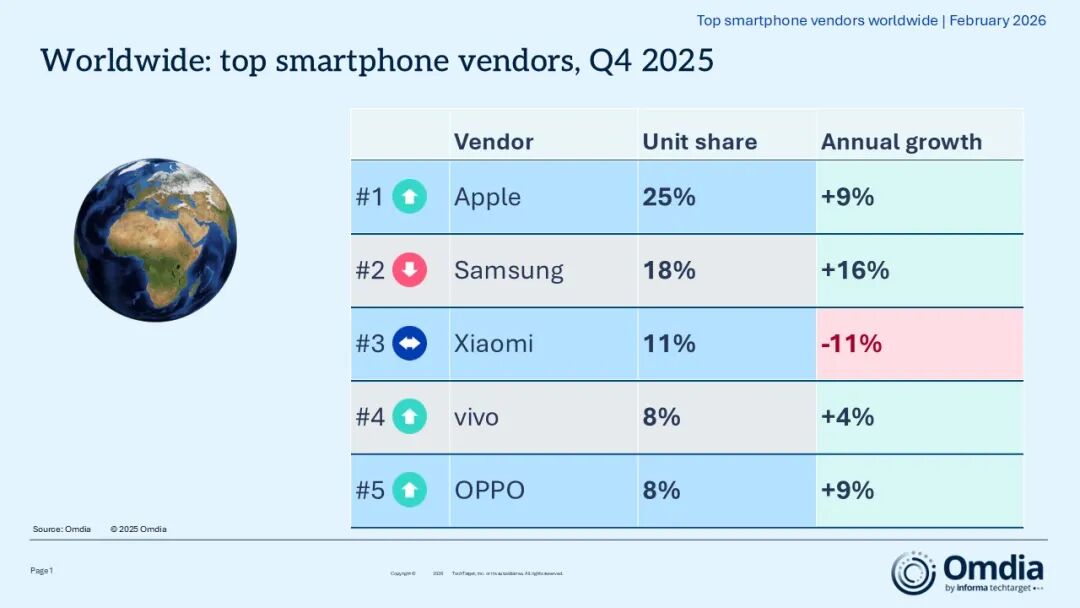
Omdia数据快闪:2025年第四季度,全球智能手机重点市场厂商排名
Canalys· 2026-02-12 01:03
Core Insights - The global smartphone market experienced a year-on-year growth of 4% in Q4 2025, driven by seasonal demand recovery and improved inventory management, despite some manufacturers facing rising component costs [2] - Apple led the global smartphone market with a 25% market share, attributed to strong demand for the iPhone 17 series, achieving record quarterly shipments and maintaining its position as the largest smartphone manufacturer for three consecutive years, slightly ahead of Samsung [2] - Samsung ranked second with an 18% market share, boosted by strong sales of models priced below $300, particularly the Galaxy A17 4G and 5G series [2] - Xiaomi maintained its position as the third-largest manufacturer, although its market share declined to 11% due to shipment challenges in key markets [2] - Vivo achieved an 8% market share, benefiting from its leading position in the Indian market, while OPPO returned to growth, re-entering the global top five [2] Regional Summaries Global Key Regions - In Q4 2025, Apple held a 25% market share globally with a 9% annual growth, while Samsung had an 18% share with a 16% growth. Xiaomi's share fell to 11% with an 11% decline, Vivo and OPPO both held 8% shares with growth rates of 4% and 9% respectively [2] Europe - In Europe, Apple captured a 30% market share with a 6% growth, while Samsung followed closely with 28% and a 10% growth. Xiaomi's share was 17%, down by 3%, and Lenovo achieved a 6% share with a 13% growth [3] APAC (Excluding Greater China) - In the APAC region, Samsung led with a 19% market share and an 18% growth, followed by Apple at 18% with a 4% growth. Vivo and OPPO held 15% and 11% shares with growth rates of 11% and 6% respectively, while Xiaomi's share dropped to 10% with a 23% decline [3] Mainland China - In Mainland China, Apple ranked first with a 22% market share and a significant 26% growth. Vivo and OPPO followed with 16% and 15% shares, experiencing declines of 8% and growth of 9% respectively [7] India - In India, Vivo led with a 25% market share and a 16% growth, followed by OPPO at 16% with a 4% growth. Samsung's share was 14%, down by 11%, while Xiaomi's share fell to 12% with a 26% decline [7] United States - In the United States, Apple dominated with a 69% market share and an 8% growth, while Samsung held 14% with a 3% decline. Lenovo captured 9% with a 13% growth [9] Brazil - In Brazil, Samsung led with a 39% market share, experiencing a slight decline of 1%. Lenovo and Xiaomi both held 23% and 15% shares with 12% growth, while Apple had an 11% share with a 10% growth [10]

Omdia:2025年全球智能手机出货量12. 5亿部 同比增长2%
智通财经网· 2026-01-15 11:27
Core Insights - The global smartphone market is projected to grow by 4% year-on-year in Q4 2025, driven by seasonal demand recovery and improved inventory management, despite some manufacturers facing rising component costs [1][2] - Apple leads the market with a 25% share, benefiting from strong demand for the iPhone 17 series, achieving record quarterly shipments and maintaining its position as the largest smartphone manufacturer for three consecutive years [1][5] - Samsung ranks second with an 18% market share, primarily due to strong sales of models priced under $300, particularly the Galaxy A17 series [1] - Xiaomi holds the third position with an 11% market share, although it experienced a decline in key markets during Q4 [1][2] - Vivo achieved an 8% market share, bolstered by its leading position in the Indian market, while OPPO returned to growth, re-entering the global top five [1][2] Market Performance - In 2025, global smartphone shipments are expected to increase by 2% year-on-year, reaching 1.25 billion units, reflecting a steady market recovery, although performance varies across regions [2] - The first half of 2025 showed weak performance, while the second half benefited from strong demand in emerging markets and positive responses to flagship model launches [2] Cost Pressures and Strategies - DRAM supply constraints are significantly impacting the smartphone industry, with expectations that this will be a key factor influencing market trends in 2026 [5][7] - Rising semiconductor costs and a slowing replacement cycle are anticipated to affect shipment momentum, prompting manufacturers to optimize configurations and align new product launch strategies with component supply [7] - Manufacturers are increasingly focusing on price control, profitability, and operational efficiency in response to rising cost pressures, with trends indicating consolidation efforts, such as realme's integration into OPPO, to maintain competitiveness [7]
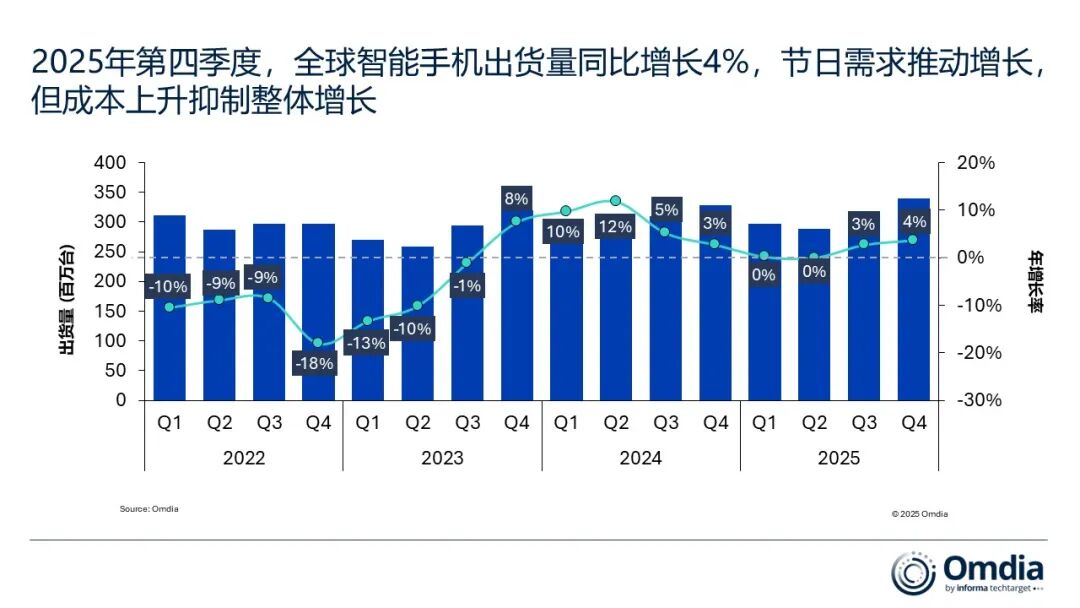
Omdia:2025年第四季度,全球智能手机市场增长4%,苹果连续三年蝉联市场首位
Canalys· 2026-01-15 09:17
Core Insights - The global smartphone market is expected to grow by 4% year-on-year in Q4 2025, driven by seasonal demand recovery and improved inventory management, despite some manufacturers facing rising component costs [1][2] - Apple leads the market with a 25% share, benefiting from strong demand for the iPhone 17 series, achieving record quarterly shipments and maintaining its position as the largest smartphone manufacturer for three consecutive years [1][5] - Samsung ranks second with an 18% market share, primarily due to strong sales of models priced under $300, particularly the Galaxy A17 series [1] - Xiaomi remains in third place with an 11% market share, although it faced shipment challenges in key markets during Q4 [1][2] - Vivo achieved an 8% market share, bolstered by its leading position in the Indian market, while OPPO returned to growth, re-entering the global top five [1][2] Market Performance - In 2025, global smartphone shipments are projected to grow by 2% year-on-year, reaching 1.25 billion units, reflecting a steady market recovery, although performance varies significantly across regions [2] - The first half of 2025 showed weak performance, while the second half benefited from strong demand in emerging markets and positive responses to flagship model launches [2] - Rising memory costs and supply constraints have begun to impact the market, limiting shipment potential in Q4 [2] Manufacturer Strategies - Rising cost pressures are reshaping manufacturers' strategies for 2026, with increased semiconductor costs and a slowing replacement cycle expected to affect shipment momentum [8] - Manufacturers are optimizing configurations and aligning new product launch strategies more closely with component supply, while leveraging channels such as trade-in programs and ecosystem bundling to support higher price points [8] - The trend towards greater scale and supply-side leverage is evident, as seen with realme's integration into OPPO, reflecting manufacturers' efforts to maintain competitiveness amid rising costs [8][6] Supply Chain Challenges - DRAM supply tightness is creating significant supply pressures in the smartphone industry, expected to be a key factor influencing market trends in 2026 [5][6] - All manufacturers are competing fiercely for supply, emphasizing long-term partnerships, leveraging scale advantages to secure capacity, and focusing on core suppliers [6] - The situation is particularly challenging for manufacturers reliant on entry-level smartphones, as these models are highly price-sensitive and memory and storage costs constitute a larger share of total material costs [6]