智能手机市场增长

Search documents
Omdia:2025年Q4全球智能手机市场同比增长4% 苹果以25%市场份额领跑
智通财经网· 2026-02-12 01:33
Core Insights - The global smartphone market is expected to grow by 4% year-on-year in Q4 2025, driven by seasonal demand recovery and improved inventory management, despite some manufacturers facing rising component costs [1] - Apple leads the market with a 25% share, benefiting from strong demand for the iPhone 17 series, achieving record quarterly shipments and maintaining its position as the largest smartphone manufacturer for three consecutive years, slightly ahead of Samsung [1] - Samsung holds the second position with an 18% market share, primarily driven by strong sales of models priced below $300, particularly the Galaxy A17 4G and 5G series [1] Global Market Rankings - In Q4 2025, the top smartphone vendors by unit share are: - Apple: 25% (+9% growth) - Samsung: 18% (+16% growth) - Xiaomi: 11% (-11% growth) - Vivo: 8% (+4% growth) - OPPO: 8% (+9% growth) [2] Regional Performance - In the APAC region (excluding Greater China), the top vendors are: - Samsung: 19% (+18% growth) - Apple: 18% (+4% growth) - Vivo: 15% (+11% growth) - OPPO: 11% (+6% growth) - Xiaomi: 10% (-23% growth) [4] - In Latin America, the rankings are: - Samsung: 33% (+21% growth) - Lenovo: 16% (+14% growth) - Xiaomi: 15% (+6% growth) - HONOR: 9% (+64% growth) - Apple: 7% (-8% growth) [4] - In India, the top vendors are: - Vivo: 25% (+16% growth) - OPPO: 16% (+4% growth) - Samsung: 14% (-11% growth) - Xiaomi: 12% (-26% growth) - Apple: 11% (-1% growth) [6] - In the United States, the rankings are: - Apple: 69% (+8% growth) - Samsung: 14% (-3% growth) - Lenovo: 9% (+13% growth) - Google: 3% (-15% growth) - TCL: 2% (-7% growth) [6] - In Brazil, the top vendors are: - Samsung: 39% (-1% growth) - Lenovo: 23% (+12% growth) - Xiaomi: 15% (+12% growth) - Apple: 11% (+10% growth) - realme: 5% (-7% growth) [7]



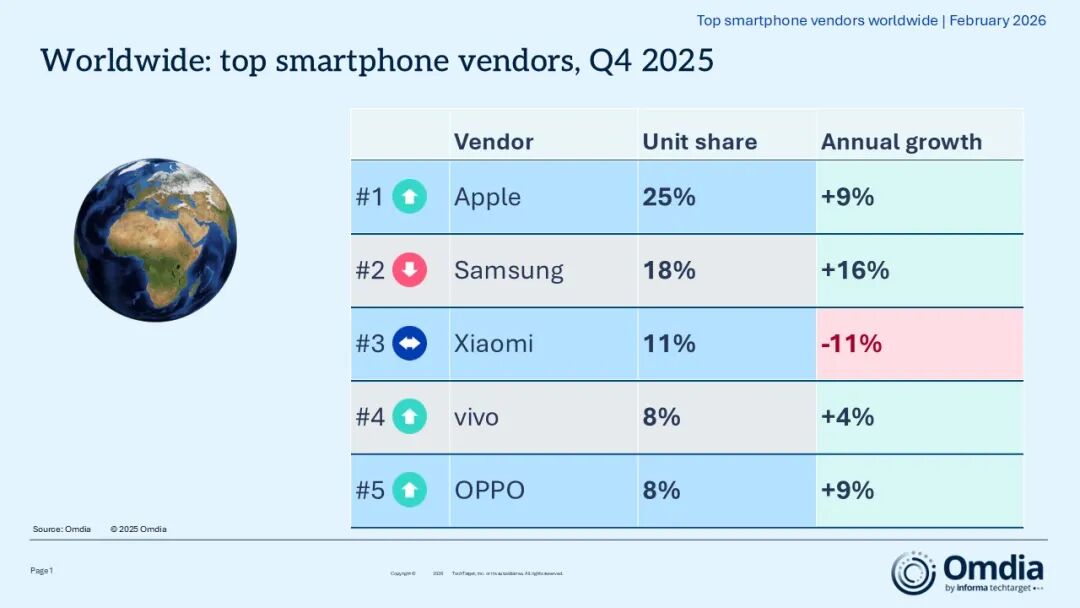
iPhone17在中国卖爆,苹果成为全球手机出货第一
Guan Cha Zhe Wang· 2026-01-12 14:21
Core Insights - The global smartphone market is projected to grow by 2% year-on-year in 2025, with Apple leading the market with a 20% share and a 10% growth rate [1] - The growth is driven by increased demand for high-end devices, recovery in key emerging markets, and the rising adoption of 5G devices [1] - The smartphone market's performance varies across regions, with emerging markets offsetting weaknesses in mature markets [1] Group 1: Market Performance - In Q4 2025, smartphone shipments stabilized with a 1% year-on-year growth, with Apple capturing a quarter of global shipments, marking its highest historical share [1] - Samsung follows with a 17% market share and a 5% year-on-year growth, driven by its mid-range Galaxy A series and high-end Galaxy Fold7 and S25 series [4] - Xiaomi holds a 13% market share, maintaining stability through a balanced product portfolio and strong execution in emerging markets [4] Group 2: Company Strategies - Apple's growth in 2025 is attributed to its expansion in emerging and mid-tier markets, supported by a strong product lineup, particularly the iPhone 17 series [3] - The iPhone 17 standard version has seen sales in China nearly double compared to the iPhone 16, aided by a strategy of enhancing specifications without increasing prices [4] - Vivo ranks fourth with a 3% year-on-year growth, benefiting from its high-end strategy and strong offline execution in India [5] Group 3: Competitive Landscape - OPPO's shipments declined by 4% year-on-year due to weak demand in its home market and intense competition, despite some growth in India and the Middle East [5] - Nothing and Google recorded impressive growth rates of 31% and 25% year-on-year, respectively, indicating strong performance outside the top five [6] Group 4: Future Outlook - The outlook for 2026 is cautious, with expectations of a market downturn due to supply chain constraints and rising component costs, leading to a 3% downward revision in shipment forecasts [7] - Apple and Samsung are expected to remain resilient due to strong supply chain capabilities and high-end market positioning, while lower-tier Chinese OEMs may face greater challenges [7]

新股消息 | 酷赛智能二次递表港交所 为全球领先的智能手机ODM企业
智通财经网· 2026-01-02 04:13
Company Overview - Coosea Intelligent is a leading global ODM provider for smartphones, offering comprehensive solutions including product definition, R&D, supply chain management, manufacturing, and after-sales services. The company has generated revenue from over 70 countries and regions, covering Asia, America, Europe, Oceania, and Africa. According to Frost & Sullivan, Coosea Intelligent is the second-largest ODM provider for local smartphone brands by shipment volume in 2024, and it is expected to rise to the top position in the first quarter of 2025 [4][5]. Product Offerings - Coosea Intelligent provides customized products that meet specific customer needs while maintaining cost advantages and excellent product performance. The main offerings include: 1. Smart devices, including consumer smartphones, rugged phones designed for industrial users, and other IoT devices. 2. Standalone printed circuit board (PCB) components and internet services related to smartphones and IoT. 3. Other services, primarily involving material procurement and R&D [5][6]. Technological Development - The company has established a core technology system for consumer smartphones and rugged phones, anticipating the growing trend of smartphone adoption. Coosea Intelligent has developed over 598 models of smartphones and PCB components, as well as over 46 other smart devices by July 31, 2025. The company continues to optimize its proprietary didoOS to meet the specific customization needs of global local brands and telecom operators [6][7]. Financial Performance - Coosea Intelligent's revenue for the fiscal years 2022, 2023, 2024, and the seven months ending July 31, 2025, were approximately RMB 1.713 billion, RMB 2.302 billion, RMB 2.717 billion, and RMB 1.584 billion, respectively. The net profit for the same periods was around RMB 110 million, RMB 203 million, RMB 207 million, and RMB 103 million, with net profit margins of 6.4%, 8.8%, 7.6%, and 6.5% [7][8][11]. Market Trends - The global smartphone market is nearing saturation, with a slight decline in shipment growth from 1.323 billion units in 2020 to 1.313 billion units in 2024. However, innovations such as AI smartphones, 5G smartphones, and foldable phones are expected to drive future growth. Emerging markets in South Asia, the Middle East, and Latin America still have significant growth potential, with smartphone penetration rates expected to increase [16][17]. Board of Directors - The board of Coosea Intelligent consists of six directors, including three executive directors and three independent non-executive directors. The directors serve a term of three years and may be re-elected upon expiration [21]. Shareholding Structure - Coosea Intelligent's shareholding structure includes Coosea Holdings with approximately 63% ownership, followed by Mr. Wang and Mr. Wu, each holding 13.5%, and several other shareholders holding smaller percentages [24]. Underwriting Team - The exclusive sponsor for Coosea Intelligent is CITIC Securities (Hong Kong) Limited, with legal advisors and auditors also appointed for compliance and financial reporting [27][28].
Omdia:2025年第三季度,中东智能手机市场同比增长23%,供应压力将使2026年增速放缓至1%
Canalys· 2025-11-21 01:04
Core Insights - The Middle East smartphone market (excluding Turkey) is expected to rebound significantly in Q3 2025, with a year-on-year increase of 23%, reaching a shipment volume of 15.1 million units, driven by rising demand in the mass market as consumers upgrade from outdated or entry-level devices to mid-range 4G and budget 5G smartphones [2][3]. Market Performance - Market performance varies across the Middle East, with Saudi Arabia experiencing a slight decline of 2% due to prolonged summer holidays affecting retail activity, while the UAE saw a 13% increase driven by major promotions from retailers like Sharaf DG and Carrefour, as well as seasonal demand and new product launches [3]. - Iraq and other Middle Eastern countries continued strong growth, achieving increases of 41% and 70%, respectively, due to intensified manufacturer activities, stronger channel incentives, and stable replacement demand in the entry-level market [3]. Manufacturer Performance - Samsung maintained its leading position with a 22% year-on-year growth, driven by early launches of the Galaxy A17 4G/5G series and strong sales of A series models [3]. - Transsion experienced a significant rebound of 47%, attributed to TECNO's expanding influence in the low-price market and its appeal to a large number of expatriates in the Gulf region [3]. - Xiaomi's performance improved with a 35% year-on-year growth after restructuring channel relationships and increasing regional investments, including the opening of its first flagship store in Dubai [3]. - HONOR led the region with a remarkable 128% year-on-year increase, benefiting from an expanded product portfolio and closer partnerships with operators and retailers [3]. - Apple achieved a 14% growth after six consecutive quarters of fluctuations, supported by strong early sales of the new iPhone 17 series, reinforcing its leadership in the high-end market [3]. Future Outlook - Omdia forecasts that growth in the Middle East smartphone market will slow to a moderate 1% in 2026, down from 13% in 2025, due to rising component costs and supply constraints, particularly affecting the low average selling price (ASP) market [5]. - To maintain growth momentum, manufacturers will need to enhance channel interactions and introduce targeted incentives in the mass market price segments, while the mid-to-high-end market is expected to remain resilient, with Apple and Samsung driving upgrade demand through stronger ecosystem value and brand loyalty [5].

iPhone17中国首月销量激增37% 苹果(AAPL.US)重夺20%市场份额高地
Zhi Tong Cai Jing· 2025-11-18 06:33
Core Insights - Apple's iPhone 17 series has driven a 37% increase in monthly smartphone sales in China, indicating strong momentum in a key market [1] - In October, one in four smartphones sold in China was an iPhone, marking Apple's first time reaching this market share threshold since 2022 [1] - The sales of each subsequent iPhone model, from the iPhone 17 priced at 5999 yuan (approximately 850 USD) to the 17 Pro Max at 8999 yuan, have exceeded their predecessors by double-digit percentages [1] Market Performance - The overall smartphone market in China grew by 8%, recovering from previous struggles despite government subsidies [1] - Apple's new iPhone models account for over 80% of its total sales, with rising average selling prices contributing to revenue growth [1] - OPPO's smartphone sales increased by 19% in October, driven by demand for its Find X9 model, while Huawei's sales fell by 19% due to the absence of new releases [1] Competitive Landscape - Huawei remains Apple's strongest competitor in China, with plans to launch its new flagship device next week [1] - Despite the upcoming Huawei Mate 80 series release on November 25, current indicators suggest that Apple's sales momentum is stable [2]
iPhone 17大卖!苹果10月在华销量暴涨37%,市场份额创2022年以来新高
Hua Er Jie Jian Wen· 2025-11-18 06:31
Group 1 - The new generation of iPhones is driving strong growth for Apple in the critical Chinese market, with a 37% year-on-year increase in smartphone sales in October [1] - Apple's market share in China reached 25% in October, indicating that one in four smartphones sold in the country is an iPhone, marking the first time since 2022 that Apple has achieved this level [1] - The success of the iPhone 17 series is the main driver behind the sales surge, with all new models showing double-digit growth compared to the previous iPhone 16 series [1] Group 2 - Apple faces competition from local brands, particularly Huawei, which is set to release its new flagship Mate 80 series on November 25 [2] - Despite the competition, Apple's iPhone momentum remains strong, with no signs of a significant slowdown in the short term [2] - The overall smartphone market in China saw an 8% year-on-year growth in October, with Oppo's sales increasing by 19% driven by its Find X9 model [2]
Omdia:2025年第三季度印度智能手机市场同比增长3% 出货量达到4840万台
Zhi Tong Cai Jing· 2025-10-22 01:29
Core Insights - The Indian smartphone market is projected to grow by 3% year-on-year in Q3 2025, with shipments reaching 48.4 million units, driven by pre-festival inventory replenishment and retail promotions [1][2] Market Performance - Vivo leads the market with a shipment of 9.7 million units, capturing a 20% market share [1] - Samsung follows with 6.8 million units shipped, holding a 14% market share [1] - Xiaomi ranks third with 6.5 million units, slightly ahead of OPPO, which has comparable shipment figures [1] - Apple returns to the top five with 4.9 million units shipped, driven by demand from lower-tier cities [1] Sales Strategies - Market momentum in Q3 is primarily driven by channel incentives rather than pure consumer demand recovery, with manufacturers reallocating marketing budgets to impactful retail incentive programs [2] - Retail incentives include cash bonuses, tiered profits, and dealer competitions offering rewards such as motorcycles and overseas trips [2] - Manufacturers have also enhanced consumer-facing promotions, including zero down payment plans and bundled sales [2] Company Strategies - Vivo's market leadership is attributed to a balanced product portfolio and strong promotional strategies, with its T series performing well online during the festive season [2] - Samsung has made progress in the mid-to-high-end market with older models and new Snapdragon-equipped S24 and S25 FE, but faces challenges in the entry-level segment [2] - OPPO's growth is driven by its F31 series and well-structured festive channel promotions [2] - Motorola achieved a record shipment of 4 million units, a 53% year-on-year increase, mainly due to the G series and Edge 60 expansion [2] - Nothing experienced a 66% growth, with its CMF Phone 2 Pro and Phone 3a as key models [2] Apple’s Market Position - Apple achieved its highest-ever shipment volume in India during Q3, with a market share of 10%, driven by demand from smaller cities and effective festive promotions [2] - The iPhone 16 and 15 series contributed significantly to shipments, alongside strong sales of the iPhone 17 standard version [2] - Apple plans to continue upgrading its Pro series and deepen its ecosystem to drive long-term value growth [2] Future Outlook - Despite a strong early performance in Q3, growth is not expected to continue into the year-end peak, with limited recovery in smartphone demand [2] - Urban consumers are delaying upgrades due to job uncertainty and cost sensitivity, leading to a potential inventory buildup in Q4 [2] - Rural market demand remains stable but insufficient to offset cautious urban sentiment, with an overall slight decline in the smartphone market anticipated for 2025 [2]
Omdia:印度智能手机市场增长3%,各品牌为节日季做准备,vivo继续蝉联榜首,苹果出货量创历史新高
Canalys· 2025-10-22 01:02
Core Insights - The Indian smartphone market is projected to grow by 3% year-on-year in Q3 2025, reaching a shipment volume of 48.4 million units, driven by pre-festival inventory replenishment and retail promotions [2][7]. Market Performance - Vivo leads the market with a shipment of 9.7 million units, capturing a 20% market share. Samsung follows with 6.8 million units and a 14% share, while Xiaomi and OPPO are nearly tied with 6.5 million units each, both holding a 13% share. Apple returns to the top five with 4.9 million units, driven by demand from lower-tier cities [2][7]. Sales Strategies - The market momentum in Q3 is primarily driven by channel incentives rather than pure consumer demand recovery. Manufacturers are reallocating marketing budgets to impactful retail incentive programs, including dealer competitions with rewards such as cash bonuses and travel [4][6]. Brand Strategies - Vivo's strong market position is attributed to a balanced product portfolio and aggressive retail strategies. Samsung is making progress in the mid-to-high-end market with new models but faces challenges in the entry-level segment. OPPO's growth is supported by targeted promotional plans centered around the F31 series [4][5]. Apple’s Performance - Apple achieved its highest-ever shipment volume in India during Q3, with a market share of 10%. Growth is fueled by demand for high-end models and effective promotional strategies, particularly in smaller cities [5]. Future Outlook - Despite a strong early performance in Q3, growth is not expected to continue into the year-end peak period. Urban consumers remain cautious due to job uncertainty and cost sensitivity, leading to delayed upgrades. The overall smartphone market is anticipated to see a slight decline in 2025, reflecting a fragile recovery sensitive to economic conditions [6].

CounterPoint报告:2025年第三季度全球智能手机出货量同比增4%
Huan Qiu Wang Zi Xun· 2025-10-16 03:44
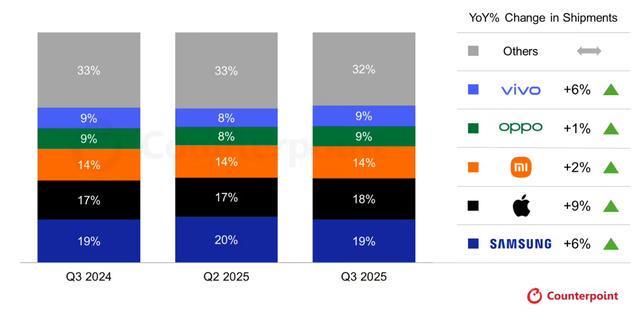
Core Insights - The global smartphone market is projected to see a 4% year-on-year increase in shipment volume by Q3 2025, driven primarily by strong performances in the Asia-Pacific (APAC) and Middle East and Africa (MEA) regions [1][3] Regional Performance - The MEA region experienced a 14% year-on-year increase in shipment volume, attributed to strong market performance from Samsung and Xiaomi, supported by a wide range of mid-range products and increased consumer demand during the back-to-school season and pre-holiday inventory buildup [1] - The Indian market also showed a notable 9% year-on-year growth in shipment volume, driven by early demand for the festive season, government relief measures boosting consumer confidence, and accelerated adoption of high-end and mid-range devices due to significant discounts and promotional support [1] Brand Competition Landscape - Samsung maintained its leadership in the global market with a 19% shipment volume share in Q3, reflecting a 6% year-on-year growth, supported by the Galaxy A series product line [3] - Apple emerged as the fastest-growing brand among the top five, with a 9% year-on-year growth rate, achieving strong growth in Japan, China, Western Europe, and parts of the APAC region, bolstered by the successful launch of the iPhone 17 series [3] - Xiaomi held the third position globally with a 14% shipment volume share and a 2% year-on-year growth rate, enhancing its market presence through partnerships with carriers and diverse promotional activities, particularly in Southeast Asia, MEA, and Latin America [3] - OPPO and vivo ranked fourth and fifth in the global smartphone market, with OPPO achieving moderate growth in the Southeast Asia and MEA markets through affordable 5G models, while vivo maintained strong momentum in India and Southeast Asia, expanding its influence in the MEA region [3]
Omdia:全球智能手机市场在2025年第三季度增长3%,苹果创下史上同期最高纪录
Canalys· 2025-10-14 14:18
Core Insights - The global smartphone market is projected to grow by 3% year-on-year in Q3 2025, driven by strong replacement demand and preemptive stocking by manufacturers ahead of a busy Q4 [2][5] - Samsung maintains the top position with a 19% market share, followed by Apple at 18%, Xiaomi at 14%, and both Transsion and Vivo at 9% each [2][5] Market Dynamics - The recovery in consumer demand for smartphone upgrades and replacements is evident, with all top five manufacturers showing year-on-year shipment growth [5][7] - Major brands have received positive responses to new product launches, with a focus on balancing hardware and software [5][9] Product Highlights - The iPhone 17 series has performed exceptionally well, with the base model upgrading storage without a price increase, while the new designs of iPhone 17 Pro and Pro Max continue to attract consumers [5][7] - Transsion has achieved double-digit growth compared to Q3 2024, marking its highest shipment volume in history, attributed to effective inventory management and demand recovery in the Middle East and Africa [7] Competitive Landscape - The smartphone market is highly competitive, with rising component costs putting pressure on profitability [9] - Manufacturers are exploring additional revenue opportunities through subscription services, accessories, and bundled sales to enhance consumer value propositions [9] Emerging Market Challenges - In emerging markets, the dominance of entry-level devices presents implementation challenges, necessitating sustainable operating models that avoid price wars while maintaining affordability for consumers [9]