Galaxy S24

Search documents
半导体行业月报:海外云厂商26年资本支出再加速,半导体产业链迎来全面涨价潮-20260211
Zhongyuan Securities· 2026-02-10 23:40
Investment Rating - The report maintains an "Outperform" rating for the semiconductor industry [1] Core Insights - The semiconductor industry is experiencing a comprehensive price increase driven by the accelerated capital expenditures of overseas cloud vendors in 2026, with significant demand from AI servers leading to a shortage in testing capacity and subsequent price hikes across the supply chain [4][8] - The domestic semiconductor industry showed strong performance in January 2026, with a rise of 18.63%, significantly outperforming the Shanghai Composite Index, which increased by 1.65% during the same period [7][13] - Global semiconductor sales continued to grow, with a year-on-year increase of 37.1% in December 2025, marking 26 consecutive months of growth, and a forecasted 8.5% growth for 2026 [7][28] Summary by Sections 1. Semiconductor Market Performance - In January 2026, the semiconductor sector saw a strong performance, with integrated circuits rising by 18.52%, discrete devices by 18.91%, semiconductor materials by 19.04%, and semiconductor equipment by 18.88% [7][13] - The Philadelphia Semiconductor Index rose by 12.92% in January 2026, outperforming the Nasdaq 100, which increased by 1.20% [19][20] 2. Global Semiconductor Sales Growth - December 2025 global semiconductor sales reached approximately $78.9 billion, with a year-on-year growth of 37.1% and a month-on-month increase of 2.7% [28] - The sales of logic products grew by 39.9% year-on-year, reaching $301.9 billion, while memory products saw a 34.8% increase, totaling $223.1 billion [28] 3. Capital Expenditure Trends - The capital expenditures of the four major North American cloud vendors (Google, Microsoft, Meta, Amazon) increased by 67% year-on-year in Q4 2025, with expectations for continued acceleration in 2026 [7][28] - Google is projected to spend between $175 billion and $185 billion in 2026, a year-on-year increase of 91-102% [7] 4. Price Trends in Semiconductor Components - In January 2026, DRAM and NAND Flash spot prices continued to rise, with DRAM prices increasing by approximately 39% and NAND prices by about 35% month-on-month [7][28] - TrendForce has revised its price forecasts for Q1 2026, expecting a 90-95% increase in general DRAM contract prices and a 55-60% increase in NAND Flash contract prices [7][28]
非洲手机季度出货:小米增长34%,荣耀增长158%
Guan Cha Zhe Wang· 2025-12-02 06:08
Core Insights - The African smartphone market is experiencing a significant rebound, with Q3 2025 shipments expected to surge by 24% year-on-year, reaching 22.8 million units, following five consecutive quarters of decline [1][7] - This growth outpaces the global smartphone market's moderate recovery, driven by increased demand in key markets, currency stabilization, enhanced financing usage, and improved retail activities [1] Market Performance - Most markets in North Africa and Sub-Saharan Africa recorded double-digit growth in smartphone shipments, with Nigeria and Egypt each accounting for 14% of regional shipments [1] - Nigeria's market saw a remarkable 29% increase, attributed to the stabilization of the Naira and a refreshed lineup of models priced below $150, stimulating upgrade demand [1] - Egypt's growth of 19% was primarily fueled by a strong mid-range market, with brands aggressively targeting the $150 to $250 price segment [1] Regional Highlights - South Africa led the growth with a 31% increase, supported by the rise of prepaid models in the low and mid-range markets, new model launches, and increased retail promotions [2] - Kenya experienced a 17% growth, driven by the rising penetration of installment payment plans, which boosted demand for entry-level models [2] Brand Performance - Omdia reported that shipments of smartphones priced below $100 surged by 57%, while those above $500 grew by 52%, indicating a dual growth trend in the market [4] - Transsion's shipments increased by 25%, supported by strong demand in Algeria, Egypt, Morocco, Nigeria, Kenya, and South Africa, with popular models like TECNO's Camon40 and Infinix's Hot60 contributing to this growth [4] - Samsung maintained a presence in the high-end market with its Galaxy S24 series, but overall growth was modest at 5%, as consumers favored value models [4] Competitive Landscape - Xiaomi is accelerating its long-term strategy in Africa, planning to enter over 15 new markets and opening its first self-operated flagship store in Morocco, with strong sales in models priced below $150 [8] - OPPO is solidifying its market position in North Africa, focusing on Egypt, while Honor is achieving steady growth in South Africa through competitive models like Honor 200 Lite [8] Future Outlook - Despite the current growth, Omdia's analyst warns of a potential 6% decline in the African smartphone market in 2026 due to rising supply-side pressures, including increased BOM costs and currency weaknesses [8] - These pressures are expected to elevate average selling prices, particularly in the $80 to $150 range, posing new payment challenges for consumers [8]




Omdia:第三季度非洲智能手机出货量同比激增24% 达到2280万台
智通财经网· 2025-11-28 01:16
Core Insights - The African smartphone market is experiencing a significant rebound, with Q3 2025 shipments expected to surge by 24% year-on-year, reaching 22.8 million units, following five consecutive quarters of decline [1][6] - Key factors driving this growth include increased market demand, currency stability, enhanced financing usage, and improved retail activities [1] - North Africa and Sub-Saharan Africa are witnessing double-digit growth in smartphone shipments, with Nigeria and Egypt each accounting for 14% of regional shipments, but with differing recovery dynamics [1][2] Market Performance - Nigeria's smartphone shipments are projected to soar by 29% year-on-year, attributed to the stabilization of the Naira and the introduction of affordable models under $150, stimulating retail upgrade demand [1] - Egypt's market is expected to grow by 19%, driven by increased demand for mid-range devices and promotional bundling strategies [1] - South Africa leads the growth with a 31% increase, benefiting from the rise of prepaid models and enhanced retail promotions [2] Product Segmentation - Smartphones priced below $100 are expected to see a remarkable 57% increase, while those above $500 are projected to grow by 52% [4] - Transsion is a key player in the entry-level market, with a 25% year-on-year increase in shipments, supported by strong demand in Algeria, Egypt, Morocco, Nigeria, Kenya, and South Africa [4] - Samsung dominates the high-end market, with strong demand for Galaxy S24 and S24 FE 5G models in South Africa, Senegal, and Algeria [4] Competitive Landscape - Xiaomi is accelerating its long-term strategy in Africa, planning to enter over 15 new markets and has opened its first flagship store in Morocco [4] - OPPO is consolidating its market position in North Africa, focusing on Egypt, while Honor is maintaining steady growth in South Africa through competitive models like Honor 200 Lite [4] Future Outlook - Despite the current growth, the African smartphone market is expected to decline by 6% in 2026 due to rising supply-side pressures, including increased BOM costs and currency depreciation [6] - The low-end 4G market, which constitutes a significant portion of demand, will be particularly affected, leading to higher average selling prices and new payment challenges for consumers [6]
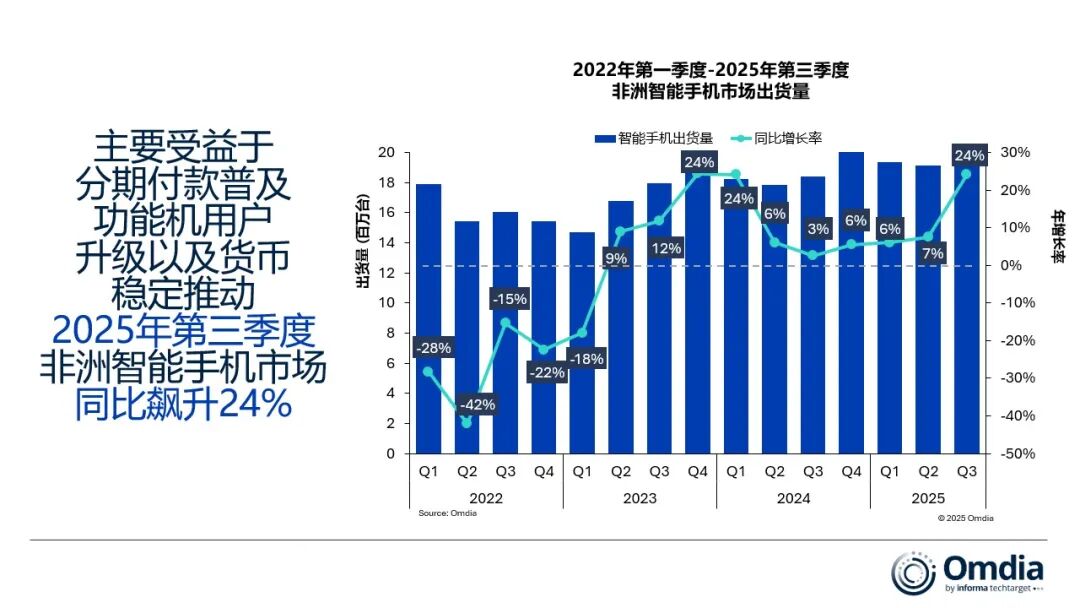
Omdia: 2025年第三季度,非洲智能手机市场出货量同比增长24%,重现双位数增长,传音继续领跑,荣耀仍保持三位数最大增幅
Canalys· 2025-11-28 01:04
Core Insights - Omdia's latest research indicates that smartphone shipments in Africa will surge by 24% year-on-year in Q3 2025, reaching 22.8 million units, marking a rebound after five consecutive quarters of slowdown, driven by increased market demand, currency stability, enhanced financing usage, and improved retail activities [1] Group 1: Regional Performance - North Africa and Sub-Saharan Africa experienced double-digit growth in smartphone shipments, with Nigeria and Egypt each accounting for 14% of regional shipments; Nigeria's market surged by 29% due to stable naira exchange rates and an updated portfolio of models priced below $150, while Egypt saw a 19% increase [1] - South Africa led with a 31% growth, benefiting from the acceleration of prepaid models in the low and mid-range markets, new model launches, and increased retail promotions [2] - Kenya's market grew by 17%, driven by the rising penetration of installment payment plans, which have become a significant driver of smartphone sales [2] Group 2: Market Dynamics - The shipment of smartphones priced below $100 increased by 57%, the fastest growth rate in three quarters, while models above $500 grew by 52%; the entry-level market's rapid growth was primarily driven by Transsion, which saw a 25% year-on-year increase in shipments supported by strong demand in Algeria, Egypt, Morocco, Nigeria, Kenya, and South Africa [5] - Major brands like Samsung dominated the high-end market with strong demand for Galaxy S24 and S24 FE 5G in South Africa, Senegal, and Algeria, although overall market growth remained moderate at 5% due to consumer preference for cost-effective models [5] Group 3: Competitive Landscape - Xiaomi is accelerating its long-term strategy in Africa, planning to enter over 15 new markets in the coming months and has opened its first self-operated flagship store in Morocco; its strong sales in the sub-$150 segment account for half of its shipments [6] - OPPO is consolidating its market position in North Africa with a focus on Egypt, while Honor is maintaining steady growth in South Africa through high-cost-performance models like Honor 200 Lite [6] Group 4: Future Outlook - Omdia forecasts a 6% decline in the African smartphone market by 2026 due to rising supply-side pressures, including increased BOM costs, tight memory supply, and ongoing currency weakness, which will particularly impact the low-end 4G market that constitutes the majority of demand in Africa [8] - These pressures are expected to raise average selling prices, especially in the $80 to $150 range, presenting new payment challenges for consumers; manufacturers will need to strengthen financing partnerships, optimize channel inventory, and localize more effectively to navigate this environment [8]

Festive boom, GST relief help Samsung clock record sales of high-end smartphones, large-screen TVs in India
The Economic Times· 2025-10-07 13:23
Group 1 - Samsung reported record sales growth in premium smartphones during the Navratri-Dussehra festive period, with sales of premium smartphones priced above Rs 30,000 increasing 1.4 times compared to the same period last year [1][6] - The company also experienced a two-fold increase in sales of premium televisions (55 inches and above) during the same festive period, attributed to deals, extended warranties, GST rate cuts, and the rising adoption of AI televisions in India [1][6] - Samsung captured an 18% market share in the overall Indian smartphone market during the first wave of the festive season, closely followed by Apple and Vivo [5][6] Group 2 - The first wave of India's festive season from September 22nd to October 2nd, 2025, saw a 5-6% increase in smartphone sales in units compared to the first wave of the festive season in 2024, with value sales increasing by 11-12% [5][6] - The government reduced GST rates on various consumer products, including large screen televisions, which positively impacted consumer sentiment and sales [2][4][6] - The second wave of festive season sales is expected to commence soon, concluding with Dhanteras and Diwali [6]


Galaxy S25 FE Review: Samsung’s Software Lifts Up This Entry-Level Galaxy
CNET· 2025-09-25 12:00
Over the last two weeks, I've been using Samsung's $650 Galaxy S25 FE. And while it's not without its flaws, this cheaper edition of the Galaxy S25 came in handy in ways I did not expect. This is all things mobile.The Galaxy S25 FE largely continues the formula that Samsung has followed for the last 2 years with the S23 and S24 FE. In this case, the S25 FE takes the phone design of the $1,000 S25 Plus and fills it with internals that match up to last year's Galaxy S24. This gives the phone the look of a bra ...

三星确认One UI 7锁屏动画故障 5月更新将修复S23/S24系列问题
Huan Qiu Wang· 2025-04-26 02:21
Core Points - Samsung Electronics has acknowledged an issue with the lock screen animation in its latest One UI 7 system on Galaxy S23 and S24 series devices, which will be addressed in a May system update [1][3] Group 1: Issue Details - Since the global rollout of One UI 7 began in early April, numerous users have reported delays or complete disappearance of the lock screen animation after device locking [3] - The problem predominantly occurs when the screen resolution is set to FHD+ (1080p) or lower, while switching to QHD+ (2K) resolution allows the animation to render correctly [3] - Over 60% of complaints are related to rendering conflicts caused by resolution settings [3] Group 2: Resolution Plan - Samsung's development team has identified the root cause as a compatibility defect in the animation rendering engine with low-resolution modes [3] - An internal test firmware (version S928BXXU4BYDE) has been pushed to select users, which successfully eliminates the animation lag at FHD+ resolution, but it has not yet been made available to all users via OTA [3] - The official fix is expected to be rolled out in batches by late May, following a 3-4 week stability verification process for the internal test firmware [3] Group 3: Additional Updates - The May system update will also include the Android security patch for May 2025 and minor UI adjustments, with priority given to the Galaxy S24 series before expanding to the S23 series and other compatible models [3] - Users can manually check for updates through the "Settings - Software Update - Manual Download" path [3] Group 4: Historical Context - Samsung's update history shows that major version iterations often come with early compatibility issues, as seen with One UI 7, which previously faced problems such as SwiftKey input method conflicts and privacy vulnerabilities in secure folder albums [4] - Industry analysts suggest users temporarily switch to QHD+ mode to avoid the issue or wait for Samsung's official confirmation of the fix before upgrading [4]