Gemini 系列

Search documents
哈佛老徐:为什么突然这么多人开始看好谷歌?聊聊背后的三个本质逻辑
老徐抓AI趋势· 2025-12-07 10:46
Core Viewpoint - The AI industry is experiencing a significant turning point, with renewed attention on Google (Alphabet) due to its long-term strategic positioning and technological advancements, particularly in the context of TPU (Tensor Processing Unit) versus GPU (Graphics Processing Unit) [2][10]. TPU - Google's TPU is being highlighted as 30% cheaper than NVIDIA's GPU, raising concerns about NVIDIA's market position if Google shifts to using TPU extensively and potentially offers it to competitors like Meta and Amazon [4]. - Historical context shows that similar concerns have arisen before, but Google's TPU, now in its seventh generation, has been in development for eight years, indicating a long-term strategy rather than a sudden emergence [6]. Organizational Structure - Google is not merely a search advertising company; it operates as a research-driven enterprise with several Nobel laureates contributing to its projects, showcasing its commitment to scientific research [7][8]. - The restructuring into Alphabet allowed Google to manage various subsidiaries independently, fostering innovation without the pressure of immediate profitability from its core search business [8]. Vision and Infrastructure - Google has invested in critical internet infrastructure, including undersea cables, positioning itself as a leader in the foundational elements of the internet [9]. - The market is recognizing that the next phase of AI development will focus on the ability to invest in foundational infrastructure rather than just model size, with Google being one of the few companies capable of managing the entire AI infrastructure chain [10][12]. Long-term Strategy - Google's strength lies in its comprehensive capabilities across algorithms, hardware, scientific research, quantum computing, data centers, and software ecosystems, making it a formidable player in the AI landscape [12][13]. - The company is not driven by short-term market fluctuations but by its long-term research, engineering, organizational, and infrastructural capabilities, which contribute to its unique position in the industry [13][15]. Conclusion - The future of AI is poised for rapid development, and companies like Google, with their extensive investments and capabilities, are likely to be at the forefront of this revolution [16].

Linear-MoE:线性注意力遇上混合专家的开源实践
机器之心· 2025-05-29 11:38
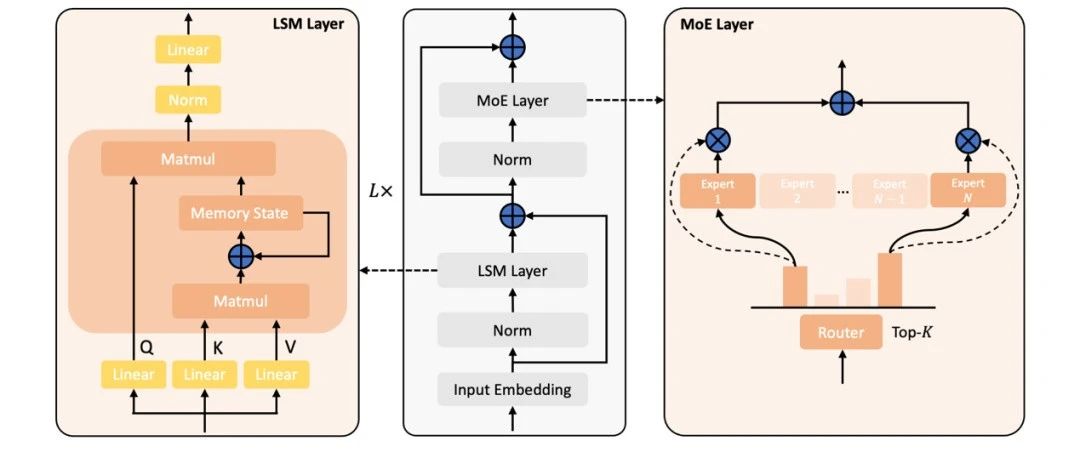
Core Insights - The article highlights the rise of Linear-MoE architecture, which effectively combines linear sequence modeling and Mixture-of-Experts (MoE) for enhanced performance in large language models [1][10]. Group 1: Linear Sequence Modeling - Significant advancements in linear sequence modeling have been achieved over the past two years, characterized by linear time complexity in training and constant memory usage during inference [5]. - The main categories of linear sequence modeling include Linear Attention, State Space Models (SSM), and Linear RNN, with notable works such as Lightning Attention, GLA, Mamba2, and RWKV [5]. Group 2: Mixture-of-Experts (MoE) - MoE has become a standard in the industry, with various models like GPT-4, Gemini, and domestic models such as DeepSeek and Qwen all adopting MoE architectures [8]. - The importance of MoE in enhancing model capabilities is emphasized, although the article does not delve deeply into this aspect [8]. Group 3: Linear-MoE Architecture - Linear-MoE offers a complete system from modeling to training, allowing flexible combinations of linear sequence modeling layers and MoE layers, while also being compatible with traditional Softmax Attention Transformer layers [10]. - Key features include a modular architecture with support for various linear modeling methods and multiple MoE implementations, ensuring stability and scalability through the Megatron-Core framework [10]. Group 4: Performance and Future Prospects - Large-scale experiments validate the superiority of Linear-MoE, demonstrating faster inference speeds (2-5 times quicker than traditional architectures) and over 50% reduction in memory usage [12][13]. - The open-source nature of Linear-MoE fills a technical gap and provides reproducible training solutions, with future exploration planned for applications in long-context understanding and Vision-Language model architectures [13].
2025 大模型“国战”:从百模混战到五强争锋
佩妮Penny的世界· 2025-05-13 10:24
Core Viewpoint - The article discusses the evolution of the AI foundational model landscape in China, emphasizing the rapid growth and valuation of key players in the industry, particularly following the emergence of ChatGPT. It highlights the competitive dynamics and future trends in the AI sector, particularly focusing on the "AI Six Tigers" and the impact of new entrants like Deepseek. Group 1: AI Six Tigers - The "AI Six Tigers" includes companies that have emerged rapidly since the launch of ChatGPT, with valuations exceeding 10 billion RMB, and the leading company, Zhipu, valued at over 25 billion RMB [1][6]. - Most of these companies were founded in 2023, indicating a swift response to market opportunities created by advancements in AI technology [1]. - The user base and revenue of these companies are still relatively low compared to their valuations, raising questions about their business models and sustainability [1][6]. Group 2: Key Players and Investment Dynamics - The key players in the AI sector include industry leaders, senior executives, and technical experts, many of whom have invested in multiple companies within the "AI Six Tigers" [2]. - Investment in these companies is often based on the founders' reputations and networks, reflecting a trend of "club deals" in venture capital [3]. - Recent strategic shifts among these companies include a focus on specific applications, such as healthcare for Baichuan Intelligence and multi-modal models for Minimax and Yuezhianmian [5]. Group 3: Challenges and Market Dynamics - Some companies within the "AI Six Tigers" may face financing difficulties due to high valuations, unproven business models, and questions about the scalability of their technologies [6]. - The AI industry is expected to see significant developments in 2024-2025, particularly with the emergence of major players like Deepseek [7]. Group 4: Deepseek's Impact - Deepseek has gained significant attention as a leading open-source inference model, prompting a renewed focus on foundational model research and competition in the AI sector [9]. - The success of Deepseek has encouraged more companies to open-source their foundational models, leading to advancements in multi-modal understanding and reasoning capabilities [9][10]. Group 5: Competitive Landscape - The competitive landscape for foundational models is narrowing, with key players including OpenAI, Google, and several domestic companies like Alibaba and ByteDance [12][18]. - Major companies are heavily investing in AI, with Alibaba planning to invest 380 billion RMB over three years and ByteDance over 150 billion RMB annually [12][18]. Group 6: Future Directions - The future of foundational models is expected to focus on multi-modal inputs and outputs, automation, and vertical industry applications, moving beyond simple parameter and data accumulation [22][23]. - The article suggests that the competition in AI should not be framed as a geopolitical race but rather as an opportunity for diverse innovation benefiting humanity [24].