Groq LPU

Search documents
从GTC到OFC-模型和算力的奔跑
2026-03-24 01:27
Summary of Conference Call Records Industry Overview - The conference call discusses the advancements in AI applications and the optical communication industry, particularly focusing on the transition from copper to optical connections and the implications for various companies involved in these technologies. Key Points and Arguments AI Application Growth - The emergence of intelligent models is accelerating, with 2026 expected to be the year of AI application explosion, supported by existing commercial benefits that can sustain related companies for at least five years, alleviating concerns about returns on computing power investments [1][2][11]. Demand for Optical Modules - The demand for 1.6T optical modules is expected to double year-on-year by 2025, with companies like Zhongji Xuchuang and Xinyi Sheng projected to have a PE ratio below 20 in 2026, indicating a reasonable undervaluation [1][5]. Copper Connection Lifecycle - The lifecycle of copper connections is being extended, with Nvidia and Broadcom confirming that copper will remain dominant in Scale-up interconnections until at least 2027, transitioning to CPO (Co-packaged Optics) only after 2028 [1][7][8]. Technological Advancements - Significant advancements in pluggable optical module technology were noted, with breakthroughs in single-wave 400G silicon photonics and EML solutions, enhancing competition with CPO technologies [1][3][4]. Supply and Demand in Optical Chips - There is a current shortage of optical chips, with Lumentum expecting revenues exceeding $100 million by Q4 2026. Domestic manufacturers like Yuanjie Technology and Changguang Huaxin are making clear progress in the CW and EML sectors [1][6]. Investment Recommendations - The optical communication sector is experiencing high demand, with recommendations to invest in leading companies like Zhongji Xuchuang and Xinyi Sheng, which are expected to maintain high growth rates due to increasing demand for optical modules [5][11]. CPO Technology Development - CPO technology is anticipated to see significant developments, with Nvidia announcing the mass production of its CPO switch chips in collaboration with TSMC. The technology is expected to be implemented in Scale-out applications by Q4 2026 [7][8]. Market Dynamics - Nvidia and Broadcom support the continued use of copper connections due to their cost-effectiveness and low power consumption, with expectations that this trend will persist until at least 2028 [9][10]. Long-term Outlook for AI Computing Power - The long-term sustainability of AI computing power investments is viewed positively, with expectations of continued growth over the next 3 to 5 years, driven by the ongoing demand for computing power in AI applications [11]. Additional Important Insights - The conference highlighted the competitive landscape between copper and optical connections, emphasizing that while copper has advantages in short-distance applications, optical connections are superior for long-distance and high-bandwidth needs [2][3]. - The potential for domestic companies to capture market share in the optical chip sector is significant, given the high barriers to entry and the current supply-demand imbalance [6]. - The introduction of new applications, such as Nvidia's Groq LPU, is expected to provide new growth opportunities for copper connections, reinforcing their relevance in the market [10].


深度解读英伟达芯片路线图
半导体行业观察· 2026-03-20 00:56
Core Insights - Nvidia has established itself as a dominant supplier in the GenAI revolution, showcasing a clear roadmap for its hardware and software developments in the AI sector [2][3] - The 2023 roadmap reveals Nvidia's annual update plan for its AI system components, with products like GX200 and Rubin R200 GPU accelerators set for release by 2025 [3][4] - Nvidia's market share in AI computing remains substantial, with projections indicating that the company will capture a significant portion of the server market revenue by 2025 [5] Roadmap Developments - The 2023 roadmap marks the first detailed annual update plan for Nvidia's AI systems, including products like Blackwell GPUs and Vera Arm server CPUs [3][4] - Nvidia's 2026 roadmap includes advancements in GPU technology, with the introduction of the "Feynman Ultra" GPU and updates to the ConnectX-10 SmartNIC [4][6] - The roadmap emphasizes the importance of these developments for OEMs and ODMs, as they are crucial for the deployment of AI training and inference systems [4][5] Market Projections - The server market is projected to reach between $420 billion and $450 billion by 2025, with Nvidia expected to generate approximately $190 billion from system material costs [5] - Machines equipped with Nvidia GPUs are anticipated to generate revenues between $275 billion and $325 billion, indicating a market share of 61% to 77% for Nvidia technology [5] - The profitability of AI systems is heavily skewed towards Nvidia, as evidenced by its gross, operating, and net profit margins [5] Technical Specifications - The Rubin R200 GPU is designed to deliver 50 petaflops of FP4 performance, significantly outperforming previous models [9] - The upcoming "Rubin Ultra" GPU is expected to double the GPU chip count and achieve 100 petaflops of FP4 performance, with advanced memory capabilities [16][19] - Nvidia's NVLink technology is set to evolve, with NVLink 6 offering 3,600 GB/sec bandwidth and NVLink 7 projected to reach 7,200 GB/sec [18][21] Future Innovations - Nvidia plans to introduce the "Kyber" rack, which will support a higher number of GPU slots and enhance overall system performance [16][21] - The integration of advanced memory technologies and chip stacking in future products like the Feynman GPU is expected to significantly boost throughput [23] - The roadmap indicates a strategic focus on optimizing both copper and optical interconnects to enhance system efficiency and performance [22][20]

美国的“阳谋”:让英伟达充当AI基建的“小发改委”
Guan Cha Zhe Wang· 2026-03-20 00:31
Core Insights - The article discusses NVIDIA's significant role in shaping the AI industry, particularly highlighted during the GTC 2026 event, where CEO Jensen Huang emphasized the company's vision of AI as a multi-layered "five-layer cake" with energy as the foundational element [3][9][19] Group 1: Product and Technology Developments - NVIDIA introduced several new products at GTC 2026, including the Vera CPU, Rubin GPU, and Groq LPU, which collectively represent a new system architecture philosophy aimed at optimizing both high throughput and low latency [4][5] - The Vera CPU, designed for high single-core performance, signifies NVIDIA's ambition to move beyond being just a GPU company to becoming a complete machine provider [5] - The introduction of the Nemotron alliance aims to ensure that AI models from various companies are optimized for NVIDIA hardware, reinforcing the company's ecosystem [7] Group 2: Infrastructure and Energy Considerations - Huang highlighted that energy is the "absolute constraint" determining how much intelligence a system can produce, indicating NVIDIA's focus on energy efficiency and planning for future power needs [9][19] - The company is developing the "Vera Rubin Space-1" space data center system, addressing potential future limitations of terrestrial power and cooling for AI computing [9] - NVIDIA's infrastructure strategy includes a comprehensive approach that encompasses not just chips but also land, power delivery, cooling systems, and network architecture, which Huang refers to as "AI factories" [6] Group 3: Market Position and Strategic Influence - NVIDIA's influence extends to the AI infrastructure investment landscape, with Huang predicting a demand of at least $1 trillion by 2027, comparable to national infrastructure spending [11] - The company controls GPU supply allocation, which significantly impacts the AI capabilities of major cloud service providers like AWS and Azure, effectively determining their business limits [12] - Huang's remarks suggest that NVIDIA is not just a company but acts as a "market coordinator" for the AI industry, aligning its commercial interests with broader national strategic goals [14][19]
GTC-2026现场解读-AI基础设施新范式
2026-03-19 02:39
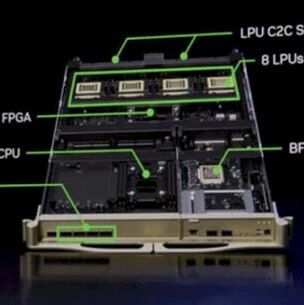
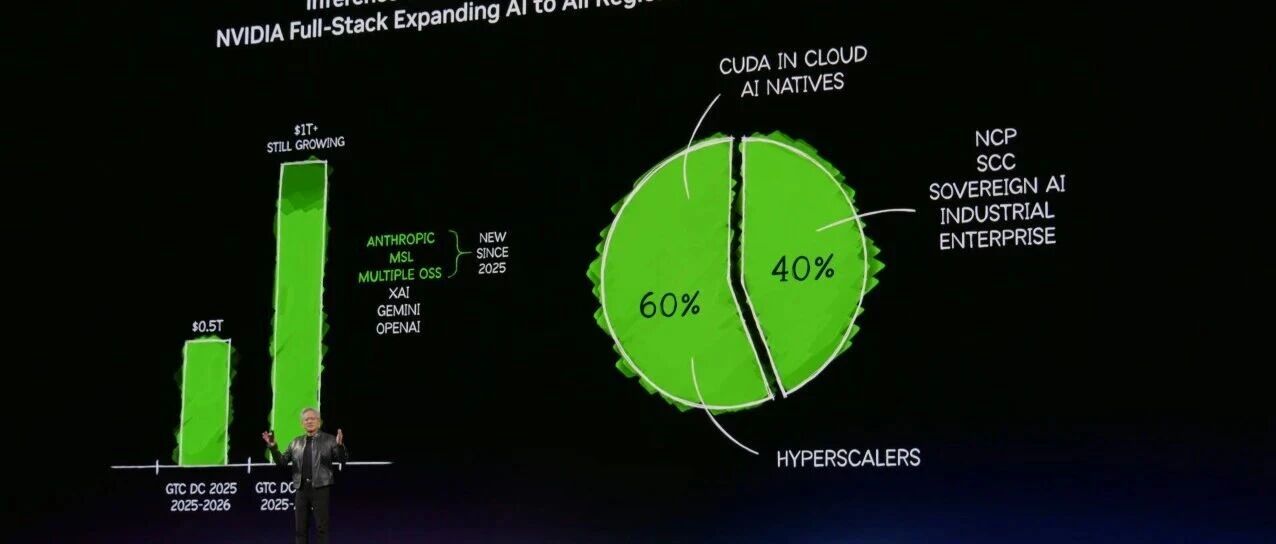
Summary of NVIDIA's 2026 GTC Conference Insights Industry and Company Overview - The conference focused on NVIDIA's strategic shift from being a chip seller to becoming a builder of AI factory platforms, emphasizing low-latency generative AI inference scenarios for 2026 [2][1]. Core Insights and Arguments - **Strategic Shift**: NVIDIA's strategy has evolved to prioritize the construction of AI factory platforms, moving away from solely chip sales. The focus is now on low-latency generative AI inference [2][1]. - **AI Infrastructure Model**: The conference introduced a "five-layer cake" model, starting from energy input to the final output of tokens, aligning with the AI factory's input-output model [2][1]. - **Chip Product Matrix**: NVIDIA showcased a comprehensive AI supercomputer product matrix, integrating technology from Groq to enhance low-latency inference capabilities. This includes a cabinet product supporting 256 Groq LPUs [3][1]. - **Revenue Guidance**: NVIDIA projected a revenue increase of approximately $500 billion for 2027, indicating stable quarter-over-quarter growth but not significant year-over-year growth compared to the previous cycle [5][6]. Additional Important Content - **Partnerships in Physical AI**: New OEM partners include Geely, BYD, and Hyundai, offering differentiated autonomous driving solutions ranging from L2+ to L4 levels. However, NVIDIA is restricted from selling autonomous driving software in mainland China, limiting its offerings to hardware [6][1]. - **Technological Evolution**: NVIDIA plans to maintain a coexistence of optical and copper connections in the short to medium term, with future products like Fairwood Ultra incorporating some CPO technology [4][1]. - **Agentic AI Trend**: The integration of Groq LPU aligns with the rise of Agentic AI applications, marking 2026 as a pivotal year for the deployment of such technologies [4][1].
英伟达改卖Token?黄仁勋GTC后发声:token就是AI新通货,值钱的不是算力,是“每度电的智商”
AI前线· 2026-03-18 11:37
Core Viewpoint - NVIDIA is positioned as an "accelerated computing company" rather than merely a GPU company, emphasizing the importance of the entire technology stack in AI development [2][10][24]. Group 1: AI Competition and Token Economy - The AI competition has shifted from merely computing power to producing high-quality results quickly and cost-effectively, with the entire process needing acceleration [4][5]. - Tokens are viewed as the core currency of the AI era, where smarter tokens can command higher prices, reflecting the efficiency of the models generating them [7][8]. - NVIDIA's acquisition of Groq and the introduction of Groq LPU aim to address the challenge of generating tokens with low latency, complementing existing GPU capabilities [9][10]. Group 2: Full-Stack Approach and Industry Integration - NVIDIA is transitioning from a focus solely on chips to a comprehensive understanding of applications, necessitating a full-stack approach to accelerate software and tools used by AI [12][20]. - The company aims to build AI factories and infrastructure globally, integrating various components like networking and storage to enhance overall system performance [22][26]. - The integration of AI with existing human tools, such as Excel and SQL, requires significant acceleration to keep pace with AI's rapid processing capabilities [14][15][30][31]. Group 3: Future of AI Models and Architectures - The limitations of current models like Transformers necessitate the development of new architectures that can handle long-term memory and continuous tasks more effectively [33][36]. - AI's ability to generate economic value is linked to its improved reasoning capabilities, allowing it to perform tasks beyond mere information generation [40][41]. - The emergence of coding agents signifies a shift where AI can assist in programming, enhancing efficiency and allowing engineers to focus on higher-level problem-solving [45][46]. Group 4: Role of CPUs and System Design - CPUs remain crucial in the AI ecosystem, with NVIDIA emphasizing the need for high-performance CPUs to prevent bottlenecks in GPU utilization [53][64]. - The design of CPUs like Vera focuses on high I/O bandwidth and single-thread performance to support the demands of AI applications [64][66]. - NVIDIA's strategy includes a collaborative approach with various architectures, ensuring that the best components are utilized for optimal system performance [66][87]. Group 5: Supply Chain and Market Dynamics - The current landscape shows that nearly all aspects of the supply chain are nearing capacity, making it challenging to scale any single component significantly [92][95]. - NVIDIA's proactive supply chain planning positions it favorably to meet future demands, despite potential constraints in power and chip availability [95][96]. - The company recognizes the importance of maintaining a competitive edge in the technology stack across all layers of AI development, from infrastructure to applications [98][99].

黄仁勋的Token经济学
经济观察报· 2026-03-17 14:23
Core Viewpoint - The core of Huang Renxun's speech at the GTC conference is not just the $1 trillion figure but a new business logic where data centers are transforming from model training facilities to token production factories [1][4]. Group 1: Market Predictions and Reactions - Huang Renxun predicts that global demand for AI infrastructure will reach $1 trillion by 2027, with actual demand potentially exceeding this figure [2]. - Following the announcement, NVIDIA's stock price jumped over 4%, while A-share stocks in the computing industry saw significant declines, with Tianfu Communication dropping over 10% [2]. - The disparity in market reactions stems from the time scale of Huang's predictions, as the next-generation Feynman chip architecture will not be available until 2028 [3]. Group 2: Token Consumption and Economic Model - Tokens, the basic units of information processed by large language models, have seen significant consumption increases due to events like the launch of ChatGPT and the release of Claude Code [6][7]. - The demand for inference services has grown 100 times in the past year, with inference now accounting for nearly 60% of server shipments in China [8]. - Huang outlines a tiered pricing model for tokens, ranging from free to $150 per million tokens, indicating that larger models and faster response times will command higher prices [9]. Group 3: Data Center Economics - Data centers are limited by power constraints, and the efficiency of token production per watt of electricity will determine profitability [11]. - A single 1GW data center could generate revenues ranging from $30 billion to $300 billion depending on the architecture used, highlighting the potential for revenue multiplication with new technologies [11][12]. - Huang emphasizes that companies have not fully utilized their existing data centers, suggesting that upgrading to new equipment could significantly increase revenue under the same power conditions [12]. Group 4: Hardware Innovations - The newly announced Vera Rubin platform consists of a system rather than a single chip, featuring liquid cooling and a significant increase in inference throughput [17]. - The combination of Vera Rubin GPUs and Groq's LPU allows for a decoupled inference process, optimizing for both high throughput and low latency [19]. - Huang projects that token generation rates could increase from 22 million to 700 million per second within two years for the same data center [20]. Group 5: Future Trends and Collaborations - Huang predicts that companies will need to budget for token usage similarly to how they budget for computers and software, with engineers receiving annual token budgets [14][15]. - NVIDIA has announced collaborations in the autonomous driving sector with companies like Uber and BYD, which positively impacted the automotive sector's stock prices [22].
Nvidia Forecast Ignites Market Surge Amid Middle East Volatility and SpaceX IPO Momentum
Stock Market News· 2026-03-16 19:38
Company Developments - Nvidia (NVDA) CEO Jensen Huang announced a target of $1 trillion in revenue from 2025 to 2027, driven by strong demand for AI chips, with 60% of business expected to come from hyperscalers [2][11] - To support this growth, Nvidia introduced the Vera CPU for agentic AI and the BlueField-4 STX storage architecture, along with a new CPU-based server rack and a Groq LPU product [3] - Nvidia's forecast led to a 1.7% surge in the Nasdaq 100 and a 1.5% gain in the S&P 500, despite geopolitical tensions [11] Market Trends - SpaceX is preparing for a record-setting IPO, engaging legal firm Gibson Dunn for assistance, as it continues to lead in the launch and satellite internet sectors [6][11] - In the energy sector, Brent crude oil prices fell by $2.93 to settle at $100.21 per barrel, reflecting market reactions to geopolitical volatility and global demand shifts [13]

英伟达GTC大会前瞻:整合Groq技术大举进攻推理芯片,三星首度代工生产,OpenAI或成首批客户
Hua Er Jie Jian Wen· 2026-03-16 01:07
Core Insights - The upcoming NVIDIA GTC conference is expected to signal a strategic shift from training to inference in the AI industry, with significant implications for investors [1] - Key developments include the integration of Groq technology, a shift in supply chain dynamics, and the expansion of physical AI and open-source model ecosystems [1] Group 1: Shift to Inference Market - NVIDIA is transitioning from a "training-first" approach to a "inference-driven" strategy, responding to competition from companies like Cerebras that offer faster and cheaper solutions [2] - The company is expected to announce a new chip system that integrates NVIDIA and Groq technologies, following a $20 billion investment in Groq technology licenses [2] - Groq's chips, known as Language Processing Units (LPU), are optimized for inference workloads, marking NVIDIA's first integration of another company's AI processor into its server architecture [2] Group 2: Supply Chain Restructuring - The Groq LPU is anticipated to be manufactured by Samsung in the second half of the year, representing a significant shift away from NVIDIA's long-standing reliance on TSMC for chip production [3] - This change may be temporary, as future LPU production could return to TSMC to ensure tighter integration with NVIDIA's upcoming AI chips [3] - OpenAI is expected to be one of the first customers for the new chip system, which may be utilized for AI-related tasks such as coding execution [3] Group 3: Architectural Changes and Future Technology Roadmap - The new system architecture will feature 256 Groq chips per rack, with Intel processors managing communication, indicating that the integration of LPU with existing systems is still in progress [4] - NVIDIA is exploring deeper integration of LPU into its future product roadmap, potentially merging Groq processors with the next-generation Feynman GPU to enhance performance and reduce costs [4] Group 4: Expansion of Physical AI and Open-Source Models - NVIDIA's focus on the AI application ecosystem is highlighted by its advancements in robotics and physical AI, particularly in the context of the rapidly growing humanoid robot industry in China [6] - The company has released a 120 billion parameter model, Nemotron 3 Super, and plans to introduce a new model, Nemotron 4 Ultra, with four times the parameters, which could lower AI inference costs and improve ROI for enterprises [6] - The signals from this GTC conference are likely to significantly influence the AI industry landscape by 2026 [6]
英伟达拟发布“神秘芯片” 或是专为推理设计的新架构
2 1 Shi Ji Jing Ji Bao Dao· 2026-03-11 05:47
Core Insights - NVIDIA is set to unveil a groundbreaking chip at the GTC conference in mid-March, which is expected to integrate Groq's LPU technology for a new inference product [1][4] - The shift in global computing demand is moving from training to inference, with predictions indicating that by 2026, inference will account for two-thirds of all AI computing power [3] - The new chip is anticipated to enhance decoding efficiency, addressing the limitations of current GPU architectures in handling large model parameters [5][6] Group 1: Chip Development and Technology - The upcoming chip is likely to be a new inference chip system that incorporates Groq's LPU technology, marking a significant integration of external architecture into NVIDIA's core AI computing product line [4] - The Groq LPU is designed specifically for inference acceleration, utilizing SRAM for model parameter storage, which offers significantly higher memory bandwidth compared to traditional GPU architectures [6] - NVIDIA may adopt a 3D stacking approach similar to AMD's V-Cache technology, integrating LPU units directly on top of GPU cores to enhance performance [7][8] Group 2: Market Trends and Predictions - The market is expected to see the emergence of specialized inference chips worth billions, which will be deployed in data centers and enterprise servers, with some chips potentially having power consumption comparable to general AI chips [3] - The industry is witnessing a trend where advanced manufacturing processes are becoming increasingly critical, with a focus on achieving high interconnect density and energy efficiency in chip designs [10] - There is a potential risk for domestic packaging and testing companies to be pushed out of the high-end market as the value of advanced chips concentrates on front-end manufacturing and advanced packaging [10]

就在下周,“AI届春晚”来了
财联社· 2026-03-10 11:08
Core Viewpoint - The upcoming NVIDIA GTC 2026 is expected to unveil groundbreaking chip architectures and technologies, including the Rubin Ultra and Feynman architectures, which will significantly enhance performance and design capabilities [2][3]. Group 1: New Chip Architectures and Technologies - NVIDIA is anticipated to introduce a new chip architecture and supporting technologies at GTC 2026, with a focus on the Rubin Ultra and the next-generation Feynman architecture [2]. - The Rubin Ultra is expected to implement an 800V HVDC power solution, while the cooling technology will shift from copper to copper alloys and potentially diamond materials, with liquid metal applications being validated by NVIDIA [2]. - The Groq LPU technology will be integrated into a new inference chip designed to meet the demands for high efficiency and low cost in AI inference, with production expected to increase from approximately 9,000 wafers to 15,000 wafers [3][4]. Group 2: Market Expectations and Strategic Developments - Investors are looking forward to more details on NVIDIA's co-packaged optics (CPO) technology and its applications in scalable networks, with a projected low market penetration rate for scale-out CPO switches in 2026-2027 [4]. - The upcoming OFC event coinciding with GTC is expected to set future trends in the optical communication industry, including advancements in traditional optical modules and CPO technology [5]. - NVIDIA's Rubin Ultra cabinet is likely to drive growth in M9 materials and NPO optical engines, with a focus on supply chain advantages for leading domestic manufacturers [5][6].