HBM9161

Search documents
又一家跨国药企抛来橄榄枝!和铂医药与百时美施贵宝共同开发新一代多特异性抗体疗法
Zheng Quan Shi Bao Wang· 2025-12-17 01:20
Core Viewpoint - The collaboration between Harbour BioMed and Bristol-Myers Squibb marks a significant step in advancing next-generation bispecific antibody therapies, with potential payments exceeding $1.1 billion for Harbour BioMed [2][3]. Group 1: Strategic Collaboration - Harbour BioMed has entered a long-term global strategic collaboration and licensing agreement with Bristol-Myers Squibb to co-develop next-generation bispecific antibody therapies [1][2]. - The agreement includes an initial payment of $90 million, with potential milestone payments of up to $1.035 billion, plus tiered royalties based on future product net sales [2][3]. Group 2: Technological Advancements - The collaboration will leverage Harbour BioMed's Harbour Mice fully human antibody technology platform, which is capable of efficiently discovering and developing innovative biotherapies [2][3]. - Harbour Mice can generate fully human monoclonal antibodies in various formats, including dual heavy and light chains (H2L2) and heavy chain-only (HCAb) antibodies, enhancing anti-tumor efficacy beyond traditional therapies [3]. Group 3: AI Integration - Harbour BioMed is integrating AI technology into its drug discovery processes, exemplified by the launch of its AI-assisted drug discovery engine, Hu-mAtrIx, which aims to accelerate antibody discovery across multiple therapeutic areas [4]. - The Hu-mAtrIx platform has been designed to work seamlessly with the Harbour Mice technology, utilizing advanced AI models for sequence generation and drugability prediction [4]. Group 4: Global Ecosystem Development - Harbour BioMed has established collaborations with multiple multinational pharmaceutical companies, including AstraZeneca, Pfizer, and Moderna, with total agreements exceeding $10 billion [6][7]. - The company employs diverse collaboration models, including licensing agreements and joint ventures, to enhance its global ecosystem for antibody drug development [7]. Group 5: Future Goals - Harbour BioMed aims to become a "new infrastructure" for global antibody drug development within the next two years, driven by its technological advancements and collaborative efforts [4].
以HCAb技术助力下一代生物制剂研发 和铂医药登上Nature旗下期刊
Zheng Quan Shi Bao Wang· 2025-09-17 00:18
Core Insights - The article highlights the recognition of HAPO Pharmaceutical and its subsidiary Nona Bio for their innovative human-derived heavy chain antibody (HCAb) technology, which addresses the challenges of long development cycles, high costs, and significant risks in the biopharmaceutical industry [1][2] - HAPO's HCAb technology is seen as a key to unlocking the next generation of biopharmaceuticals, with advantages in molecular size, antigen recognition, and tissue penetration [2][4] - The company has established a flexible and diverse business model that enhances its competitive edge, attracting partnerships with major pharmaceutical companies like AstraZeneca and Pfizer [4][5] Technology and Innovation - HAPO's proprietary Harbour Mice platform is a rare human antibody development platform capable of generating both dual light chain (H2L2) and heavy chain (HCAb) monoclonal antibodies [2] - The HCAb Plus™ platform has been developed to support the creation of complex molecules such as bispecific antibodies and antibody-drug conjugates (ADCs) [2][5] - The company has launched an AI-assisted drug discovery engine, Hu-mAtrIx™, to accelerate antibody discovery across various therapeutic areas [7] Business Model and Partnerships - HAPO has successfully engaged in over ten licensing agreements with major pharmaceutical companies, leveraging a License-out model [4] - The NewCo model allows HAPO to deepen collaborations through joint ventures, exemplified by its partnership with Boston Children's Hospital [4] - A notable partnership with AstraZeneca includes a $4.575 billion deal and a $105 million equity investment, marking a shift from single transactions to strategic partnerships [4] Financial Performance - HAPO has achieved profitability in 2023 and 2024, with a reported net profit of approximately 523 million yuan in the first half of the year, reflecting a 51-fold year-on-year increase [5][8] - The company aims to become a global leader in antibody drug development, targeting a growth trajectory similar to that of Regeneron [7][8] Future Goals - HAPO's strategic focus is on "platform monetization + pipeline breakthroughs," with plans to solidify its position as a "new infrastructure" in global antibody drug development [7] - The company has developed over 20 innovative products with differentiated competitive advantages, including the core product HBM9161, which received breakthrough therapy designation from the National Medical Products Administration [7][8]
资本市场的双向奔赴:解码和铂医药-B(2142.HK)千万级回购背后的战略棋局
Ge Long Hui· 2025-05-13 02:20
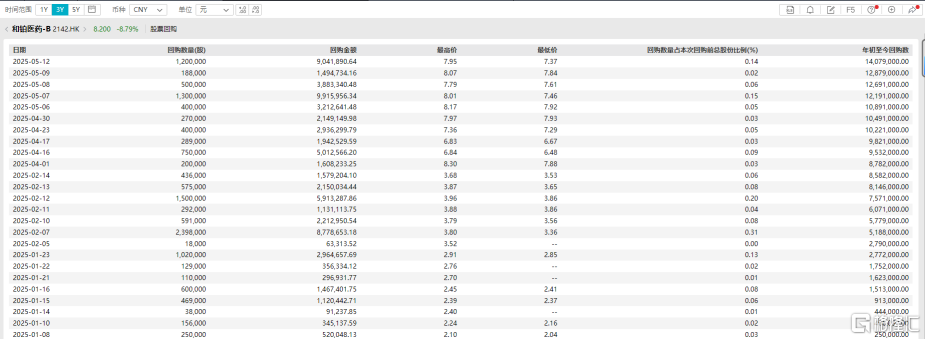
Core Viewpoint - The recent stock buyback activities by Heptagon Pharmaceuticals (2142.HK) have attracted market attention, showcasing the company's strong performance and management's confidence in its future growth despite the broader biotech industry's challenges [1][2]. Group 1: Buyback Activities - Heptagon Pharmaceuticals has spent a total of HKD 29.68 million on share buybacks in May, acquiring 3.588 million shares, with a significant buyback of HKD 9.76 million for 1.2 million shares on May 12 [1][2]. - The company's stock price has surged over 400% year-to-date, leading to a market capitalization of HKD 6.9 billion [1]. - The management's decision to engage in substantial buybacks is interpreted as a strong endorsement of the company's intrinsic value and future business prospects [2][6]. Group 2: Financial Health and Cash Flow - Heptagon Pharmaceuticals has transitioned from a "burning cash" phase to a "cash-generating" phase, achieving over CNY 1 billion in annual recurring revenue for the first time [7]. - The company has a cash reserve of CNY 1.2 billion, bolstered by strategic partnerships that have generated nearly USD 300 million in upfront and milestone payments [7]. - The NewCo collaboration model has allowed the company to secure significant upfront payments and ongoing revenue streams, ensuring financial stability for future R&D [7]. Group 3: Strategic Partnerships and Platform Advantages - The strategic partnership with AstraZeneca has enabled Heptagon to leverage its proprietary technology platform, resulting in substantial upfront payments and potential future earnings [8]. - The collaboration model includes technology licensing, joint development, and equity investment, enhancing the company's competitive edge in the biotech sector [8]. - Heptagon has established numerous partnerships with leading pharmaceutical companies, positioning itself favorably in the industry [8]. Group 4: Valuation and Future Outlook - The management's aggressive buyback strategy reflects a forward-looking assessment of the company's value, aiming to transition from pipeline valuation to platform premium [9]. - The company aims to become a sustainable profit-generating global biotech engine, breaking the cycle of financing and cash burn typical in the industry [9]. - Forecasts suggest that Heptagon's total revenue will reach CNY 2.6 billion, CNY 4.17 billion, and CNY 5.66 billion from 2024 to 2026, with a target market value of CNY 8.592 billion [9].