HTF50ETF

Search documents
博时基金董事长张东:策马扬鞭 春启新程
Zhong Guo Ji Jin Bao· 2026-02-17 06:48
Group 1: Macro Economic Outlook - The global economic environment is becoming increasingly complex, with the Federal Reserve's monetary policy easing nearing its end and a restructuring of global liquidity patterns [1] - China's economic stability and continued openness are expected to enhance the attractiveness of RMB assets in global allocations [1] - The "14th Five-Year Plan" is set to inject continuous industrial momentum into the capital market through strategies like technological innovation, green transformation, and rural revitalization [1] Group 2: Capital Market Opportunities - The stock market presents structural opportunities, particularly in sectors like technology independence, energy transition, and consumer recovery, where companies with real competitiveness will continue to be revalued [2] - Key sectors expected to remain active include high-tech manufacturing and digital economy, with cross-border investment opportunities arising from the linkage between Hong Kong and A-shares [2] - The focus for 2026 will be on fundamental analysis, embracing "new demand" and "new supply" driven by national development and industrial upgrades [2] Group 3: Fixed Income Market Insights - The bond market retains allocation value, with interest rates likely to remain relatively low, supporting the stabilizing role of government bonds and high-grade credit bonds [3] - Investment opportunities will arise from detailed exploration of term spreads and credit spreads, as well as the flexible application of "fixed income plus" strategies [3] - Attention should be given to sub-sectors with low correlation to macro cycles and assets like REITs that provide stable cash flow characteristics [3] Group 4: Asset Allocation Strategy - Asset allocation should emphasize balance and flexibility, transitioning from "single Beta" to "multiple Alpha" strategies to mitigate risks associated with increased market volatility in 2026 [3] - A dynamic allocation approach across equities, fixed income, and alternative assets is recommended to find low-correlation combinations [3] - Strategic emphasis on alternative assets such as gold and certain commodities is advised for diversification, alongside the use of ETFs for efficient and precise risk management [3] Group 5: Financial Sector Developments - The "14th Five-Year Plan" emphasizes the acceleration of building a financial powerhouse, with significant focus on developing technology finance, green finance, inclusive finance, pension finance, and digital finance [4] - The company aims to deepen research and enhance services to support national goals and create greater value for society and clients [4]

002326宣布:终止收购
Zhong Guo Ji Jin Bao· 2026-02-14 07:59
Group 1 - The core point of the article is that Yongtai Technology has terminated the acquisition of a 25% stake in Shaowu Yongtai High-tech Materials Co., Ltd. from CATL, which means that CATL's reverse investment in the listed company has fallen through [1][2] - Yongtai Technology announced that it would continue to explore capital operation plans that align with the company's development needs in the future [2] - The company is a manufacturer of fluorine-containing fine chemicals and is one of the few enterprises that span both inorganic and organic fluorochemical industries [2] Group 2 - Yongtai High-tech's main products, such as lithium hexafluorophosphate and lithium bis(fluorosulfonyl)imide, are key materials for lithium battery electrolytes, which are crucial for improving battery conductivity and achieving fast charging [2] - As of November last year, Yongtai Technology disclosed that its solid lithium hexafluorophosphate had an annual production capacity of approximately 18,000 tons, while liquid lithium bis(fluorosulfonyl)imide had a capacity of 67,000 tons, and electrolytes had a capacity of 150,000 tons [2] - The company is currently involved in a lawsuit due to a commercial secret infringement dispute, with the amount in question being 887 million yuan [3] Group 3 - Yongtai Technology's performance forecast indicates a narrowing of net losses attributable to shareholders to between 25.6 million and 48.6 million yuan for 2025, with significant improvements in core operating losses [3] - The demand in the new energy and energy storage sectors is rapidly increasing, leading to a substantial rise in sales and prices of the company's core lithium battery materials, which is a key driver for reducing losses [3]



股份制银行板块2月4日涨1.51%,招商银行领涨,主力资金净流入11.33亿元
Zheng Xing Xing Ye Ri Bao· 2026-02-04 08:56
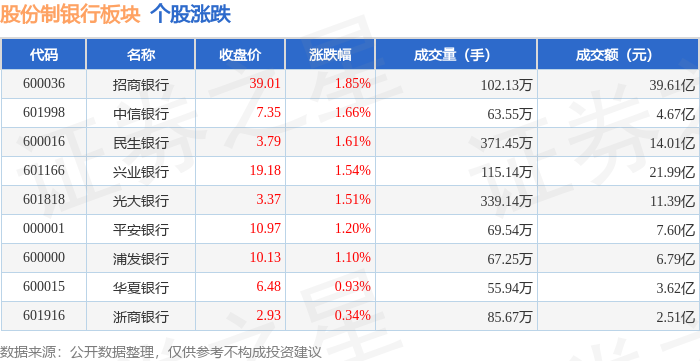
Group 1 - The banking sector saw an increase of 1.51% on February 4, with China Merchants Bank leading the gains [1] - The Shanghai Composite Index closed at 4102.2, up 0.85%, while the Shenzhen Component Index closed at 14156.27, up 0.21% [1] - Key stocks in the banking sector showed various performance metrics, with China Merchants Bank closing at 39.01, up 1.85%, and CITIC Bank at 7.35, up 1.66% [1] Group 2 - The banking sector experienced a net inflow of 1.133 billion yuan from main funds, while retail and speculative funds saw net outflows of 0.351 billion yuan and 0.782 billion yuan, respectively [1] - Major banks like China Merchants Bank and Industrial Bank had significant net inflows of 1.642 billion yuan and 0.322 billion yuan, respectively, indicating strong institutional interest [1] - In contrast, banks like Everbright Bank and CITIC Bank faced net outflows of 0.549 billion yuan and 0.239 million yuan, reflecting weaker retail sentiment [1]




股份制银行板块1月30日跌0.53%,华夏银行领跌,主力资金净流出6.65亿元
Zheng Xing Xing Ye Ri Bao· 2026-01-30 08:54
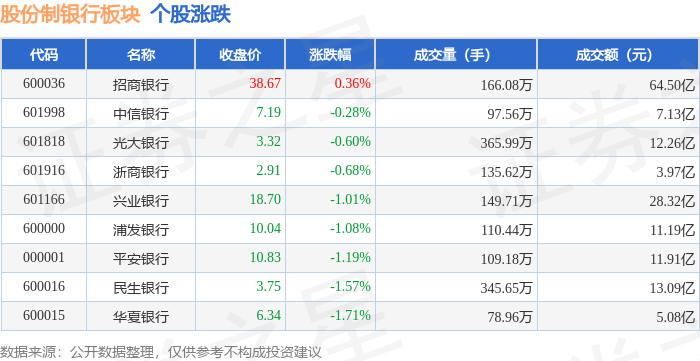
Group 1 - The banking sector experienced a decline of 0.53% on January 30, with Huaxia Bank leading the drop [1] - The Shanghai Composite Index closed at 4117.95, down 0.96%, while the Shenzhen Component Index closed at 14205.89, down 0.66% [1] - Major banks such as China Merchants Bank and CITIC Bank showed mixed performance, with China Merchants Bank slightly up by 0.36% and CITIC Bank down by 0.28% [1] Group 2 - The banking sector saw a net outflow of 665 million yuan from institutional investors, while retail investors contributed a net inflow of 564 million yuan [1] - Specific banks like Huaxia Bank and Minsheng Bank faced significant net outflows from institutional investors, with Huaxia Bank seeing a net outflow of 67 million yuan [1] - Retail investors showed a preference for certain banks, with significant net inflows into banks like Ping An Bank and Zhejiang Commercial Bank [1]