
国防军工

Search documents
粤开宏观:如何看待A股近期调整?压力释放而非趋势逆转
Yuekai Securities· 2026-03-23 23:30
Market Overview - The A-share market has recently experienced significant adjustments, with the Shanghai Composite Index dropping 3.63% to 3813.28 points, and the ChiNext Index falling 3.49% to 3235.22 points, effectively erasing all gains made in the year[1] - The Nikkei 225 index fell by 3.48%, while the KOSPI index dropped by 6.49%, indicating a broader regional market downturn influenced by geopolitical tensions[1] Geopolitical Impact - The ongoing US-Iran conflict has escalated, leading to fears of high oil prices triggering global inflation and monetary tightening, causing funds to withdraw from risk-sensitive assets like stocks[2] - The market's reaction to the geopolitical situation reflects a shift towards "stagflation," with concerns that rising oil prices could squeeze corporate profits and increase living costs, thereby impacting consumption and economic fundamentals[2] Market Sentiment and Technical Factors - The A-share market's decline is attributed to three main factors: external macroeconomic constraints, internal profit-taking pressures, and technical sell-offs triggered by breaking key psychological levels[2] - The Shanghai Composite Index's breach of the 3900-point mark triggered panic selling among traders, exacerbating the market's downward momentum[2] Long-term Outlook - Despite the current adjustments, the long-term outlook for the A-share market remains positive, supported by China's strong economic, military, and diplomatic capabilities, as well as a stable domestic environment[2] - The report suggests focusing on sectors with improving supply-demand dynamics and strong profit recovery potential, such as non-ferrous metals, electric power equipment, and petrochemicals[2] Investment Strategy - Short-term strategies should include reducing positions and balancing allocations to mitigate risks associated with high market volatility due to ongoing geopolitical tensions[2] - Long-term investment should target sectors related to domestic self-sufficiency and technological independence, including AI, new energy, and defense industries, which are expected to remain active throughout the year[2]
看好境内投资资产!2026年险资配置展望来了
Guang Zhou Ri Bao· 2026-02-26 16:36
Core Insights - The China Banking and Insurance Asset Management Association released a survey indicating the investment intentions of insurance institutions for 2026, highlighting a positive outlook for domestic stocks and securities investment funds [1] Asset Allocation Overview - A total of 127 insurance institutions participated in the survey, including 36 asset management firms and 91 insurance companies [1] - Most insurance institutions plan to maintain their allocation ratios for bank deposits, bonds, securities investment funds, and other financial assets similar to 2025, with some showing a willingness to slightly increase stock investments [1] Detailed Asset Allocation Plans - In terms of bond market outlook, most insurance institutions hold a neutral stance, expecting 10-year government bond yields to be in the range of 1.8% to 1.9% and 30-year yields between 2.2% and 2.4% [3] - Over half of the institutions anticipate high-grade credit bond yields to center around 2.0% to 2.5%, with overall credit spreads expected to fluctuate [3] - The preferred bond types include high-grade industrial bonds, perpetual bonds, secondary capital bonds, and convertible bonds, with a focus on 10 to 30-year maturities [3] A-Share Market Outlook - Most insurance institutions are optimistic about the A-share market for 2026, favoring stocks in indices such as the Sci-Tech 50, CSI 300, and ChiNext [3] - Key sectors of interest include electronics, non-ferrous metals, power equipment, computers, communications, pharmaceuticals, and basic chemicals, with a focus on themes like semiconductor chips, defense, AI computing power, and high dividends [3] Fund Investment Preferences - For 2026, insurance asset management institutions prefer to allocate to equity funds, secondary bond funds, mixed equity funds, index funds, and ETFs, while insurance companies favor secondary bond funds and growth funds [5] - Nearly half of the insurance institutions plan to slightly increase their allocation to public funds [5] Offshore Investment Preferences - Hong Kong stocks are the most favored offshore investment for insurance institutions in 2026, with gold and US stocks also receiving attention [5] - About half of the asset management institutions plan to slightly increase their allocation to Hong Kong stocks, while 40% of insurance companies intend to maintain their current allocation [5]

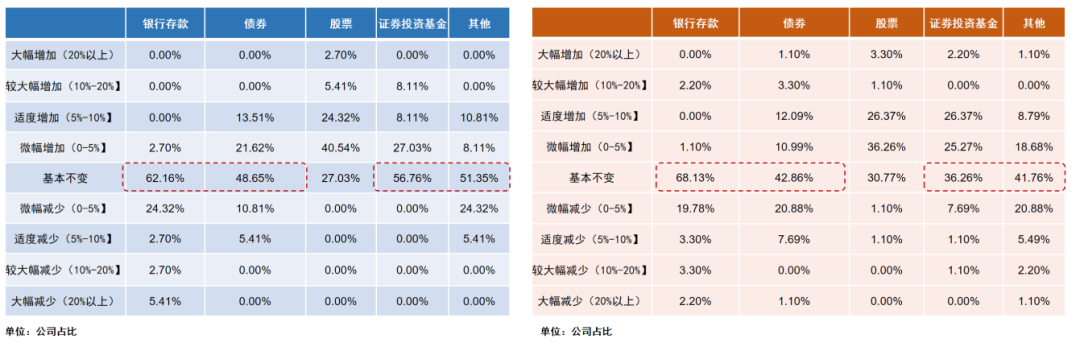
多数保险机构对2026年A股市场持较乐观态度,计划小幅增配A股
Jin Rong Jie· 2026-02-25 03:58
Group 1 - The core viewpoint of the articles indicates that insurance institutions are optimistic about domestic investments in stocks and securities investment funds for 2026, with a tendency to slightly increase stock investments [1] - Most insurance institutions plan to maintain their allocation ratios for bank deposits, bonds, securities investment funds, and other financial assets similar to 2025, with some intending to moderately increase stock investments [1] - In the bond market, insurance institutions hold a neutral outlook for 2026, favoring high-grade corporate bonds, perpetual bonds, subordinated debt, and convertible bonds, primarily focusing on bonds with maturities between 10 to 30 years [1] Group 2 - Regarding the A-share market, insurance institutions are generally optimistic for 2026, favoring indices such as the Sci-Tech Innovation 50, CSI 300, and ChiNext, and industries like electronics, non-ferrous metals, and pharmaceuticals [1] - The main factors influencing the A-share market are expected to be corporate profit recovery and liquidity conditions, with most insurance institutions planning to slightly increase their allocation to A-shares [1] - In terms of fund investments, insurance asset management institutions prefer equity funds, secondary bond funds, and mixed equity funds, with nearly half planning to slightly increase their allocation to public funds [2] Group 3 - For overseas investments, Hong Kong stocks are the most favored by insurance institutions for 2026, with gold and US stocks also receiving attention [2] - About half of the insurance asset management institutions plan to slightly increase their allocation to Hong Kong stocks, while 40% of insurance companies intend to maintain their current allocation levels [2]
博时基金董事长张东:策马扬鞭 春启新程
Zhong Guo Ji Jin Bao· 2026-02-17 06:48
Group 1: Macro Economic Outlook - The global economic environment is becoming increasingly complex, with the Federal Reserve's monetary policy easing nearing its end and a restructuring of global liquidity patterns [1] - China's economic stability and continued openness are expected to enhance the attractiveness of RMB assets in global allocations [1] - The "14th Five-Year Plan" is set to inject continuous industrial momentum into the capital market through strategies like technological innovation, green transformation, and rural revitalization [1] Group 2: Capital Market Opportunities - The stock market presents structural opportunities, particularly in sectors like technology independence, energy transition, and consumer recovery, where companies with real competitiveness will continue to be revalued [2] - Key sectors expected to remain active include high-tech manufacturing and digital economy, with cross-border investment opportunities arising from the linkage between Hong Kong and A-shares [2] - The focus for 2026 will be on fundamental analysis, embracing "new demand" and "new supply" driven by national development and industrial upgrades [2] Group 3: Fixed Income Market Insights - The bond market retains allocation value, with interest rates likely to remain relatively low, supporting the stabilizing role of government bonds and high-grade credit bonds [3] - Investment opportunities will arise from detailed exploration of term spreads and credit spreads, as well as the flexible application of "fixed income plus" strategies [3] - Attention should be given to sub-sectors with low correlation to macro cycles and assets like REITs that provide stable cash flow characteristics [3] Group 4: Asset Allocation Strategy - Asset allocation should emphasize balance and flexibility, transitioning from "single Beta" to "multiple Alpha" strategies to mitigate risks associated with increased market volatility in 2026 [3] - A dynamic allocation approach across equities, fixed income, and alternative assets is recommended to find low-correlation combinations [3] - Strategic emphasis on alternative assets such as gold and certain commodities is advised for diversification, alongside the use of ETFs for efficient and precise risk management [3] Group 5: Financial Sector Developments - The "14th Five-Year Plan" emphasizes the acceleration of building a financial powerhouse, with significant focus on developing technology finance, green finance, inclusive finance, pension finance, and digital finance [4] - The company aims to deepen research and enhance services to support national goals and create greater value for society and clients [4]
产品创新、投研升级、出海拓展 公募行业多点突破“新棋局”
Shang Hai Zheng Quan Bao· 2026-02-03 00:24
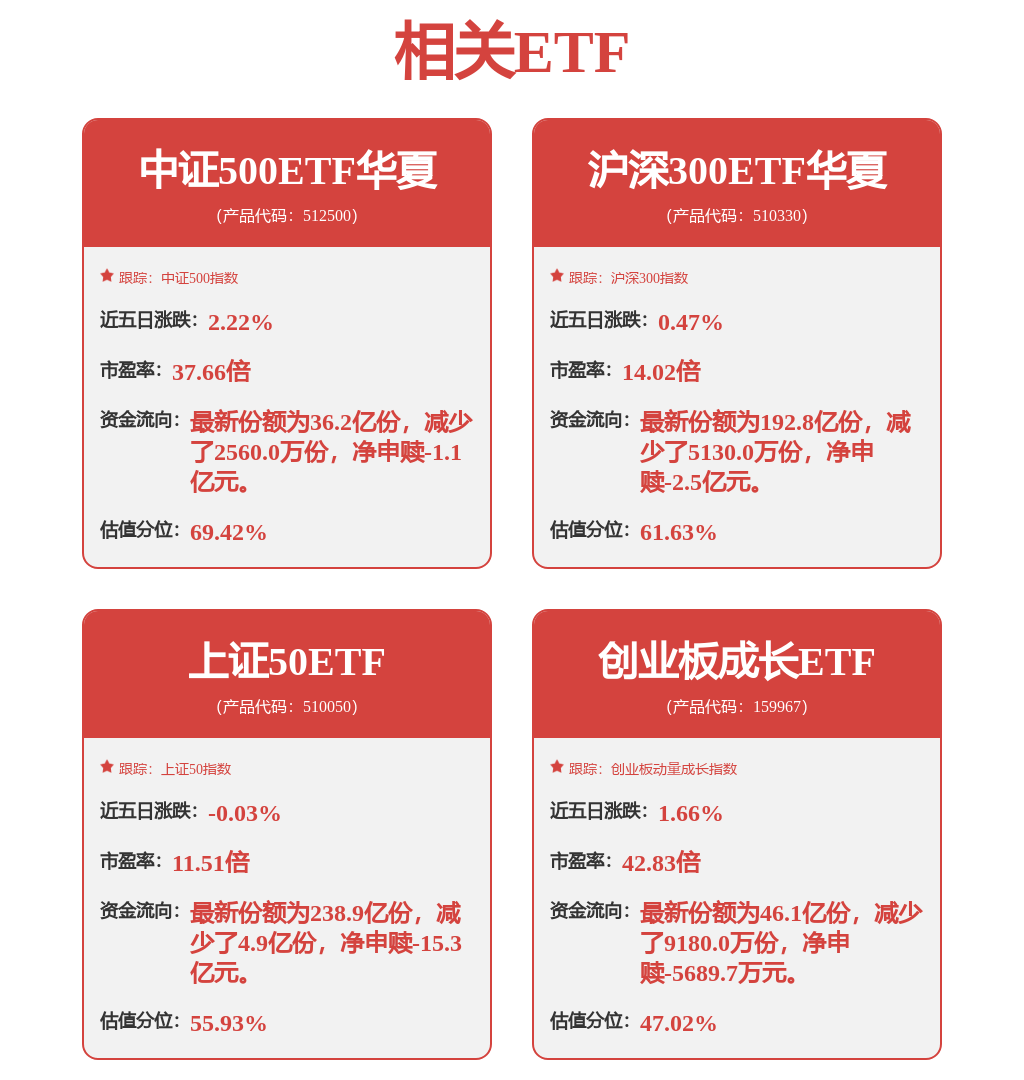
Core Viewpoint - The public fund industry in China is entering a phase of high-quality development, with ongoing reforms aimed at optimizing and upgrading the sector, focusing on product innovation, team-based research, and enhancing international competitiveness [1][6]. Group 1: Product Innovation - The public fund industry is currently adopting a dual-line strategy for product innovation, focusing on equity products and absolute return products like FOFs to meet diverse investor needs [2][3]. - In January, 123 new funds were established, with a total issuance scale of 1,202.11 billion yuan, of which 95 were equity funds with an issuance scale of 812.43 billion yuan [2]. - Notable equity funds include the Guangfa Research Smart Mixed Fund, which raised 72.21 billion yuan, marking the first fund to exceed 70 billion yuan since November 2022 [2]. - FOFs have also gained traction, with an issuance scale of 199.43 billion yuan in January, indicating strong demand for low-risk investment options [3]. Group 2: Research and Team Dynamics - The public fund industry is shifting towards a team-based research model, moving away from the traditional reliance on star fund managers, which is expected to optimize the industry ecosystem [4]. - The establishment of the Ruiyuan Research Balanced Three-Year Holding Mixed Fund, managed by a team of new faces rather than established managers, exemplifies this trend [4]. - Changes in fund management personnel are also evident, with new managers being appointed to replace seasoned professionals, indicating a generational shift in leadership [5]. Group 3: Long-term Investment Ecosystem - The China Securities Regulatory Commission emphasizes the need for ongoing reforms to broaden long-term funding sources and promote long-term, rational, and value-based investments [6]. - Analysts predict that by 2030, the scale of public funds could exceed 50 trillion yuan, driven by deeper financial asset allocation by residents and the influx of long-term capital [6]. - The industry is expected to see a shift towards passive investment strategies and ETFs, which will become essential tools for long-term allocation [6]. Group 4: International Expansion - Leading public funds are increasingly focusing on international expansion, with products like the Southern Dongying CSI A500 ETF being listed on international exchanges, enhancing access for global investors [7]. - Strategic partnerships, such as the collaboration between Huatai and Korean investment firms, are being formed to deepen engagement in the Hong Kong ETF market [7]. - The industry is committed to integrating technology and enhancing service offerings to support national development and capital market reforms [7].
产品创新 投研升级 出海拓展 公募行业多点突破“新棋局”
Shang Hai Zheng Quan Bao· 2026-02-02 18:45
Core Insights - The public fund industry in China is focusing on high-quality development and reform, as emphasized by the China Securities Regulatory Commission (CSRC) during the 2026 system work meeting [2][7] Product Innovation - The public fund sector is witnessing continuous product innovation, with a dual focus on equity products and absolute return products like FOFs [2][3] - In January, 123 new funds were established, with a total issuance scale of 120.21 billion yuan, of which 95 were equity funds totaling 81.24 billion yuan [2] - Active equity funds have shown a resurgence, with notable issuances such as the GF Research Smart Mixed Fund at 7.22 billion yuan, marking the first active equity fund to exceed 7 billion yuan since November 2022 [2][3] Investment Trends - The current investment direction aligns closely with market trends, including cloud computing ETFs, AI ETFs, and funds focused on consumer and digital economy themes [3] - FOFs have gained traction, with a total issuance of 19.94 billion yuan in January, and 14 products still in the issuance phase as of February 2 [3] Research and Team Dynamics - The public fund industry is shifting towards a team-based research model, moving away from the traditional star fund manager approach [5] - Newer fund managers are emerging, as seen in the establishment of the Ruiyuan Research Balanced Fund, which was managed by a team of less-known managers rather than established stars [5][6] Long-term Investment Ecosystem - The CSRC aims to deepen reforms in the public fund sector, focusing on long-term investment strategies and risk management tools to foster a "long money, long investment" market ecosystem [7] - Analysts predict that by 2030, the public fund scale could exceed 50 trillion yuan, driven by deeper financial asset allocation and the entry of long-term capital [7] International Expansion - Leading public funds are increasingly looking to expand internationally, with products like the Southern Dongying CSI A500 ETF being listed on exchanges in Singapore and Hong Kong [8] - Strategic partnerships are being formed, such as the collaboration between Huatai and Korean investment firms to enhance their presence in the Hong Kong ETF market [8]
航天军工带头上攻,军工龙头ETF(512710)盘中涨幅达4.53%
Mei Ri Jing Ji Xin Wen· 2026-01-19 06:35
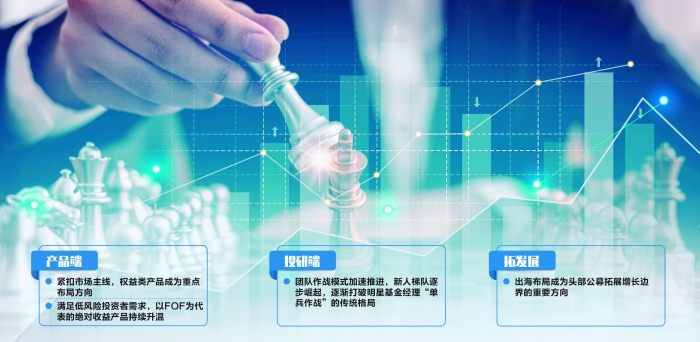
Core Viewpoint - The stock indices in Shanghai and Shenzhen are experiencing a strong upward trend, particularly in the aerospace and military sectors, with significant gains in large aircraft, general aviation, commercial aerospace, and aircraft carriers [1] Group 1: Market Performance - The military industry leader ETF (512710) has seen an intraday increase of 4.53%, while the aviation ETF (159392) has risen by 3.01% [1] - Key stocks within the military industry leader ETF, including AVIC Aircraft, Hongdu Aviation, and Aero Engine Corporation of China, have reached their daily limit up [1] Group 2: Industry News - The National Defense Science and Technology Industry Administration has officially released the top ten news stories for the defense technology industry in 2025, highlighting the successful combat achievements of the J-10CE export fighter jet [1] - In the field of aviation power, a domestically developed 1200 kW turboprop engine has successfully completed its ignition test, marking a significant advancement into the testing and validation phase of its development [1] Group 3: Index Information - The military industry leader ETF (512710) closely tracks the CSI Military Industry Leader Index (931066), which selects 30 listed companies involved in military products and services to reflect the overall performance of leading companies in the military sector [1]


中钢洛耐(688119.SH):公司目前产品暂未应用于商业航天领域
Ge Long Hui· 2026-01-16 08:57
Core Viewpoint - The company, Zhonggang Luonai (688119.SH), has indicated that its products are not currently applied in the commercial aerospace sector, focusing instead on defense and military applications [1] Group 1 - The company is developing special materials and construction technologies for rocket launch stations, primarily for the defense and military industry [1] - The business related to these applications constitutes a small portion of the company's overall operations [1] - The current activities in this area do not significantly impact the company's performance for the period [1]

国雄资本董事长姚尚坤:2026年资本市场聚焦结构性机遇与多元配置
Zhong Guo Jing Ying Bao· 2026-01-15 05:23
Core Insights - The current capital market is characterized by stable overall volume and active structure, driven by policy support and industrial upgrades [1] - The technology growth sector, particularly in artificial intelligence, semiconductors, biomedicine, and new energy, is identified as the core driver for the year [1] - The investment strategy for 2026 will focus on "new demand" and "new supply," emphasizing technological innovation and green transformation under national strategic guidance [1] Group 1: Investment Strategy - The investment strategy will revolve around "new demand" areas such as technology innovation (AI, high-end chips), green transformation (new energy, new power systems), and national security (defense, information security) [1] - In the "new supply" area, traditional manufacturing will enhance efficiency through equipment upgrades and technology transformation, providing high-cost performance investment opportunities [1] - The correlation between Hong Kong and A-shares will expand cross-border investment opportunities, but a focus on fundamentals is necessary to avoid speculative trading [1] Group 2: Bond Market Insights - The interest rate is expected to remain low, with government policies supporting the economic environment, making interest rate bonds and high-grade credit bonds stable options [2] - The investment strategy will focus on detailed operations of term spreads and credit spreads, along with a "fixed income +" strategy to enhance yield flexibility [2] - It is recommended to allocate to assets with weak correlation to the macro cycle, such as REITs, to improve portfolio resilience against volatility [2] Group 3: Organizational Strategy - The company plans to accelerate the large-scale application of AI technology in research, management, and collaboration to enhance organizational agility [2] - There will be a deepening of industry chain cooperation and integration of ESG concepts into daily operations, promoting green development [2] - The emphasis is on capturing structural opportunities with a long-term perspective, rather than chasing short-term fluctuations [2]