
Habitat

Search documents
Sainsbury’s grocery growth offsets weaker merchandise and Argos sales in Q3
Yahoo Finance· 2026-01-09 15:31
Core Insights - Sainsbury's reported stronger third-quarter grocery sales and maintained its full-year profit outlook despite weaker performance in general merchandise and Argos [1][4] Group 1: Sales Performance - Total retail sales excluding fuel increased by 3.9% year-on-year to £10.02 billion ($13.43 billion) for the 16 weeks ending January 3, 2026 [1] - Grocery sales advanced by 5.4% during the same period, while general merchandise and clothing sales declined by 1.1% [1] - Online grocery sales rose by 14%, and convenience stores achieved record performance [2] Group 2: Specific Brand Performance - The Tu clothing brand experienced volume growth, outperforming the wider clothing market despite overall softer demand [3] - Habitat, the homewares and furnishings brand, posted a 6% sales increase, while the relaunched Chad Valley range delivered 7% growth [3] Group 3: Profit Outlook and Financial Guidance - The company expects retail underlying operating profit to exceed £1 billion for the 2025/2026 financial year, driven by strong grocery trading momentum and market share gains [4] - Sainsbury's raised its guidance for retail free cash flow to more than £550 million, up from previous guidance of more than £500 million [6] - The company plans to return over £800 million to shareholders through ordinary dividends, a £250 million special dividend, and a £250 million share buyback [6] Group 4: Strategic Initiatives - Sainsbury's aims to achieve £1 billion in cost savings by March 2027 under its "Next Level" strategy, with ongoing investments in technology, store operations, and supply chain efficiency [5]
具身智能领域最新世界模型综述:250篇paper带大家梳理主流框架与任务
具身智能之心· 2025-10-30 00:03
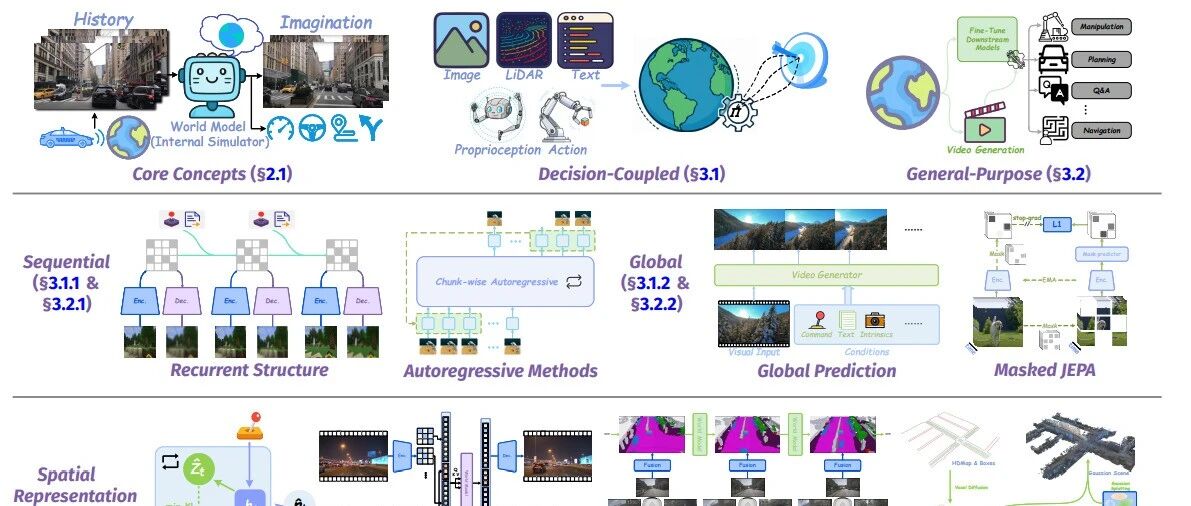
Core Insights - The article discusses the concept of world models in embodied AI, emphasizing their role as internal simulators that help agents perceive environments, take actions, and predict future states [1][2]. Group 1: World Models Overview - The research on world models has seen unprecedented growth due to the explosion of generative models, leading to a complex array of architectures and techniques lacking a unified framework [2]. - A novel three-axis classification method is proposed to categorize existing world models based on their functionality, temporal modeling, and spatial representation [6]. Group 2: Mathematical Principles - World models are typically modeled as partially observable Markov decision processes (POMDPs), focusing on learning compact latent states from partial observations and the transition dynamics between states [4]. - The training paradigm for world models often employs a "reconstruction-regularization" approach, which encourages the model to reconstruct observations from latent states while aligning posterior inference with prior predictions [9]. Group 3: Functional Positioning - World models can be categorized into decision-coupled and general-purpose types, with the former optimized for specific decision tasks and the latter serving as task-agnostic simulators [6][15][16]. - Decision-coupled models, like the Dreamer series, excel in task performance but may struggle with generalization due to their task-specific representations [15]. - General-purpose models aim for broader predictive capabilities and transferability across tasks, though they face challenges in computational complexity and real-time inference [16]. Group 4: Temporal Modeling - Temporal modeling can be divided into sequential reasoning and global prediction, with the former focusing on step-by-step simulation and the latter predicting entire future sequences in parallel [20][23]. - Sequential reasoning is beneficial for closed-loop control but may suffer from error accumulation over long predictions [20]. - Global prediction enhances computational efficiency and reduces error accumulation but may lack detailed local dynamics [23]. Group 5: Spatial Representation - Various strategies for spatial representation include global latent vectors, token feature sequences, spatial latent grids, and decomposed rendering representations [25][28][34][35]. - Global latent vectors compress scene states into low-dimensional variables, facilitating real-time control but potentially losing fine-grained spatial information [28]. - Token feature sequences allow for detailed representation of complex scenes but require extensive data and computational resources [29]. - Spatial latent grids maintain local topology and are prevalent in autonomous driving, while decomposed rendering supports high-fidelity image generation but struggles with dynamic scenes [34][35]. Group 6: Data Resources and Evaluation Metrics - Data resources for embodied AI can be categorized into simulation platforms, interactive benchmarks, offline datasets, and real robot platforms, each serving distinct purposes in training and evaluating world models [37]. - Evaluation metrics focus on pixel-level generation quality, state/semantic consistency, and task performance, with recent trends emphasizing physical compliance and causal consistency [40].

VERSES (VRSS.D) Update / Briefing Transcript
2025-07-29 17:30
Summary of VERSES (VRSS.D) Update / Briefing July 29, 2025 Company Overview - **Company**: VERSES (VRSS.D) - **Focus**: Development of AI and robotics technology, particularly in real-world applications and enterprise solutions Key Points Uplist Plans - The company is actively pursuing an uplist to a major tier one US exchange, such as Nasdaq or the New York Stock Exchange, to access larger pools of capital and greater liquidity [3][4][6] - A reverse split is required to meet minimum share price requirements for listing on these exchanges [3] - Transitioned from a foreign private issuer to a domestic SEC reporting company, which comes with different public disclosure requirements [4] Corporate Strategy and Technology Development - The company is focused on creating real-world intelligence through AI, addressing the limitations of current AI technologies that struggle with practical applications [14][15][18] - Emphasis on developing enterprise-ready solutions that can handle mission-critical applications, such as real-time sensing and modeling of environments [19][22] - The company has made significant advancements in its technology, including the development of Genius, a platform designed for adaptive real-time learning [32][35] Product Innovations - **Acxiom**: A cognitive architecture that demonstrates superior performance in spatial reasoning and real-time learning, outperforming competitors like Google's models [35][37] - **VBGS**: A new machine vision technology that allows for real-time mapping and sensing of environments, significantly improving accuracy and efficiency [40][41] - **Genius Act**: A robotic simulation that showcases the ability of robots to learn and adapt in real-time, achieving tasks without extensive pre-training [44][46] Market Position and Recognition - The company has gained attention from various media outlets and industry experts, indicating a growing recognition of its technology and potential [75] - Partnerships with notable organizations, including NASA and JPL, highlight the credibility and applicability of its technology in real-world scenarios [74] Customer Adoption and Revenue Potential - Strong adoption of the Genius platform across diverse industries, including CRM, banking, and media, with customers acting as both users and potential resellers [67][70] - The company is optimistic about future revenue growth as it transitions from research to revenue-generating phases [72][75] Future Outlook - The company believes it is at a pivotal moment, with the potential to significantly impact the AI and robotics market by solving complex real-world problems [89][90] - Continued focus on developing systems that can operate intelligently in dynamic environments, aiming to lead in the enterprise and industrial sectors [66][87] Additional Important Insights - The company acknowledges the challenges faced during the transition period but emphasizes the strength and resilience of its team and technology [5][6] - The strategic focus on real-world applications of AI and robotics positions the company uniquely in a market that is increasingly recognizing the limitations of traditional AI approaches [14][18][63]