IGZO

Search documents
DRAM,巨变前夜
半导体行业观察· 2026-03-18 00:50
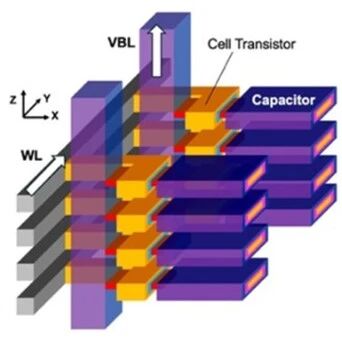
Core Viewpoint - The global semiconductor industry is undergoing a fundamental structural reorganization due to the explosive growth of artificial intelligence (AI) and large-scale language models (LLMs), with a significant shift towards 3D DRAM architectures to meet increasing demands for bandwidth and memory capacity [2][3]. Group 1: Current Challenges in DRAM Technology - Traditional 2D DRAM faces critical physical and engineering limitations as it approaches the limits of miniaturization, particularly below 10nm nodes, leading to issues such as electron tunneling and gate leakage [2][3][5]. - The current planar 1T1C architecture of DRAM is limited by physical and electrical defects, with the aspect ratio of capacitors exceeding 40:1, leading to structural instability and manufacturing challenges [5][6]. - Electrical leakage paths and the need for frequent refresh cycles due to charge loss are significant contributors to the "memory wall" phenomenon, which degrades system performance and increases power consumption [7]. Group 2: Transition to 3D DRAM - The industry is exploring vertical channel transistors (VCT) as an intermediate step to enhance integration density while leveraging existing planar process infrastructure [8][10]. - The 4F2 VCT architecture offers structural advantages, reducing chip area by over 30% compared to the 6F2 structure, but faces challenges such as floating body effects and parasitic capacitance [10][12]. - The next step is the development of vertical stacked DRAM (VS-DRAM), which aims to increase bit density by stacking memory cells vertically, similar to 3D NAND flash technology [14][16]. Group 3: Innovations in 3D DRAM - The emergence of capacitor-less 3D DRAM architectures, such as 2T0C and 3T0C structures, allows for single-chip integration by utilizing parasitic capacitance for charge storage, significantly enhancing integration density [19][20]. - Innovations in materials, such as IGZO for channel transistors, are being explored to reduce leakage currents and improve data retention times, addressing the limitations of silicon-based transistors [21][22]. - The development of advanced bonding techniques, such as wafer-to-wafer (W2W) hybrid bonding, is crucial for achieving high-density integration while maintaining yield and performance [30][31]. Group 4: Competitive Landscape and Strategic Directions - Major players in the DRAM market, including Samsung, SK Hynix, and Micron, are investing heavily in R&D to secure leadership in the 3D DRAM space, each adopting distinct strategies [42][43]. - Samsung is pursuing a gradual transition to 3D DRAM through the validation of 4F2 VCT structures, aiming for commercialization by 2030 [43][44]. - SK Hynix is focusing on maintaining its HBM dominance while developing vertical gate (VG) technology and leveraging IGZO materials for future 3D DRAM applications [45][46]. - Micron is taking a high-risk approach by skipping the transitional 4F2 stage and directly advancing to 3D DRAM development, capitalizing on its extensive patent portfolio [47][48]. - Kioxia is targeting low-power applications with its OCTRAM technology, which utilizes oxide semiconductor channels to achieve ultra-low leakage currents [49][50]. Group 5: Future Outlook - The transition to 3D DRAM is not merely a change in form factor but represents a convergence of technologies, including new materials, packaging innovations, and capacitor-less architectures, which will be critical for survival in the semiconductor industry [51][52]. - The upcoming semiconductor supercycle from 2024 to 2026 will serve as a testing ground for the physical limits of data bandwidth and integration density required for advanced computing systems [53][54].


这一创新,打破内存微缩死局!
半导体芯闻· 2026-01-23 09:38
Core Insights - The demand for low-power memory close to computing logic is driven by artificial intelligence workloads, leading to new memory designs and material explorations across various applications [1][11] - DRAM remains the preferred technology for most applications despite challenges in miniaturization and increasing demand from AI data centers, resulting in a memory shortage in the industry [1][11] Group 1: DRAM and Memory Technologies - The miniaturization of DRAM faces challenges, with designers looking to vertical structures to increase density while avoiding high lithography costs [1] - Low-leakage transistors are being explored to reduce refresh power in large storage arrays, with materials like IGZO showing promise due to their acceptable carrier mobility and low leakage [1][2] - Research from Samsung indicates that zinc migration during IGZO annealing can lead to uncoordinated indium sites, affecting performance, but optimizing electrode materials can mitigate interface migration and oxygen loss [2] Group 2: Innovations in Oxide Semiconductors - Researchers from Changxin Storage Technology successfully created functional IGZO devices by optimizing deposition processes and reducing hydrogen content, achieving a drive current of 60.9 μA/μm [3] - Kioxia demonstrated a 3D DRAM oxide channel replacement process that helps reduce thermal degradation, achieving over 30 μA per cell in prototype storage units [5] - A hybrid design using oxide semiconductors and silicon in a 256×256 array improved density by 3.6 times and reduced energy consumption by 15% compared to high-density SRAM [6] Group 3: Advanced Memory Architectures - A fully self-aligned design by Georgia Tech improved performance by 10 times and reduced energy-delay-area product by 75% to 80% compared to traditional SRAM cells [8] - Researchers are exploring the integration of transistor-based memory into backend processes, balancing speed and maturity of silicon technology with simpler but lower-performing alternatives [8] - Non-volatile memory designs using ferroelectric layers and IGZO as channel materials have shown promising durability and performance, with a wide storage window of 1.6 V [9]