Inferentia推理芯片

Search documents
这条芯片赛道,大火
半导体行业观察· 2025-11-22 03:09
Core Viewpoint - The article highlights the rapid growth and significance of ASIC (Application Specific Integrated Circuit) in the semiconductor industry, particularly driven by the increasing demand for AI computing power. Unlike general-purpose GPUs, ASICs are tailored for specific applications, leading to superior performance and efficiency in AI tasks [1][4][11]. Group 1: ASIC Development and Market Dynamics - ASIC emerged in the 1980s as a response to the need for customized chips that could meet specific product requirements, breaking away from the traditional model of generic chip production [1][2]. - The introduction of TSMC and the evolution of EDA tools in the 1990s allowed system manufacturers to design chips independently, leading to the customer-owned tools (COT) model, which enhanced supply chain flexibility [3]. - The success of Google's TPU in 2016 marked a turning point, establishing ASIC as a critical component in AI infrastructure, with major tech companies recognizing the need for customized chips to optimize efficiency and cost [4][5]. Group 2: Advantages of ASIC - ASICs offer extreme performance optimization by focusing resources on specific tasks, such as matrix multiplication and convolution operations, which are essential for AI computations [7][8]. - The energy efficiency of ASICs is a significant advantage, especially in AI applications where power consumption is critical. ASICs can minimize static power loss by eliminating unnecessary components [9][10]. - The compact design of ASICs allows for powerful functionalities to be integrated into small form factors, which is increasingly important in modern devices like smartphones and IoT applications [10][11]. Group 3: Market Leaders and Financial Performance - Broadcom and Marvell have emerged as dominant players in the ASIC market, with Broadcom reporting AI business revenues exceeding $4.4 billion, a 46% year-over-year increase, and Marvell's data center revenue reaching $1.441 billion, a 76% increase [12][14]. - The combined market share of Broadcom and Marvell exceeds 60%, with Broadcom holding 55-60% and Marvell 13-15%, primarily serving top-tier cloud service providers [12][13]. - Marvell predicts that global data center capital expenditures will surpass $1 trillion by 2028, with ASIC market size expected to reach $55.4 billion, growing at a CAGR of 53% from 2023 to 2028 [14][15]. Group 4: Emerging Competitors and Strategic Moves - Traditional semiconductor companies like Intel and Qualcomm are pivoting towards ASIC markets, with Intel focusing on custom chip services and Qualcomm acquiring Alphawave to enhance its SerDes capabilities [22][24]. - MediaTek is also making strides in the ASIC space, securing contracts with major tech firms like Google and Meta for custom chip designs [29][31]. - Taiwanese companies such as Wistron and Chipone are capitalizing on the ASIC trend, leveraging their relationships with TSMC and their technical expertise to secure significant market positions [32][34]. Group 5: Future Outlook and Challenges - The ASIC market is expected to continue growing, driven by the increasing complexity of AI models and the need for efficient computing solutions [16][17]. - However, challenges remain, including the need for advanced IP design capabilities and the ability to manage complex system integrations as AI applications evolve [17][20]. - Domestic Chinese firms are also positioning themselves to capture market share in the ASIC space, despite facing challenges in IP accumulation compared to international giants [39][41].


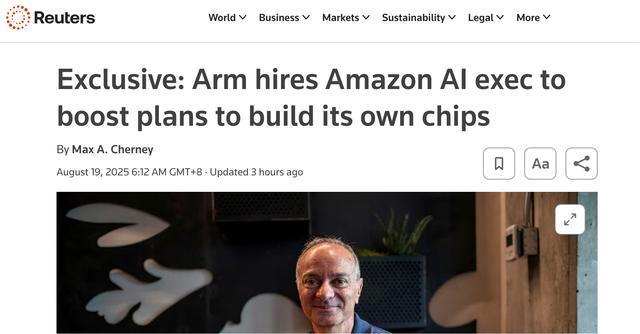
外媒爆ARM挖角亚马逊AI芯片掌门人,剑指自主芯片设计
Huan Qiu Wang Zi Xun· 2025-08-19 03:29
Core Insights - ARM has appointed Rami Sinno, former senior director of AI chips at Amazon, as senior vice president to lead its AI chip development project, marking a strategic shift from traditional IP licensing to a full-chain ecosystem of "IP + chip design + manufacturing" [1][4] - The hiring of Sinno is seen as a defensive strategy against the risk of major clients moving away from ARM architecture, as companies like Apple, Qualcomm, and NVIDIA explore custom architectures [4] Company Strategy - ARM's transition is not abrupt; it announced plans in July to invest part of its profits into the manufacturing of its own chips and components [4] - CEO Rene Haas has discussed the potential to go beyond design to build smaller, function-specific, and modular chip versions, as well as complete systems [4] Market Context - The recruitment of Sinno, who led the development of the Inferentia and Trainium chips at Amazon, is expected to complement ARM's strengths in low-power architecture and help overcome energy efficiency challenges in AI chips [4] - The compensation package for Sinno includes a $5 million annual salary, $20 million in restricted stock, and performance-based bonuses, indicating ARM's commitment to this strategic direction [4]